
On this page
- Download the bid qualification worksheet
- Field notes from two rPP installations
- Jefferson Reservoir: agree on the concrete details
- Friant-Kern: make the edge work inspectable
- Check the proposed crew and qualifications
- Match the seam test plan to the material
- Define QC and independent CQA responsibilities
- Set the material specification before bidding
- Ask for references that match the work
- Agree on subgrade acceptance and protection
- Check access and crew availability
- Use the worksheet to resolve bid exceptions
- Where EC Applications fits
Owner and engineer resource
Liner installer bid qualification worksheet
Use one blank worksheet per bidder for lagoon liners and covers, mining containment, landfills, or water and wastewater work. Start with the same drawings, material specification and permit requirements, then record the evidence each bidder supplies.
The print version has space for a submitted document reference, responsible party, exception and review disposition beside each request. The CSV opens in a spreadsheet for side-by-side bidder review. Both are free, with no sign-up.
For examples of what to ask, see the Jefferson and Friant-Kern field photos and the material-specific review table below.
1. Governing documents
Permit conditions, drawings, specification sections and revisions used for this bid; list unresolved design questions.
2. Material and conformance
Manufacturer, product, polymer, reinforcement and thickness; proposed conformance records and compatibility documentation required by the specification.
3. Relevant project references
Comparable application, material and installation details; installer scope, completion date and reference contact where available.
4. Assigned crew and qualifications
Proposed supervisor and welding technicians; project-required qualification records and availability for the planned work.
5. Seaming and trial welds
Factory and field seam map; method, equipment and trial-weld criteria for the specified polymer and reinforcement; response to changing conditions.
6. Testing and repair plan
Applicable test methods, coverage, sampling frequency, acceptance criteria, repair and retest procedure; identify untestable details and proposed alternatives for approval.
7. QC and independent CQA
Installer QC records; independent CQA scope where required; who witnesses tests, resolves failed results and releases work before covering or filling.
8. Subgrade and access
Preparation and acceptance criteria; who prepares, inspects and accepts each area; access, dewatering and protection responsibilities.
9. Penetrations and terminations
Approved details at pipes, sumps, columns and edges; concrete preparation, batten/anchor and seal details where specified; inspection access before concealment.
10. Scope and schedule
Mobilization, material delivery, site readiness, weather assumptions, protection by other trades, exclusions and change procedure.
11. Licensing, insurance and warranties
Project-state license verification where required; contract-required insurance; separate material and workmanship terms, exclusions and claim process.
12. Closeout records
Panel/seam as-builts tied to material lots, test and repair IDs; retest results and unresolved items; installer QC submission and separate final acceptance.
Use dispositions such as accepted, clarification needed, or not applicable with a reason. An empty cell means the item is unresolved. The worksheet organizes review; the project engineer, permit and contract establish the requirements and acceptance decisions.
References for the technical review
- AGRU: HDPE installation guidance
Material conformance, subgrade, welding and QC examples for HDPE.
- ASTM D6392-25: nonreinforced geomembrane seams
Public scope identifies the nonreinforced materials covered by this destructive seam test.
- Seaman: XR-5 installation specification
Product-specific fabrication, field seaming and testing requirements; sections 1.04, 1.11 and 1.12.
- ASTM D6434-25: flexible polypropylene test selection
Public scope covers test selection for flexible polypropylene geomembranes.
An installation bid needs to identify the specified liner, the crew, the seaming and testing plan, and the work included. Without those details, two bids may cover different systems or leave different responsibilities with the owner.
This guide and its blank qualification worksheet help owners and engineers compare bids for lagoon liners and covers, mining containment, landfills, and water and wastewater projects. Fill in the project requirements first. Record the document or drawing that supports each response, and resolve exceptions before award.
Field notes from two rPP installations
ECA's rPP case studies document a 45 mil reinforced polypropylene bottom liner with batten bar attachments to concrete at Jefferson Reservoir in Wenatchee, Washington, and 45 mil rPP canal lining at Friant-Kern in Visalia, California. The same material description leads to different questions about the work. These photographs show the settings; the review questions below are planning guidance, not findings from the project inspection records.
Jefferson Reservoir: agree on the concrete details
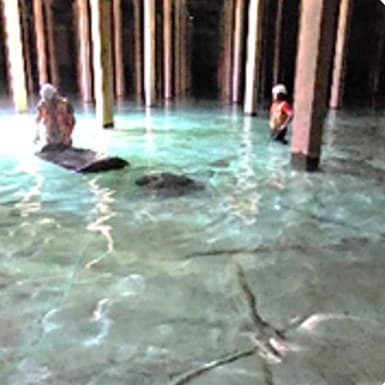
Ask the bidder to mark every column, wall transition and penetration on the proposed panel layout. Which concrete repairs and surface preparation are included, and who accepts the prepared surface? Have the engineer identify the required attachment and sealing details, the checks to record, and the inspection hold point before those connections are concealed. Resolve these interfaces before comparing installation scope.
Friant-Kern: make the edge work inspectable
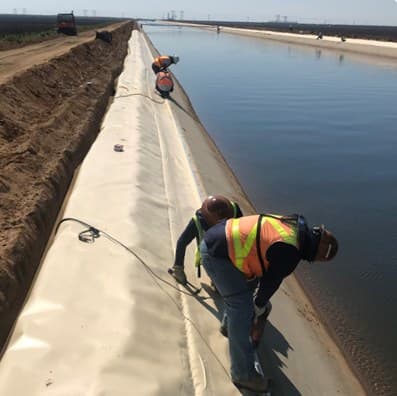
Ask for a reach-by-reach sequence showing access, liner deployment, edge connections and test access. Who controls water levels and confirms the available work area? Which factory seams, field seams and termination details appear on the inspection map? Identify the records and release needed before an area becomes inaccessible or water levels change. These questions apply to the proposed job; the photograph does not document Friant-Kern's water-control or acceptance procedure.
Check the proposed crew and qualifications
Ask for the qualification records required by your specification for the technicians proposed for the work. Check which materials and seaming methods those records cover. Company approvals, technician qualifications and project-specific trial welds answer different questions; review each where the contract requires it.
Match the seam test plan to the material
Ask for a test plan that maps each seam type and detail to an applicable method. Air-channel testing requires an appropriate dual-track seam. Vacuum testing, spark testing or another specified method may apply to other seams and details. The plan should identify locations that cannot be tested by the proposed method and provide an alternative for engineer approval.
ASTM D6392 covers destructive peel and shear testing of nonreinforced geomembranes joined by thermal methods. Match the procedure to the specified polymer, reinforcement and seam construction. The table gives examples of the distinctions to resolve.
Scroll the table sideways to see the owner and engineer review.
| Specified sheet | Ask the installer | Owner or engineer review |
|---|---|---|
| Nonreinforced HDPE | Map dual-track seams, extrusion details and repairs to their proposed tests. Supply trial-weld and production-test records. | Confirm applicable D6392 peel/shear criteria and nondestructive methods. Set coverage and sampling in the project documents. |
| Reinforced polypropylene (rPP) | Identify the reinforced product and factory/field seam methods. Submit its manufacturer procedures and test plan. | D6434 addresses test selection for reinforced and unreinforced polypropylene. Confirm the reinforced-sheet criteria; D6392 is scoped to nonreinforced geomembranes. |
| XR-5 reinforced sheet | Separate factory fabrication records from field-seam inspection. Identify the product-specific repair and retest procedure. | Seaman's XR-5 specification describes factory heat/RF seams, hot-air field seaming and air-lance or vacuum inspection. Confirm the applicable product and project requirements. |
The primary references linked with the worksheet explain these distinctions. Record the specified test coverage, sampling frequency and acceptance criteria before award. Have the engineer resolve any seam or connection that cannot be tested by the proposed method.
Define QC and independent CQA responsibilities
The installer records its own QC checks, test results and repairs. Where independent construction quality assurance is required, name that provider separately in the bid package. Agree who witnesses the specified tests, reviews failures and retests, and authorizes the next construction step. An installer QC submission alone does not establish independent CQA or final acceptance.
Set the material specification before bidding
Put the specification revision in every bid request. Identify the product or permitted alternatives, polymer, reinforcement, thickness, exposure conditions and details. Ask each bidder to state proposed substitutions so the engineer can evaluate them before comparisons are made.
Ask for references that match the work
Ask for projects that match the application, material and critical details. A landfill reference can demonstrate a different scope from a floating cover or a water reservoir. Record the installer's actual work, completion date and an available reference contact. Keep an award record separate from evidence of completed installation.
Agree on subgrade acceptance and protection
Define who prepares the subgrade, who inspects it and who accepts it before deployment. Include the specified surface criteria, access and dewatering responsibilities, and the procedure when an area is not ready. AGRU's HDPE guidance calls for a uniform surface free of sharp objects and continued checks of the work area.
Record acceptance by area and identify who protects the prepared surface and installed liner from later work. Before covering, filling or handing an area to another trade, reconcile the seam map, tests, repairs and open items with the party authorized to release it.
Check access and crew availability
Compare the actual mobilization plan. Ask where the proposed crew and equipment will come from, when they are available and what happens if the site schedule changes. An office address alone does not answer those questions.
Use the worksheet to resolve bid exceptions
Use the worksheet to track the required submittals, who supplied them and what remains open. Request the same information from every bidder. When a response excludes an item, record who would perform it and whether the contract documents need clarification.
Where EC Applications fits
EC Applications installs geosynthetic liners and covers nationwide, with offices in Anaheim, California, Midland, Texas, and Sparks, Nevada. For lagoon liners and covers, mining, landfill, and water and wastewater work, our services page describes installation scopes and links to documented project evidence.
Share the material specification, drawings, location and schedule with ECA so the proposed scope and qualification package can be reviewed against the project requirements.