
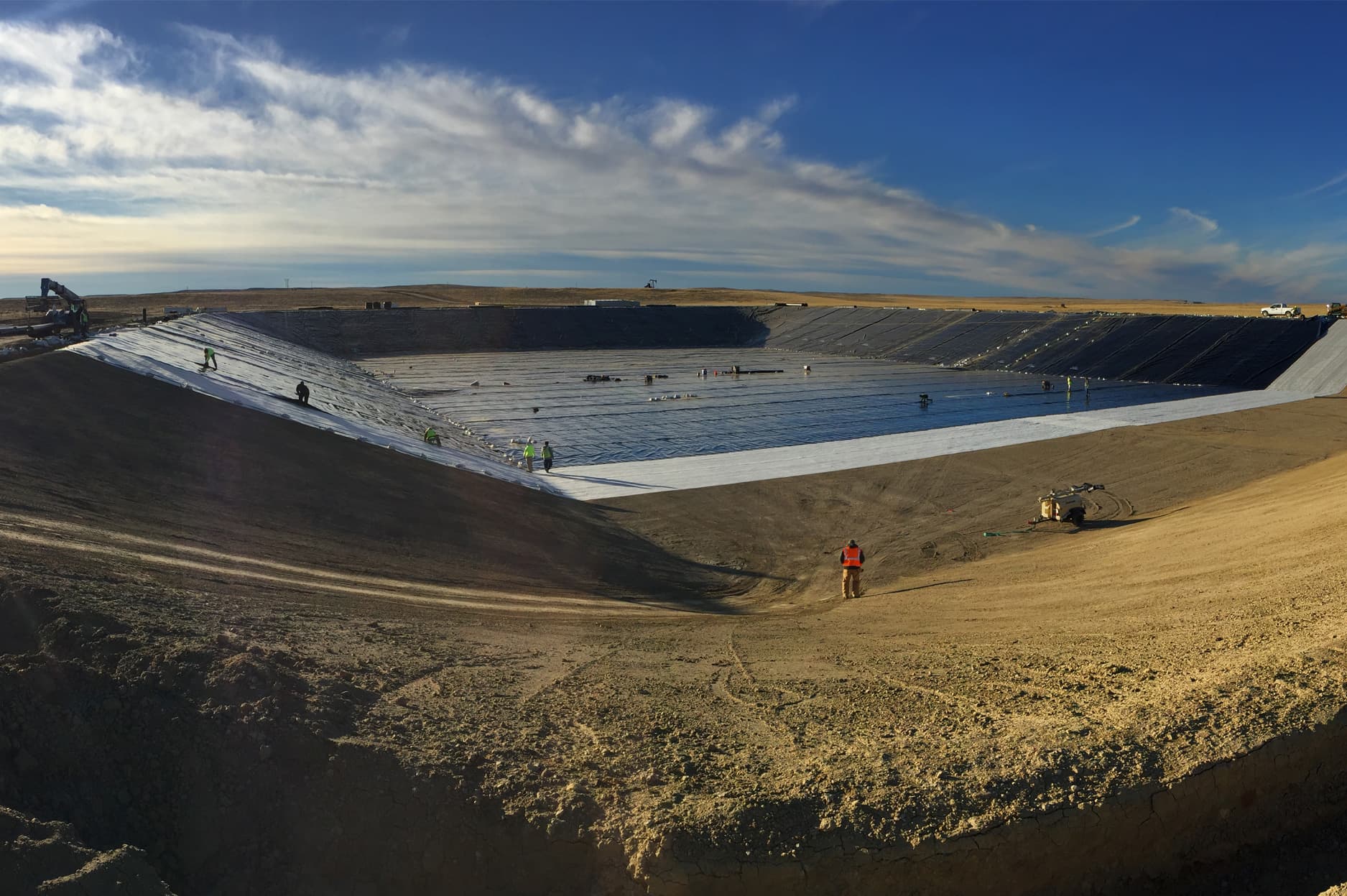
Oil and Gas Containment Liners
Oil and gas containment liners are geomembrane systems that keep frac water, drilling mud, and produced water contained on site, protecting soil and groundwater while giving operators reliable fluid storage through drilling, completion, and production. EC Applications engineers, fabricates, and installs these systems for frac water ponds, drilling mud ponds, pit liners, water corrals, and produced water storage, with custom panels fabricated up to 25,000 SF or 4,000 lbs per panel and off-the-shelf inventory stocked for rapid deployment from our California, Texas, and Nevada locations.
Leer esta página en EspañolWhich liners hold frac water, drilling mud, and produced water?
The right liner depends on the fluid: fresh and frac makeup water is routinely contained with HDPE, LLDPE, or reinforced polyethylene; drilling mud ponds typically call for HDPE or reinforced polypropylene that tolerates solids loading and cleanout equipment; and produced water, with its high total dissolved solids and hydrocarbon carryover, is best served by chemically resistant membranes such as HDPE or XR geomembrane. EC Applications installs the full range, so material selection is driven by your fluid chemistry, service life, and schedule rather than by whatever a single-material shop happens to carry.
Materials we fabricate and install include smooth and textured HDPE and LLDPE, smooth and textured drain liner, XR geomembrane, unreinforced and reinforced polypropylene, PVC, woven coated polyethylene, reinforced polyethylene, geosynthetic clay liner (GCL), woven and non-woven geotextiles, geonet, and geocomposite. That breadth lets us pair a primary containment membrane with the cushion geotextiles, drainage layers, and leak detection components a complete pit or pond lining system needs.
How fast can a pit or pond be lined?
Prefabrication is what makes oilfield lining fast: we fabricate custom panels up to 25,000 SF or 4,000 lbs per panel in the shop, then ship them folded on pallets or rolls so a pit that would take days of field seaming can be deployed and welded out in a fraction of the time. For common pit and corral sizes we also maintain off-the-shelf inventory across our locations, which means standard drop-in liners can ship immediately rather than waiting on a fabrication slot.
Shop fabrication does more than save time. Factory seams are made in controlled conditions on flat tables, which reduces the number of field welds exposed to wind, dust, and temperature swings on a live pad. Fewer field seams means fewer potential leak paths and a shorter window in which lining work competes with drilling and completion traffic for space on location.
Our Midland, Texas location puts crews and material in the Permian Basin, while Anaheim, California and Sparks, Nevada cover western operations. Crews mobilize to remote well sites and coordinate directly with drilling and completion schedules so the liner is in and tested when water starts moving.
What secondary containment do well sites and tank batteries need?
Well sites and tank batteries need engineered secondary containment around tanks, pumps, and chemical storage: lined earthen berms, prefabricated drop-in containment liners inside steel or earthen walls, and geomembrane floors under equipment where a release would otherwise reach soil. A properly lined containment area captures leaks and overfills from production tanks, holds them until recovery, and keeps stormwater that contacts equipment from carrying hydrocarbons off the pad.
EC Applications installs both permanent field-welded containment systems and prefabricated drop-in liners sized to your berm geometry, including boots and seals at pipe penetrations. Because we fabricate in-house, drop-in liners for standard tank battery layouts can be built to dimension and shipped ready to place. For larger facility-scale work, our secondary containment service covers full SPCC-driven containment design and installation.
Should you use a reusable or single-use pit liner?
Choose based on how long the pit lives and what goes in it: single-use liners suit short-duration duty such as a drilling mud pit that will be closed out with the well, where the liner is sacrificial and cost per square foot matters most, while reusable liners make sense for water corrals, frac ponds, and staging pits that get relocated between pads, where a heavier reinforced membrane survives repeated deployment, folding, and transport.
Reinforced materials such as reinforced polyethylene and reinforced polypropylene hold up to repeated handling because the scrim carries the mechanical load. For permanent installations like long-term produced water ponds, a thicker HDPE or XR geomembrane system with proper anchor trenches and, where required, leak detection is the durable answer. We help operators match liner class to duty cycle so they are not buying permanent-grade material for a thirty-day pit or redeploying a membrane that was never designed to move.
How are oilfield liners installed and quality tested?
Field installation follows the same discipline as our municipal and mining work: subgrade acceptance, panel placement per an approved layout, thermal fusion or extrusion welding of field seams, and seam testing before the pit takes fluid. Dual-track fusion welds are pressure tested and extrusion welds are vacuum-box tested, with destructive seam samples tested for shear and peel strength per ASTM D6392 where the project specification requires it.
That quality assurance record matters on regulated fluids like produced water: it documents that every seam in the containment system was tested, ties each panel and weld back to the installation drawings, and gives operators a defensible file if a regulator or landowner ever asks how the pit was built.
Applications
- Frac water ponds
- Drilling mud ponds
- Pit liners
- Water corrals
- Raw water storage ponds
- Produced water containment
- Tank battery secondary containment
- Well site berm liners
What sets this work apart
We fabricate custom panels up to 25,000 SF and stock off-the-shelf options for rapid deployment, supported by our California, Texas, and Nevada locations.
Quality assurance
Installation quality is verified against the project specification using the applicable ASTM and GRI test methods, with documented QA records at handoff.
Materials we install
- HDPE / LLDPE
- polypropylene
- PVC
- drain liners
- XR geomembranes
- geotextiles
Why ECA for this work
- Two CSLB-licensed entities: California licenses #894068 and #1003207.
- In-house specialty fabrication shop for prefabricated panels and custom geosynthetic products.
- We fabricate custom panels up to 25,000 SF and stock off-the-shelf options for rapid deployment, supported by our California, Texas, and Nevada locations.
- Offices in Anaheim, California; Midland, Texas; and Sparks, Nevada, serving sites nationwide.
Related resources
- Oil and gas containment across the upstream market
- Oilfield pit and pond lining across Texas
- Produced water pit lining in Midland and the Permian Basin
- Produced water pit lining: materials and regulations
- Seven questions to ask before lining a produced-water pit
- In-house geomembrane welding and liner installation crews
Material and system specifications
| Material | Typical use | Key properties |
|---|---|---|
| Smooth / textured HDPE | Produced water ponds, frac ponds, permanent pits | Broad chemical resistance, UV stable, strong fusion-welded seams |
| LLDPE | Ponds and pits over settling or irregular subgrade | More flexible than HDPE, conforms to subgrade, good elongation |
| XR geomembrane | Hydrocarbon and high-TDS brine service | High chemical and hydrocarbon resistance, reinforced, low thermal expansion |
| Reinforced polyethylene / polypropylene | Reusable pit liners, water corrals, drop-in containment | Lightweight, large prefabricated panels, handles repeated deployment |
| Geosynthetic clay liner (GCL) | Composite lining under primary geomembrane | Self-sealing bentonite layer, backup hydraulic barrier |
How the work gets done
- 1
Scope and material selection
We review the fluid (frac water, mud, produced water), pit geometry, and service life, then recommend the membrane and any geotextile, drainage, or GCL components.
- 2
Fabrication or stock pull
Custom panels are fabricated up to 25,000 SF or 4,000 lbs each; standard sizes ship from stocked inventory for expedited delivery.
- 3
Mobilization and subgrade prep
Crews mobilize from Anaheim, Midland, or Sparks, verify subgrade acceptance, and coordinate around drilling and completion traffic.
- 4
Deployment and field welding
Panels are placed per the layout drawing and field seams are completed by thermal fusion or extrusion welding.
- 5
Seam testing and documentation
Seams are pressure or vacuum tested, destructive samples are pulled where specified, and a QA record ties every weld to the drawings.
- 6
Closeout or redeployment
Permanent systems are anchored and turned over; reusable liners are recovered, inspected, and staged for the next pad.
Frequently asked questions
More of what we install
Ready to scope your oil & gas containment project?
Our crews handle engineering, fabrication, field installation, and maintenance. Tell us about your site and we will scope it with you.