
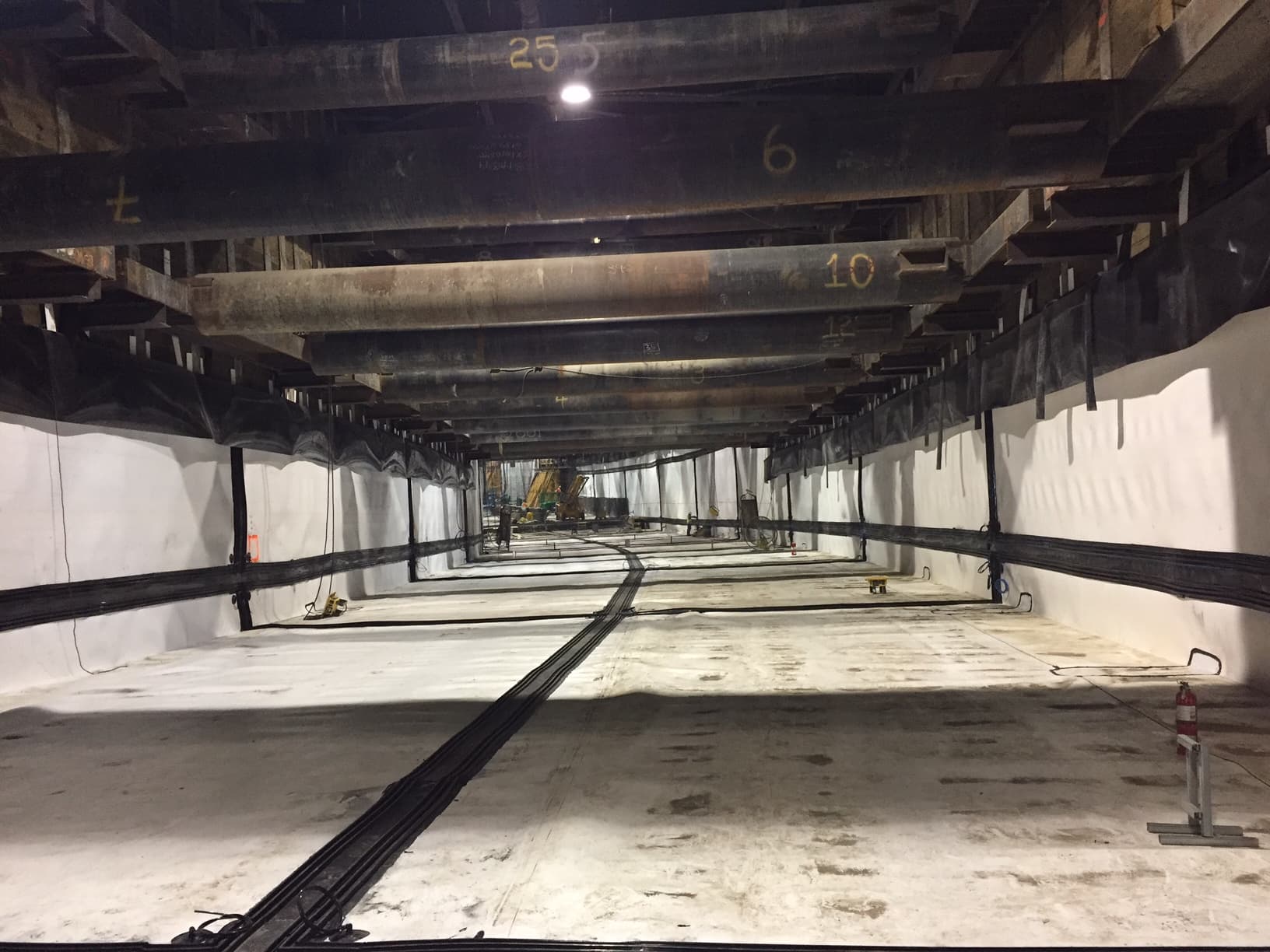
Tunnel Waterproofing Membrane Installation
Tunnel waterproofing membrane installation places a flexible geomembrane lining between the excavated ground and the tunnel's final structure so groundwater never reaches the concrete. EC Applications supplies and installs complete tunnel lining systems built around a 110 mil VLDPE hydrocarbon-resistant geomembrane, a non-woven geotextile cushion, waterbars, and injection hoses, using an induction welding system that produces 30% fewer field seams. We partner with Agru America and TPH Waterproofing Systems on system design and materials.
How does a geomembrane tunnel lining system work?
A geomembrane tunnel lining system works by wrapping the tunnel in a continuous, flexible waterproof envelope installed between the initial ground support and the final structural lining. Groundwater that reaches the excavation is intercepted at the membrane and drained or held back before it can contact the finished concrete, which protects reinforcing steel from corrosion and keeps the tunnel interior dry for its full service life.
The system is more than a single sheet. A heavy non-woven geotextile cushion goes against the substrate first to protect the membrane from punctures caused by rock points, shotcrete roughness, and construction traffic. The geomembrane is then fixed to the tunnel profile and welded into a continuous barrier. Waterbars welded across the membrane divide the lining into discrete compartments, and injection hoses installed at joints and compartment boundaries give crews a built-in way to seal any future leak with grout instead of breaking into the finished lining.
Flexible geomembranes have proven to provide the best waterproofing alternative for tunnels because they tolerate the movement, moisture, and irregular substrates that rigid coatings and cementitious systems struggle with. Unlike many spray-applied products, the membrane systems EC Applications installs can be placed in humid or moist conditions, which matters in active excavations where a perfectly dry substrate is rarely achievable.
Why does seam count matter, and how does induction welding cut field seams by 30%?
Seam count matters because field seams are the most likely place for a tunnel lining to leak: every seam is welded overhead or on a curved wall, in construction conditions, by a crew working against schedule. Fewer seams means fewer opportunities for a defect, less testing, and faster installation. That is why experienced tunnel owners and heavy-civil contractors evaluate lining proposals on seam count, not just material thickness.
EC Applications installs tunnel membranes with an induction welding system that produces 30% fewer field seams than conventional attachment methods. Instead of penetrating the membrane with fasteners, induction welding bonds the geomembrane to discs fixed on the substrate through the sheet itself, which minimizes liner penetrations while holding the membrane tight to the tunnel profile. Fewer penetrations and fewer seams translate directly into a lower leak risk for the life of the structure.
How do tunnel lining systems tolerate seismic activity and ground movement?
Tunnel lining systems tolerate seismic activity and ground movement because the geomembrane stretches with the structure instead of cracking. The Agru VLDPE membrane at the heart of the system exhibits superior elongation properties, so when the ground shifts, settles, or shakes, the membrane deforms and recovers without losing watertightness. Rigid waterproofing systems can fracture under the same movement and leak at exactly the moment the structure is most stressed.
This flexibility is a primary reason geomembrane systems are specified for transit, water, and utility tunnels in seismically active regions, including the California corridors where EC Applications is headquartered. VLDPE also offers better chemical resistance to hydrocarbons and other harmful chemicals than many alternatives, which protects the lining where tunnels pass through contaminated ground or carry vehicle traffic.
What goes into an EC Applications tunnel lining system?
A complete EC Applications tunnel lining system has four core components: a 22 oz non-woven geotextile cushion layer that protects the membrane from the substrate, a 110 mil VLDPE hydrocarbon-resistant geomembrane that forms the waterproof barrier, VLDPE waterbars with an exclusive integrated hose clamp that compartmentalize the lining, and TPH injection hoses with associated fittings that allow targeted grouting of any compartment after the concrete is placed.
We deliver this as a system, not a pile of materials. EC Applications partners with Agru America, the geomembrane manufacturer, and TPH Waterproofing Systems, the injection technology specialist, and design and specification assistance is available from ECA, AGRU, and TPH staff. Engineers get help detailing the lining around penetrations, cross passages, and transitions before the first roll arrives on site, and the installing crew is the same organization that helped shape the specification.
How are leaks located and repaired after the tunnel is lined?
Leaks are located by compartment and repaired by injection, without demolishing the finished lining. Because waterbars divide the membrane into discrete sealed compartments, any water that appears inside the tunnel can be traced to the specific compartment it entered, rather than migrating along the full length of the structure and hiding its source. This compartmentalization is the single biggest maintenance advantage of a waterbar-based system.
Once the leaking compartment is identified, crews inject sealing grout through the TPH injection hoses that were cast into that compartment during construction. The integrated hose clamp on the VLDPE waterbar keeps each hose positioned and sealed where it crosses the barrier. The result is a repair path that was engineered into the tunnel on day one: no coring, no chasing cracks, and no guesswork about where the water is coming from.
Applications
- Transit and rail tunnel waterproofing
- Highway and roadway tunnel lining
- Water conveyance and utility tunnels
- Cut-and-cover tunnel sections
- Tunnel cross passages and portals
- Underground structures in seismic zones
- Tunnels through hydrocarbon-impacted ground
- Rehabilitation of leaking tunnel linings
What sets this work apart
Our induction welding system produces 30% fewer field seams, and we partner with Agru America and TPH Waterproofing Systems.
Quality assurance
Installation quality is verified against the project specification using the applicable ASTM and GRI test methods, with documented QA records at handoff.
Materials we install
- 110 mil VLDPE hydrocarbon-resistant geomembrane
- non-woven geotextile cushion
- waterbar systems
- injection hoses
Why ECA for this work
- Two CSLB-licensed entities: California licenses #894068 and #1003207.
- In-house specialty fabrication shop for prefabricated panels and custom geosynthetic products.
- Our induction welding system produces 30% fewer field seams, and we partner with Agru America and TPH Waterproofing Systems.
- Offices in Anaheim, California; Midland, Texas; and Sparks, Nevada, serving sites nationwide.
Related resources
Material and system specifications
| Component | Material | Function |
|---|---|---|
| Cushion layer | 22 oz non-woven geotextile | Protects the membrane from punctures on rock and shotcrete substrates |
| Waterproofing membrane | 110 mil VLDPE, hydrocarbon resistant | Continuous flexible barrier with high elongation for ground movement |
| Waterbar | VLDPE with exclusive integrated hose clamp | Divides the lining into sealed compartments for leak isolation |
| Injection system | TPH injection hoses and fittings | Enables targeted grout injection to seal any compartment after construction |
How the work gets done
- 1
Design and specification support
ECA, AGRU, and TPH staff assist the engineer with system selection, compartment layout, and detailing at penetrations and transitions.
- 2
Substrate preparation and cushion
The tunnel surface is inspected and the 22 oz non-woven geotextile cushion layer is fixed to protect the membrane from point loads.
- 3
Membrane installation
The 110 mil VLDPE geomembrane is placed and secured with the induction welding system, minimizing liner penetrations and producing 30% fewer field seams.
- 4
Waterbars and injection hoses
VLDPE waterbars compartmentalize the lining and TPH injection hoses are routed through the integrated hose clamps at each compartment.
- 5
Seam testing and handover
Field seams are tested, compartments are documented, and the as-built compartment map is turned over so any future leak can be traced and injected.
Frequently asked questions
More of what we install
Ready to scope your tunnels project?
Our crews handle engineering, fabrication, field installation, and maintenance. Tell us about your site and we will scope it with you.