
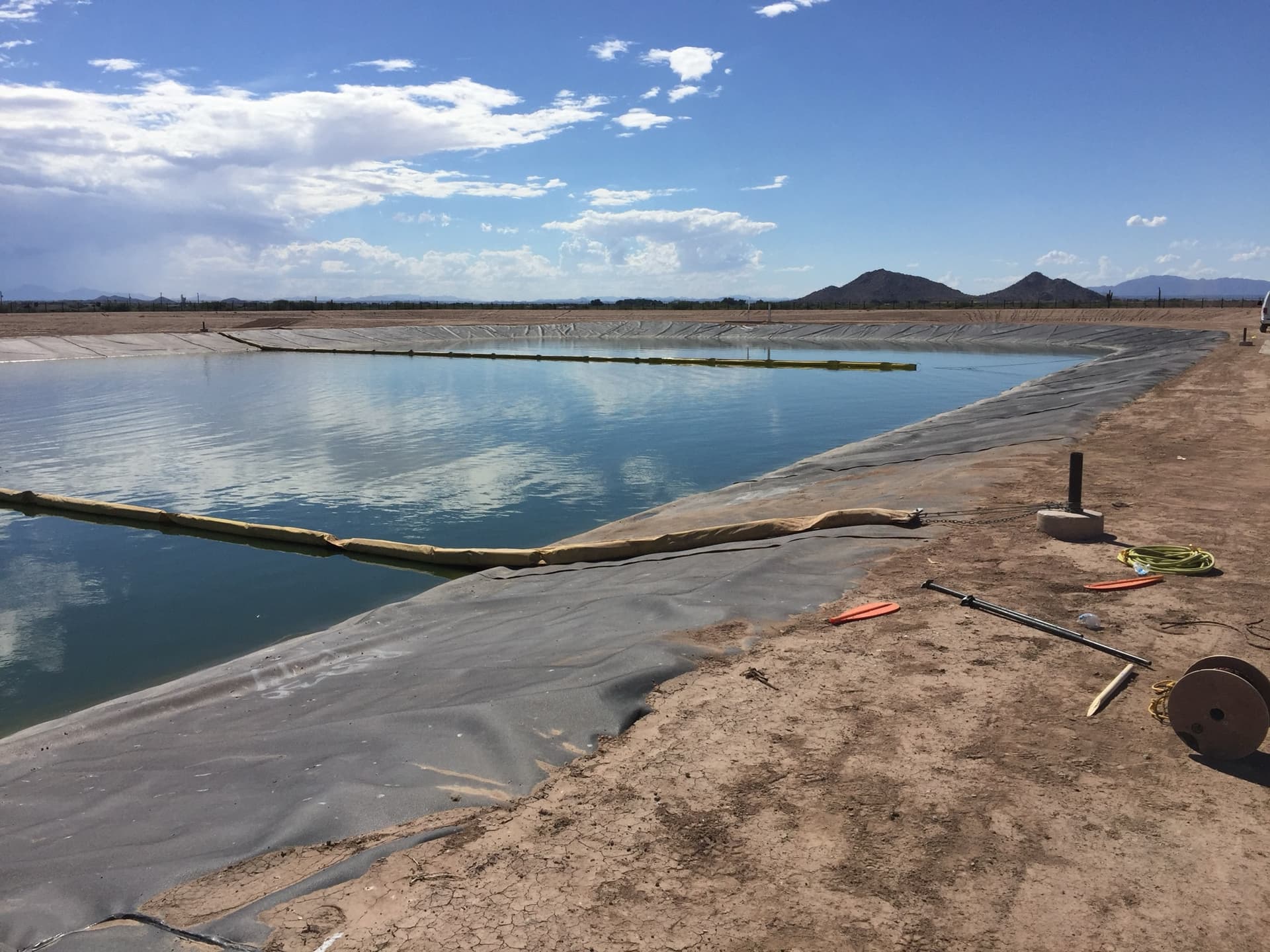
Water Reservoir Liner Installation
A water reservoir liner is a flexible geomembrane installed inside a concrete reservoir, steel tank, clearwell, or earthen basin to stop seepage and protect stored water from contamination. EC Applications installs single and composite lined systems in potable and raw water storage, along with the baffles, floating covers, and mechanical attachments that complete the system.
Reservoir lining experience at the concrete attachment
ECA's Jefferson Reservoir case study records a 45 mil reinforced polypropylene bottom liner installed in Wenatchee, Washington, in 2025, with batten bars securing the liner to concrete. Its Friant-Kern Canal case study records 160,000 square feet of 45 mil reinforced polypropylene liner in Visalia, California, completed in 2023.
Source: EC Applications rPP case studies, Jefferson Reservoir and Friant-Kern Canal. These examples describe the liner installation scope.
See the Jefferson Reservoir liner installationA detail to resolve before installation
The Jefferson detail puts concrete attachments into the scope alongside the membrane. Ask the designer to identify substrate repairs, battens, gaskets, anchors, and pipe terminations. For reinforced polypropylene, select tests for the actual sheet and seam construction: ASTM D6434 distinguishes reinforced and unreinforced flexible polypropylene when selecting test methods.
Read the ASTM D6434 scope for polypropyleneWhat to send for a quote
Provide the site location, potable or raw-water duty, structure drawings, specified material, substrate survey, penetration schedule, and attachment details. Include access limits, cleaning responsibilities, and the outage available for installation and owner acceptance. ECA installs reservoir liners nationwide.
Agree on the handoff records
Agree on the panel and seam map, material records, attachment details, test results, and repaired areas to be delivered. For potable service, identify the party responsible for disinfection, water-quality clearance, and return to service under the utility specification.
Discuss this installationWhat reservoir lining work does EC Applications perform?
EC Applications lines concrete reservoirs, steel tanks, clearwells, and earthen and raw water reservoirs to eliminate seepage and contamination, installing everything from single geomembrane liners to full composite systems with baffles, floating covers, and mechanical attachments. The work covers both rehabilitation of existing storage and lining for new construction.
Growing demand for fresh water and changing climate patterns have pushed utilities toward higher storage capacity, and a leaking reservoir works directly against that goal. Water lost through cracked concrete, corroded steel floors, or permeable earthen embankments is treated water paid for and never delivered. A properly specified and installed liner converts an aging structure into watertight storage at a fraction of the cost of demolition and reconstruction.
Because reservoir projects rarely stop at the liner itself, ECA also fabricates and installs the components around it: floating covers that keep stored water isolated from debris, birds, and airborne contamination, and baffle curtains that direct flow through the basin to maintain disinfectant contact time and prevent short-circuiting.
Which liner materials are used for potable and raw water storage?
Potable water contact requires materials certified to NSF/ANSI 61, the drinking water system components standard, while raw water storage allows a broader range of geomembranes selected for durability and cost. EC Applications installs smooth and textured HDPE and LLDPE, drain liners, XR reinforced geomembranes, CSPE (Hypalon), reinforced and unreinforced polypropylene, geosynthetic clay liner (GCL), EPDM, and PVC.
Material selection is driven by the structure and the service. Reinforced membranes such as XR geomembranes, CSPE, and reinforced polypropylene hold their dimensions well and suit mechanically attached installations on concrete and steel, where the liner hangs on walls rather than resting in an anchor trench. HDPE and LLDPE offer excellent chemical resistance and long service life in earthen basins. GCL and composite constructions add a self-sealing clay layer beneath the geomembrane where regulators or site conditions call for redundancy.
For rehabilitation work, the existing substrate often decides the material. A cracked concrete reservoir with active leakage calls for a liner and attachment system that can bridge movement, while a corroded steel tank floor may be better served by a drain liner system that intercepts and monitors any future weepage.
How is a liner installed in an existing concrete reservoir or steel tank?
Lining an existing structure starts with draining and cleaning the reservoir, repairing the substrate, and then deploying geomembrane panels that are seamed together in place and mechanically attached to the walls, columns, and penetrations. Unlike an earthen basin, where the liner terminates in a soil anchor trench, a concrete or steel structure requires mechanical terminations: stainless steel batten bars compressing the membrane against the wall over a gasket, anchored into the concrete or fastened to welded studs on steel.
Surface preparation is the step that determines liner life. Spalled concrete, protruding aggregate, sharp edges, and abandoned fittings are repaired or ground smooth, and a geotextile cushion is installed where the substrate could abrade the membrane. Columns, inlet and outlet piping, drains, and hatches each receive fabricated boots and sealed terminations so the finished lining is continuous across every penetration.
Every field seam is tested before the reservoir returns to service. Dual-track fusion welds are air pressure tested and extrusion welds are vacuum box or spark tested, following the destructive and non-destructive seam evaluation practices of ASTM D4437 and the material manufacturer's QC requirements. On potable installations, the finished lining is then disinfected in accordance with the utility's standard practice before the reservoir is refilled.
Can liners be combined with floating covers and baffle curtains?
Yes, and on potable reservoirs the liner and floating cover are frequently designed and installed as one system, with the cover sealed to the same perimeter attachment so the stored water is fully encapsulated. EC Applications installs both, which keeps the interface details, material compatibility, and warranty under a single installer instead of split between trades.
Baffle curtains complete the hydraulic side of the system. Suspended or floating baffles installed inside the lined reservoir lengthen the flow path between inlet and outlet, improving disinfectant contact time and eliminating dead zones. Because baffles, covers, and liners all terminate at the same walls and penetrations, sequencing them under one contractor avoids the conflicts that appear when each component is detailed in isolation.
When should a reservoir be relined instead of repaired or replaced?
Relining makes sense when the structure is sound but no longer watertight: leakage through cracks, joints, or corroded floors that patching has failed to stop, or seepage from an earthen basin that shows up as wet ground or rising water loss numbers. A geomembrane lining addresses the entire wetted surface at once rather than chasing individual leaks, and it typically costs far less than demolishing and rebuilding storage capacity.
Persistent water loss is usually quantified before lining with a simple drawdown test, isolating the reservoir and measuring level change over time against evaporation. That baseline confirms the problem, sizes the benefit, and gives the utility a before-and-after comparison once the liner is in service. Whether the driver is rehabilitation of an existing reservoir or a lining specification for new construction, ECA can support the design conversation early, when material and attachment choices are cheapest to get right.
Applications
- Potable water reservoir lining
- Concrete reservoir lining and rehabilitation
- Steel tank liners and floor drain liner systems
- Clearwell liners at treatment plants
- Earthen and raw water reservoir lining
- Single and composite lined systems
- Floating covers over lined reservoirs
- Baffle curtains for contact time and flow control
- Mechanical attachments, battens, and penetration boots
Material specifications
Quality assurance
Installation quality is verified against the project specification using the applicable ASTM and GRI test methods, with documented QA records at handoff.
Materials we install
- HDPE / LLDPE
- drain liners
- XR geomembranes
- CSPE (Hypalon)
- GCL
- EPDM
- PVC
Why ECA for this work
- Two CSLB-licensed entities: California licenses #894068 and #1003207.
- In-house specialty fabrication shop for prefabricated panels and custom geosynthetic products.
- Offices in Anaheim, California; Midland, Texas; and Sparks, Nevada, serving sites nationwide.
Related projects
Related resources
Material and system specifications
| Material | Construction | Where it fits |
|---|---|---|
| HDPE / LLDPE | Smooth or textured, unreinforced | Earthen and raw water reservoirs, long service life, high chemical resistance |
| XR geomembranes | Reinforced | Mechanically attached concrete and steel structures needing high strength and dimensional stability |
| CSPE (Hypalon) | Reinforced | Potable reservoir liners and floating covers with a long utility track record |
| Polypropylene | Reinforced or unreinforced | Potable-grade linings and covers where flexibility and weldability matter |
| Drain liner | Smooth or textured with drainage studs | Tank floors and structures where leak interception and monitoring are required |
| GCL | Bentonite composite | Secondary layer under geomembranes in composite lined earthen basins |
| EPDM / PVC | Unreinforced sheet | Raw water storage and site-specific applications |
How the work gets done
- 1
Condition assessment
Inspect the drained structure, document cracks, corrosion, joints, and penetrations, and review any drawdown or leakage data to size the problem.
- 2
Material selection and submittals
Match the geomembrane to the service (potable versus raw water), the substrate, and the attachment method, with NSF/ANSI 61 certified material for drinking water contact.
- 3
Surface preparation
Repair spalls and sharp edges, clean the substrate, and place geotextile cushion where needed so the membrane rests on a smooth, stable surface.
- 4
Deployment and seaming
Deploy panels and join them with dual-track fusion and extrusion welds performed by experienced technicians under a documented QC program.
- 5
Attachments and penetrations
Install stainless steel battens, anchor terminations, and fabricated boots at walls, columns, piping, drains, and hatches for a continuous watertight lining.
- 6
Testing and return to service
Air pressure, vacuum box, and spark test every seam per ASTM D4437 practice, then support disinfection and refill on potable installations.
Frequently asked questions
More of what we install
Ready to scope your water reservoirs project?
Our crews handle engineering, fabrication, field installation, and maintenance. Tell us about your site and we will scope it with you.