
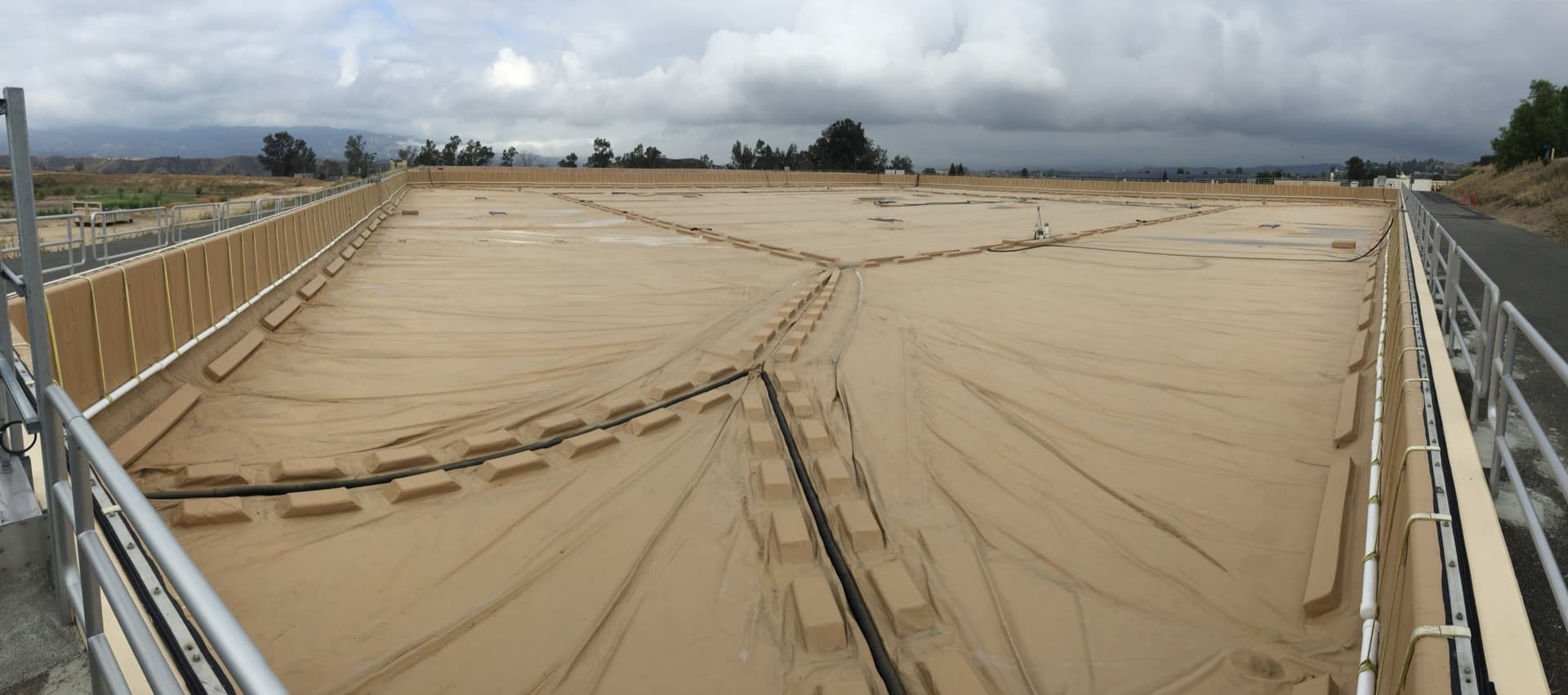
Water and Wastewater Liner Contractor
EC Applications lines and covers the assets a water or wastewater utility runs on: treatment lagoons, reservoirs, clearwells, tanks, and basins, combining geomembrane liners, floating covers, and baffle curtains into systems that can be phased around plant operations.
One contractor across the whole treatment plant
A water or wastewater plant is a collection of lined and covered structures: raw water reservoirs, clearwells, treatment lagoons, aeration and settling basins, holding ponds, sediment basins, chlorine contact channels, and the containment areas around chemical feed and process equipment. Most of those assets rely on a geomembrane, a cover, or a baffle system somewhere in their life cycle, whether that is a new liner under a lagoon, a floating cover over finished water, or a curtain layout that fixes short-circuiting in a basin that no longer meets its detention time.
EC Applications works across that entire footprint as a single water and wastewater liner contractor. Crews install liners in earthen, concrete, and steel structures, fabricate and deploy floating covers, and hang floating or fixed baffle curtains, so a utility can scope a multi-asset rehabilitation program with one point of responsibility instead of splitting liner, cover, and baffle packages across separate vendors whose details have to be forced to fit together in the field.
Treatment lagoons, holding ponds, and plant containment
On the wastewater side, the core scope is lagoon and pond lining: municipal and industrial storage lagoons, holding ponds, treated-water and irrigation reuse storage, clarification systems, and sediment basins. HDPE is the workhorse material for most lagoon service because it pairs broad chemical resistance with UV stability and long exposed life, typically installed at 40 to 80 mil with textured sheet on slopes for friction. LLDPE adds flexibility over soft subgrades where settlement is expected, while reinforced polypropylene and XR geomembranes suit exposed duty, mechanically attached details, and prefabricated panels.
The same crews line the smaller containment structures that keep a plant compliant: concrete vaults, channels, and tanks, and secondary containment around chemical storage. Where an aging lagoon is leaking, relining over a prepared existing liner or subgrade is often faster and less disruptive than reconstruction, and it can be sequenced cell by cell so treatment capacity stays online while each basin is taken down, cleaned, relined, and returned to service.
Municipal reservoir and clearwell lining
On the drinking water side, EC Applications rehabilitates concrete reservoirs, steel tanks, clearwells, and earthen raw water storage with flexible geomembrane linings. Aging concrete is the most common driver: decades of service leave reservoirs with cracked floors, deteriorated joints, and seepage losses that work directly against a utility's storage goals. Rather than demolishing and rebuilding the structure, a mechanically attached geomembrane lining bridges the cracks and joints and restores a watertight envelope inside the existing shell, typically at a fraction of the cost and outage time of structural reconstruction.
Materials in potable contact are certified to NSF/ANSI 61, the drinking water system components standard. Reinforced membranes such as XR geomembranes, CSPE (Hypalon), and reinforced polypropylene hold their dimensions well and suit mechanical attachment to concrete walls, columns, and floor terminations, while smooth and textured HDPE and LLDPE, geosynthetic clay liners, EPDM, and PVC round out the options for raw water and buried service. Liner, floating cover, and baffle work in the same reservoir can be combined into one outage window so the asset is drained and disinfected once, not three times.
Liners, covers, and baffles as one hydraulic system
The three product families solve different problems and work best when they are designed together. The liner stops seepage out of the structure. A floating cover isolates the water surface, which controls evaporation, algae growth, odor, heat loss, and contamination from birds and debris, and on anaerobic lagoons and digesters the cover doubles as a biogas collection surface. Baffle curtains manage what happens inside the water column: vertical geomembrane walls redirect flow from inlet to outlet along a longer serpentine path, eliminating dead zones and increasing effective detention time, which improves settling, biological treatment, and disinfection contact.
Because one contractor fabricates and installs all three, the details that connect them are engineered rather than improvised: baffle terminations at lined slopes, cover perimeters at liner anchor trenches, and penetrations for piping, hatches, and gas collection. That matters most on retrofit work, where a basin built decades ago has to accept modern components without compromising the new watertight envelope.
Working around a plant that cannot stop treating
Utilities rarely have the luxury of a full plant shutdown, so sequencing is part of the scope from the first site walk. Multi-basin programs are phased so that only one cell is out of service at a time, with the schedule built around seasonal flows and the plant's permit obligations. Some components avoid an outage entirely: floating baffle curtains are factory fabricated to depth and length, floated into position on a live basin, and pulled vertical by ballast, so the structure is never drained or bypassed.
Where an asset does have to come down, prefabricated panels and reinforced materials shorten the field schedule by moving welding into the shop, and seam testing and quality documentation are produced as the work progresses so the basin can be inspected, approved, and refilled without waiting on paperwork. EC Applications self-performs this work with its own crews from offices in California, Texas, and Nevada, and holds California CSLB licenses #894068 and #1003207 for public and municipal work in that state.
Services for this market
- Water Reservoirs
Reservoir, tank, and clearwell lining with NSF/ANSI 61 potable-contact materials.
- Wastewater Containment
Treatment lagoon, holding pond, and sediment basin liners for new build and remediation.
- Baffle Curtains
Floating and fixed baffle curtains that fix short-circuiting and dead zones in basins and reservoirs.
- Floating Covers
Floating covers for evaporation, algae, odor, and biogas control, from potable to digester duty.
Building a contractor shortlist? Compare installation scopes, relevant experience, and quality records before requesting bids.
Frequently asked questions
More markets we serve
Working on a water and wastewater project?
Tell us about the site and our team will scope the right containment approach with you, from materials to installation.