
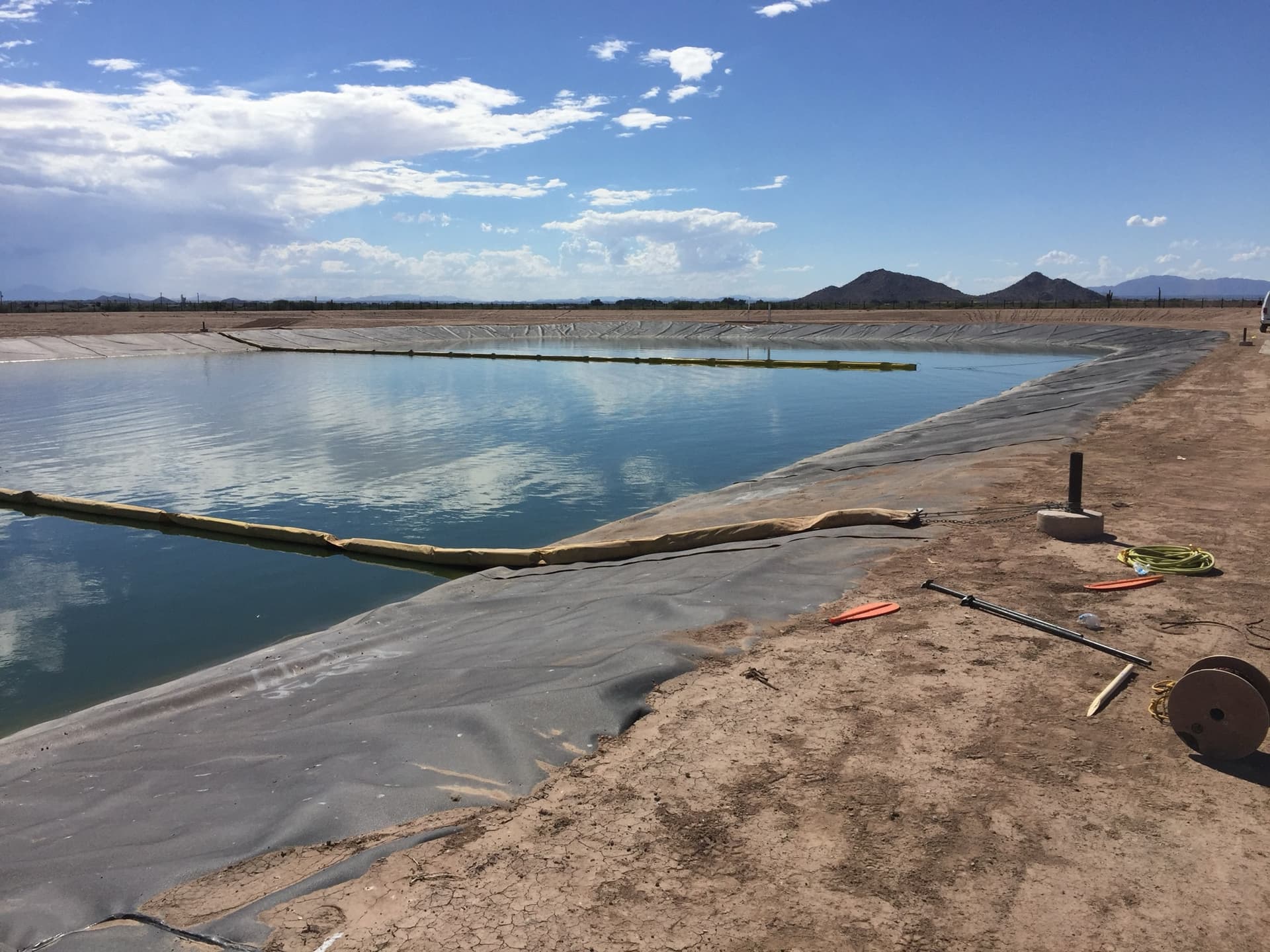
Agricultural Pond Liners
EC Applications installs geomembrane liners for irrigation ponds, farm water storage, and agricultural lagoons, and adds floating covers where odor control or gas capture matters. Growers, dairies, and ag districts use lined ponds to stop seepage losses and keep stored water where it belongs.
Water storage that actually holds water
For a farm, water storage is production capacity. An unlined earthen pond in permeable soil can lose a meaningful share of its stored volume to seepage through the floor and banks, and in sandy or fractured ground the losses can rival what the pond delivers to the field. A geomembrane liner makes the pond essentially impervious, so the acre-feet you capture in the wet months are still there when irrigation demand peaks.
EC Applications is a geosynthetics installation contractor. We line irrigation ponds, farm reservoirs, tailwater return basins, and agricultural lagoons with HDPE and reinforced polypropylene geomembranes, and we fabricate and install floating covers where an operation needs odor control, evaporation reduction, or gas capture over stored waste. The same crews and quality practices we bring to municipal and industrial containment apply to ag work: prepared subgrade, factory or field seaming, and seam testing before the pond goes into service.
Irrigation and farm water storage ponds
Irrigation storage is the most common agricultural lining scope. Districts and growers line new ponds during construction and retrofit existing earthen ponds that have never held their rated volume. The material choice usually comes down to HDPE geomembrane for large exposed ponds where chemical and UV resistance drive the decision, or reinforced polypropylene where flexibility and large prefabricated panels simplify installation on smaller or irregular ponds.
Pond size is rarely the limiting factor. Small farm ponds can often be lined with a few prefabricated panels sized in the shop and deployed in a day, while multi-acre irrigation reservoirs are lined from rolls seamed in place by welding crews. What matters more than acreage is access, subgrade condition, and whether the pond can be dewatered for the work. On working farms we plan installation around the irrigation calendar so storage is back in service before the season needs it.
Ag lagoons and manure containment
Dairies, feedlots, and food processors store process water and manure in lagoons that sit directly over the farm's own groundwater. Lining those lagoons protects wells and keeps nutrients in the containment system instead of the soil column, which is exactly what state water boards and nutrient management plans increasingly expect. A geomembrane liner gives an ag lagoon a defined, inspectable barrier rather than relying on compacted soil alone.
Lagoon liners see different duty than freshwater ponds: agitation equipment, solids loading, and periodic cleanout traffic. Liner selection and details like thicker material at ramps and equipment zones, anchored terminations, and protective layers where pumps and agitators operate are part of the design conversation, not an afterthought.
Covers for odor control and gas capture
A liner solves seepage; a cover solves what the neighbors smell. Floating covers over manure and process water lagoons contain odor, keep rainwater out of the treated volume, and can be configured to collect biogas where an operation digests waste. For irrigation storage, covers also cut evaporation losses, which in hot growing regions can be a significant fraction of stored volume over a season.
EC Applications fabricates and installs floating cover systems as a standing capability, so a lagoon can be lined and covered as one coordinated scope instead of two separate contracts with a seam of responsibility between them.
What installation and upkeep look like
A typical lined pond project runs: dewater and prepare the subgrade, remove or bed over rocks and debris that could puncture the liner, deploy geomembrane panels, weld and test the seams, and anchor the liner at the crest. Where the subgrade is rough, a geotextile cushion goes down first. The pond returns to service as soon as the liner passes seam testing and the anchor trench is backfilled.
Maintenance is straightforward: walk the pond periodically, keep equipment and livestock off exposed liner, watch UV-exposed areas and mechanical wear points, and patch punctures promptly while they are small. Exposed HDPE liners are formulated for long-term UV exposure, and a lined pond that is inspected on a routine schedule is a decades-long asset.
Services for this market
- Wastewater Containment
Ag lagoon, holding pond, and manure containment liners for dairies and processors.
- Water Reservoirs
Irrigation pond and farm reservoir lining that stops seepage losses.
- Floating Covers
Lagoon covers for odor control, evaporation reduction, and gas capture.
- Specialty Fabrication
Prefabricated liner panels sized for farm ponds and delivered ready to install.
Building a contractor shortlist? Compare installation scopes, relevant experience, and quality records before requesting bids.
Frequently asked questions
More markets we serve
Turning manure or waste into biogas? EFI USA builds the full system.
EC Applications installs the liners and covers that agricultural containment depends on. When a dairy, swine, or food-processing site wants to capture and monetize biogas, our parent company EFI USA designs and builds the complete system: covered lagoon and anaerobic digester systems, biogas collection, cap-and-flare and gas handling, and oxygen injection for odor and H2S control.
Working on a agriculture project?
Tell us about the site and our team will scope the right containment approach with you, from materials to installation.