
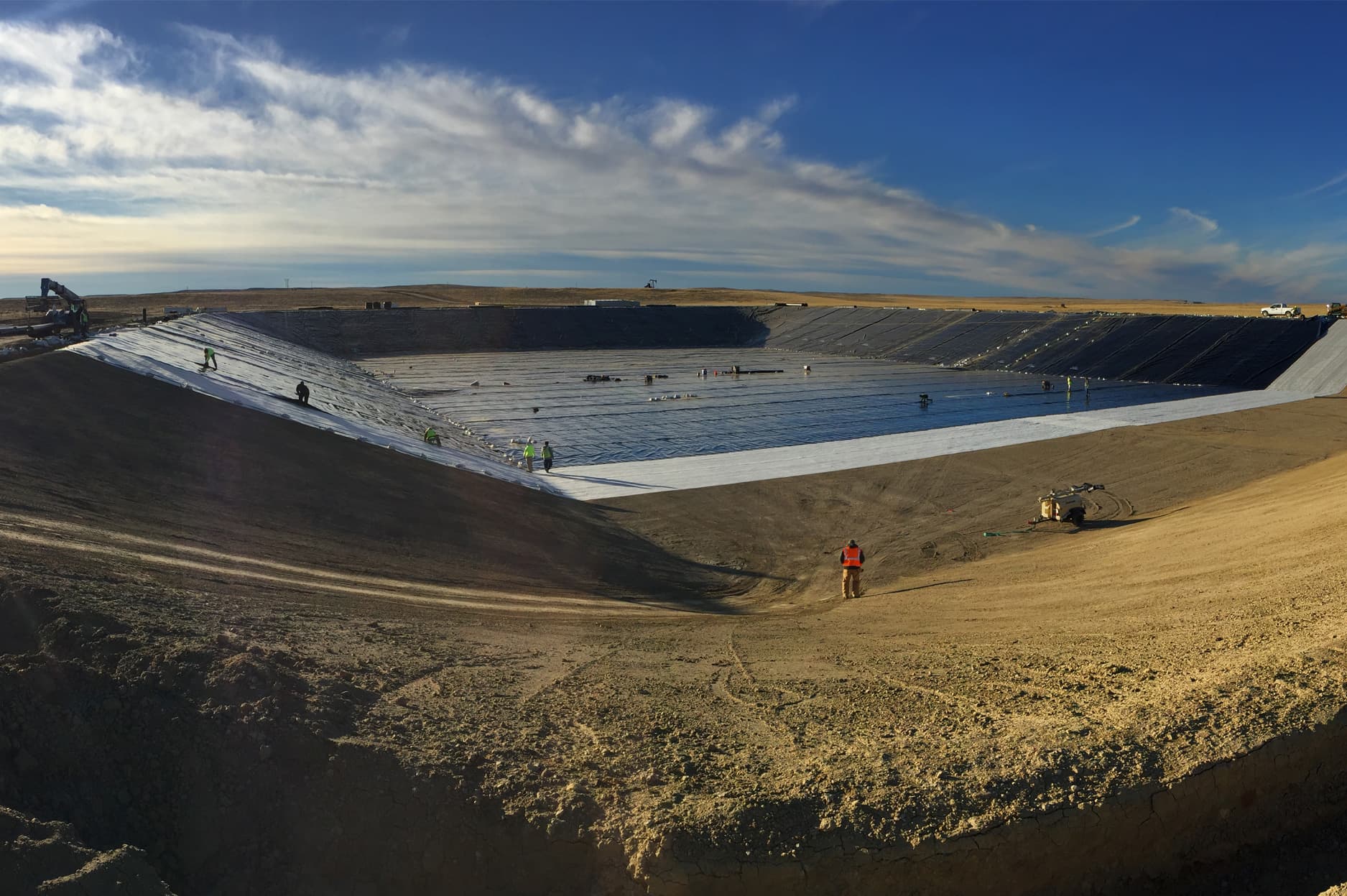
Oilfield Containment Services
EC Applications provides oilfield containment services across the drilling-to-production cycle, lining frac water ponds, drilling mud pits, produced water storage, and well-site secondary containment with geomembranes selected for hydrocarbons and high-TDS brine. Crews and stocked material work out of our Midland, Texas location for the Permian Basin, with Anaheim, California and Sparks, Nevada covering western operations.
Containment from spud to production
Every phase of a well's life creates fluids that have to stay where they are put. During drilling, mud pits hold water-based or oil-based drilling fluid and cuttings. During completion, frac ponds and water corrals stage the large volumes of water a multi-well pad consumes and recovers. Once the well is producing, produced water storage and tank battery containment become the long-duration systems that protect soil and groundwater for years, not weeks.
EC Applications lines all of it. We treat oilfield containment as one continuous scope rather than a series of unrelated pits, which means the mud pit liner, the frac pond, and the produced water pond on the same pad can be planned together: one mobilization window, materials matched to each fluid, and quality documentation that reads the same across the whole site. Operators get a single lining contractor to schedule against instead of three.
Drilling and completion: mud pits, frac ponds, and water corrals
Drilling mud pits are short-lived and hard-used. They take solids loading, cleanout equipment, and constant traffic, so they typically call for HDPE or reinforced polypropylene that tolerates abuse and can be closed out economically with the well. Frac ponds and water corrals are the opposite problem: large, fast-moving water volumes on a completion schedule that does not wait for a lining crew to field-weld for a week.
Prefabrication is how we keep up. Panels are shop fabricated and shipped folded so most of the seaming is done before material reaches the pad, and standard pit and corral sizes ship from stocked inventory. For water corrals and staging pits that relocate between pads, reinforced materials handle repeated deployment, folding, and transport, so the same liner can follow the frac spread rather than being abandoned with each location.
Production: produced water storage and long-term ponds
Produced water is the hardest fluid on a lease. High total dissolved solids, hydrocarbon carryover, and exposure measured in years demand chemically resistant membranes such as HDPE or XR geomembrane, installed with anchored perimeters and, where the design calls for it, leak detection between primary and secondary layers. This is permanent-grade work: the liner system is expected to perform for the life of the disposal or recycling operation.
Regulatory context reinforces the engineering. In Texas, the Railroad Commission's Statewide Rule 8 governs surface facilities that store and handle oilfield fluids, and pit permitting generally turns on demonstrating that contained fluids cannot migrate to soil or groundwater. A documented liner system, with seams tested and recorded during installation, is central to making that demonstration and to defending it later if a regulator or landowner asks how the pond was built.
Well sites and tank batteries: secondary containment
Around tanks, pumps, and chemical storage, the exposure is a release rather than routine storage. Lined earthen berms, geomembrane floors under equipment, and prefabricated drop-in liners set inside steel or earthen containment walls capture leaks and overfills and hold them until recovery. For facilities subject to federal Spill Prevention, Control, and Countermeasure requirements under 40 CFR Part 112, engineered secondary containment sized to the largest tank plus freeboard is the core compliance mechanism.
Because we fabricate in-house, drop-in liners for standard tank battery layouts can be built to your berm dimensions with boots and seals at pipe penetrations, then shipped ready to place. Field-welded permanent systems cover larger facilities where a drop-in liner is not practical.
When a liner fails: assessment and rapid replacement
Liner failures do not happen on convenient schedules. When a pit or pond comes out of service, the first question is repair versus replacement: localized damage from equipment contact or a failed seam can often be patched and retested, while widespread chemical degradation or UV embrittlement means the membrane has reached end of life. Our crews assess the failure, weld and test repairs where the membrane is sound, and replace the system where it is not.
Replacement speed is where prefabrication and stocked inventory pay off again. A standard-size replacement liner can ship from stock while the pit is being cleaned, and shop-fabricated panels cut field welding time once crews are on location, shortening the window the pit spends offline.
Installation quality is what prevents the next failure. Field seams are completed by thermal fusion or extrusion welding, pressure or vacuum tested, and where the specification requires it, destructive samples are tested for shear and peel strength per ASTM D6392. The QA record ties every panel and weld back to the drawings.
Serving the Permian Basin and the West
Our Midland, Texas location at 10320 W County Road 60 puts crews and stocked liner inventory in the Permian Basin, close enough to coordinate directly with drilling and completion schedules rather than mobilizing across the country. Anaheim, California, our headquarters, and Sparks, Nevada extend coverage across California and Great Basin oil and gas operations, and all three locations support mobilization to remote well sites.
Services for this market
- Oil & Gas Containment
Frac water, produced water, and drilling mud pit liners, plus water corrals, for E&P and oilfield service companies.
- Secondary Containment
Tank battery and fuel storage secondary containment at well sites and midstream facilities, including SPCC-driven designs.
- Specialty Fabrication
Prefabricated liner panels up to 25,000 square feet, shipped ready to deploy on oilfield schedules.
Frequently asked questions
More markets we serve
Working on a oil and gas project?
Tell us about the site and our team will scope the right containment approach with you, from materials to installation.