
Mining Geosynthetics Contractor
EC Applications installs the geosynthetic systems a mine depends on: heap leach pad liners that protect groundwater and metal recovery, tailings storage facility liners, solution channels, and evaporation and process ponds, with crews for Nevada mining containment ponds based at its Sparks office.
Geosynthetics carry both compliance and recovery at a mine
On most industrial sites, a liner is an environmental safeguard. On a heap leach operation it is also part of the process circuit. The geomembrane under the heap does two jobs at once: it keeps cyanide or acid leach solution out of the ground, and it routes pregnant solution across the pad floor to collection piping and the recovery plant. A defect in that liner is simultaneously a permit problem and lost metal, which is why mine operators and EPCs treat liner installation quality as an economic variable, not just a construction line item.
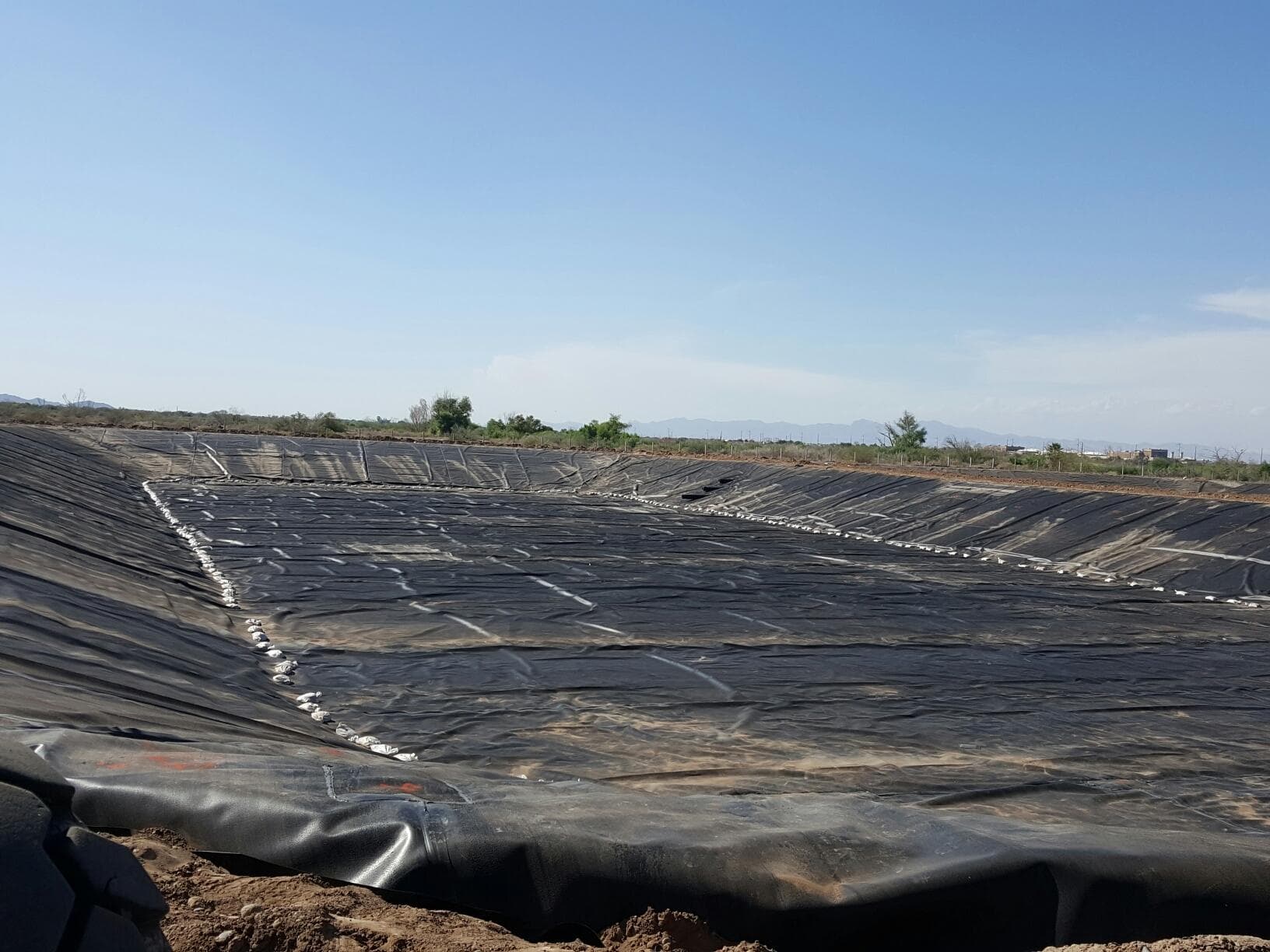
EC Applications works as a mining geosynthetics contractor across that full containment scope: leach pad liner systems, tailings storage facility liners, lined solution channels and floor sumps, process and evaporation ponds, and secondary containment for the fuel and reagent storage that supports the operation. Crews install smooth and textured HDPE and LLDPE, reinforced polypropylene, XR geomembranes, GCL, PVC, geotextiles, GeoNet, and geocomposite drainage layers, matched to the chemistry, temperatures, and loads of each facility.
Heap leach pads and solution containment
A typical leach pad cross-section builds up from a prepared, compacted subgrade to a low-permeability soil layer or GCL, the primary geomembrane, and a protective overliner of drain cover fill with embedded collection piping. Textured geomembrane is common on slopes and in high shear zones so the ore stack and liner interface stay stable as the heap rises. Pad grading directs solution to lined channels and floor sumps, then on to pregnant and barren solution ponds sized to the facility water balance, with storm events included.
The details around the edges decide how well the system performs: anchor trenches, pipe boots at collection and injection penetrations, tie-ins between pad phases, and the transitions from pad to channel to pond. EC Applications fabricates and fields those details with the same seam standards as the open panels, so the containment envelope is continuous from the top of the heap to the recovery plant.
Tailings storage facilities and mine ponds
Tailings storage facilities carry a different design brief than leach pads. Instead of routing solution to recovery, a TSF liner is built for long-term static containment of saturated tailings, decant water, and consolidation drainage over decades. Liner selection leans toward durability and chemical endurance, and the geometry is dominated by embankment slopes, raises, and decant structures rather than a broad process floor.
Because most TSFs are raised in stages over the mine life, expansion tie-ins are routine work: new liner is welded into the existing system, and every tie-in seam is tested the same way as new construction before the raise goes into service. The pond inventory around a mine gets the same treatment. Evaporation ponds, storm water ponds, process water ponds, and overflow cells are each lined to their duty, and many benefit from prefabricated panels when the site is remote and the installation window is short.
QA that protects permits and metal recovery economics
Mining liner installation runs under formal construction quality assurance. Field seams are made by wedge welding or extrusion welding, then verified nondestructively over their full length with air pressure testing of dual-track wedge seams and vacuum box or spark testing of extrusion welds. Destructive samples are cut at specified intervals and tested for shear and peel strength per ASTM D6392, and material rolls arrive with manufacturer certifications against recognized specifications such as GRI GM13 for HDPE.
That documentation trail matters twice on a mine. Regulators use it to confirm the containment system was built as permitted. Operators use it because seam quality on a leach pad directly protects solution recovery: solution that escapes the liner system is metal that never reaches the plant. A clean CQA record at construction also simplifies life later, when the facility is expanded, repaired, or eventually closed.
Nevada footprint and work on operating facilities
Nevada's zero-discharge permitting framework for mining, administered by the Nevada Division of Environmental Protection, makes engineered containment the backbone of nearly every fluid management facility on a mine site. Process components are designed so solution stays within the lined system rather than being released, which puts liner design, installation quality, and documented QA at the center of the permit. The state references, NAC 445A.435 and 445A.438 for mining process ponds and NDEP guidance WTS-5 and WTS-37 for pond liners, are linked on the Nevada row of our liner requirements by state table.
EC Applications' Sparks office at 150 Isidor Court positions crews along the I-80 corridor serving northern Nevada's mining districts, with California and Texas offices supporting work across the West. Crews handle new cell construction, phase expansions, and liner repair on operating facilities, sequencing work around production so leach circuits and water management systems stay in service while the geosynthetics work gets done.
Services for this market
- Mining
Heap leach pads, tailings impoundments, solution channels, evaporation ponds, and floor sumps.
- Secondary Containment
Fuel and reagent secondary containment for mine site facilities.
- Specialty Fabrication
Prefabricated panels and custom geosynthetic products shipped to remote mine sites.
Building a contractor shortlist? Compare installation scopes, relevant experience, and quality records before requesting bids.
Frequently asked questions
More markets we serve
Working on a mining project?
Tell us about the site and our team will scope the right containment approach with you, from materials to installation.