
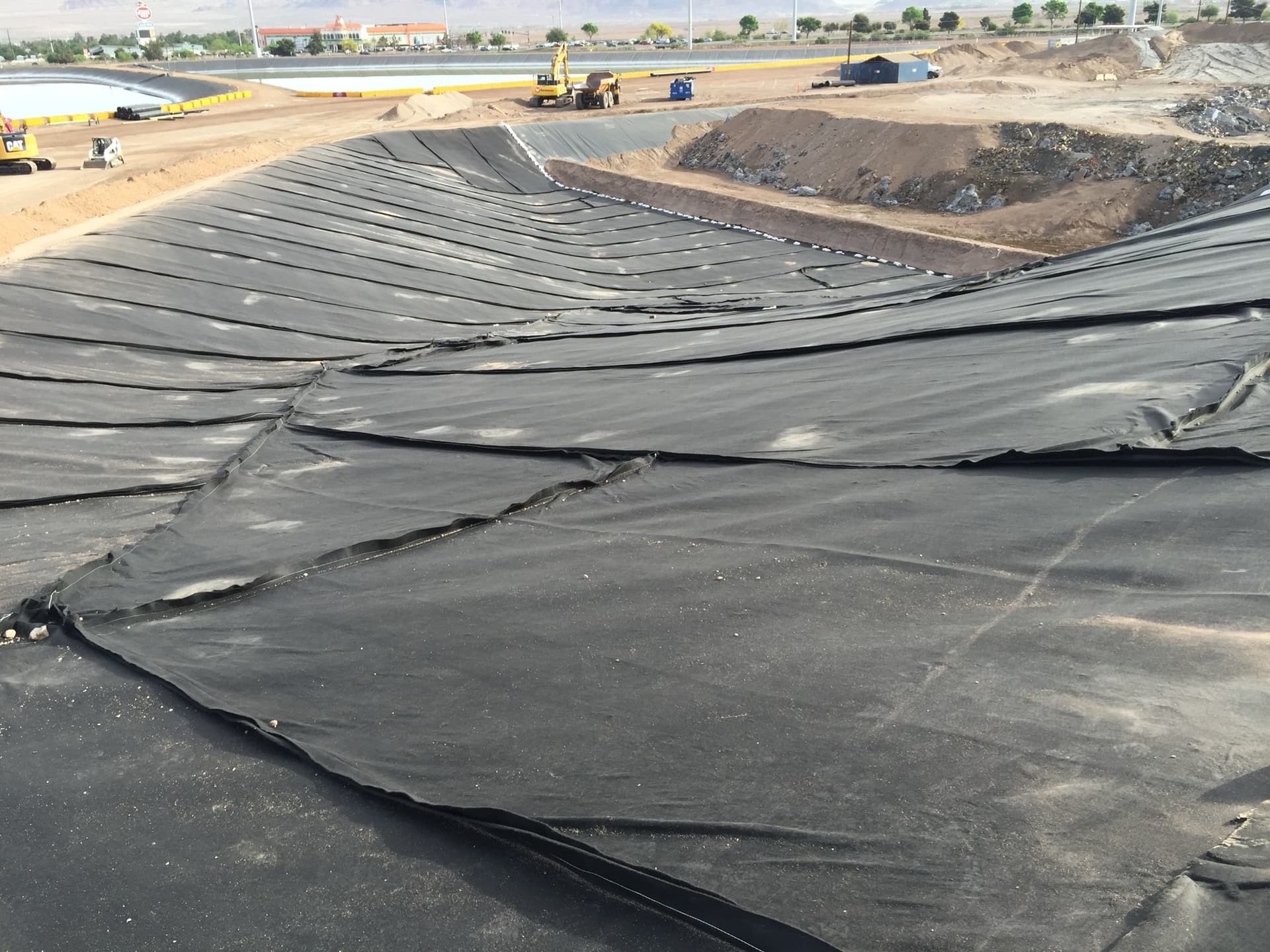
Geomembrane Liner Repair and Leak Location
Geomembrane liner repair is the diagnosis and welded correction of damage in an existing liner: punctures, tears, failed seams, degraded boots, and loose terminations. EC Applications repairs geomembrane liners in ponds, pits, containment berms, leach pads, and reservoirs across California, Texas, and Nevada, locating the damage, welding a tested fix in place, and documenting the repair so the facility can return to service without replacing the whole system.
How is a leak in a geomembrane liner found?
Most liner leaks announce themselves indirectly: unexplained water loss, wet ground or vegetation outside a containment, solution showing up in a leak detection sump, or a monitoring result the permit does not allow. The first step is a physical survey of the liner itself. Experienced crews walk the exposed membrane and inspect the places damage concentrates: seams, pipe boots and penetrations, batten and embedment terminations, anchor trenches, sumps, and any area that sees equipment traffic or ice, wind, and debris loading.
Where a visual survey is not enough, seams can be retested the same way they were qualified at construction, with air pressure testing of dual-track fusion seams and vacuum box testing of extrusion seams. For liners under water or soil cover, engineers often specify electrical leak location surveys, which pinpoint defects by driving current across the membrane and mapping where it passes through. EC Applications repairs the defects those surveys flag, retests the finished work, and turns over documentation of every repair location and test result.
Which repair methods are used: extrusion welding, patches, and boots
The standard repair for a puncture or tear in polyethylene liner is an extrusion-welded patch: a piece of the same geomembrane, cut with rounded corners and extending well past the damage, welded over the defect and vacuum box tested. Failed or suspect fusion seams are repaired with cap strips welded over the seam. Damage too large or too concentrated to patch is cut out and replaced panel by panel, with new sheet fusion welded to the sound surrounding liner.
Repairs are not limited to the sheet. Pipe boots that have pulled, cracked, or lost their clamp seal are refabricated and rebooted with stainless steel bands over compatible sealant. Loose mechanical terminations are re-battened and resealed, and embedment attachments are rewelded. Before production welding starts, welders run trial welds under the actual field conditions, and every repair seam is nondestructively tested, with destructive samples pulled where the project specification requires them.
Material matters as much as method. A repair weld only performs if the patch material is compatible with the existing sheet, so crews confirm the liner material and condition first. EC Applications installs and repairs smooth and textured HDPE and LLDPE, reinforced and unreinforced polypropylene, XR geomembranes, PVC, and spray-applied membranes on concrete.
When should a liner be repaired and when replaced?
Repair is the right call when the damage is localized and the surrounding membrane is still sound: a puncture from equipment, a seam that failed testing, a boot that let go, wind damage along one slope. The test is whether the existing sheet still takes a strong weld. Crews evaluate the material in the field, and trial welds on the aged liner give a direct answer.
Replacement enters the conversation when the membrane itself is at end of life. Long UV exposure oxidizes polyethylene until it turns brittle and stress-cracks, and a liner in that condition will not hold new welds reliably no matter how good the welder is. Widespread cracking, chalking, and repairs that keep multiplying across a liner are the usual signs. Even then, full replacement is not always necessary: weathered sections can be cut out and replaced while protected areas stay in service, and new geomembrane can be tied into existing liner, the same approach used to expand leach pads and ponds in phases. EC Applications gives a direct recommendation either way after inspecting the liner, because a repair that will not last serves nobody.
Can a liner be repaired while the facility stays in service?
Usually, yes, with sequencing. Ponds can be drawn down only as far as the repair requires. Containment systems can be repaired one cell at a time so tanks stay in service. On operating mines, repair crews work inside the site's access, hot work, and solution management controls so lining work fits into the operation instead of interrupting it. Prefabricated patches, boots, and panels from the shop cut the field time on every one of those jobs.
Speed matters because a known leak is a compliance clock as much as a maintenance item. Nevada NDEP permits generally require timely corrective action once a leak is detected, and SPCC-regulated containment is only compliant while it is sufficiently impervious. Getting a crew on the liner quickly, welding a durable fix, and documenting the retest is what closes that clock out.
Repair crews across the West
EC Applications mobilizes repair crews from three offices. Sparks, Nevada covers the state, from the I-80 mining corridor to Las Vegas and southern Nevada. Anaheim, California covers Southern California and the Central Valley, where the ag ponds, oilfield sumps, and municipal lagoons around Bakersfield and Fresno generate steady repair work. Midland, Texas covers the Permian Basin, where produced water and frac pond liners live a hard life and a leaking pit can idle operations.
Every crew carries the same welding, testing, and deployment equipment used on new construction, and the shop in Anaheim fabricates custom boots, patches, and replacement panels to fit the existing system. Crews repair liners regardless of who originally installed them.
Applications
- Pond, lagoon, and reservoir liner repair
- Secondary containment liner repair and rebooting
- Heap leach pad and solution pond repair on operating mines
- Produced water and frac pit liner repair
- Failed seam cap stripping and retesting
- Pipe boot and penetration reseals
- Termination re-battening and embedment rewelds
- Panel replacement and tie-ins to existing liner
- Floating cover and baffle repairs
- Post-survey repair of electrical leak location findings
Quality assurance
Installation quality is verified against the project specification using the applicable ASTM and GRI test methods, with documented QA records at handoff.
Materials we install
- HDPE / LLDPE
- polypropylene
- XR geomembranes
- PVC
- spray-applied membrane
Why ECA for this work
- Two CSLB-licensed entities: California licenses #894068 and #1003207.
- In-house specialty fabrication shop for prefabricated panels and custom geosynthetic products.
- Offices in Anaheim, California; Midland, Texas; and Sparks, Nevada, serving sites nationwide.
Material and system specifications
| Defect | Standard repair | Verification |
|---|---|---|
| Puncture or tear in sheet | Extrusion-welded patch with rounded corners, same material as the liner | Vacuum box test of the patch weld |
| Failed or suspect fusion seam | Cap strip extrusion welded over the seam length | Vacuum box test, destructive samples where specified |
| Pipe boot leak | Refabricated boot welded to the liner, clamped with stainless bands over sealant | Vacuum box or air lance test of the boot weld |
| Loose mechanical termination | Re-batten with new gasket and hardware, or reweld to embedment strip | Visual and pull check per specification |
| Oxidized, brittle panel | Cut out and replace with new sheet fusion welded to sound liner | Air pressure test of dual-track fusion seams per ASTM D5820 |
| Widespread end-of-life degradation | Phased or full replacement, tied into any liner worth keeping | Full CQA program as on new construction |
How the work gets done
- 1
Diagnose
Review the symptoms (water loss, sump flow, monitoring results), the liner material and age, and the facility's operating constraints before anyone touches the membrane.
- 2
Locate
Walk and inspect the liner, retest suspect seams by air pressure or vacuum box, and repair against electrical leak location survey results where the engineer specifies one.
- 3
Verify weldability
Run trial welds on the aged material under actual field conditions. If the sheet will not hold a strong weld, say so and scope replacement instead.
- 4
Repair
Patch, cap strip, replace panels, reboot penetrations, and reseal terminations with shop-fabricated parts matched to the existing system.
- 5
Test and document
Nondestructively test every repair weld, pull destructive samples where specified, and turn over a record of each repair location and result.
- 6
Prevent the next one
Flag wear patterns, traffic damage, and aging areas found during the work so the owner can plan maintenance before the next leak.
Frequently asked questions
More of what we install
Ready to scope your liner repair and leak location project?
Our crews handle engineering, fabrication, field installation, and maintenance. Tell us about your site and we will scope it with you.