
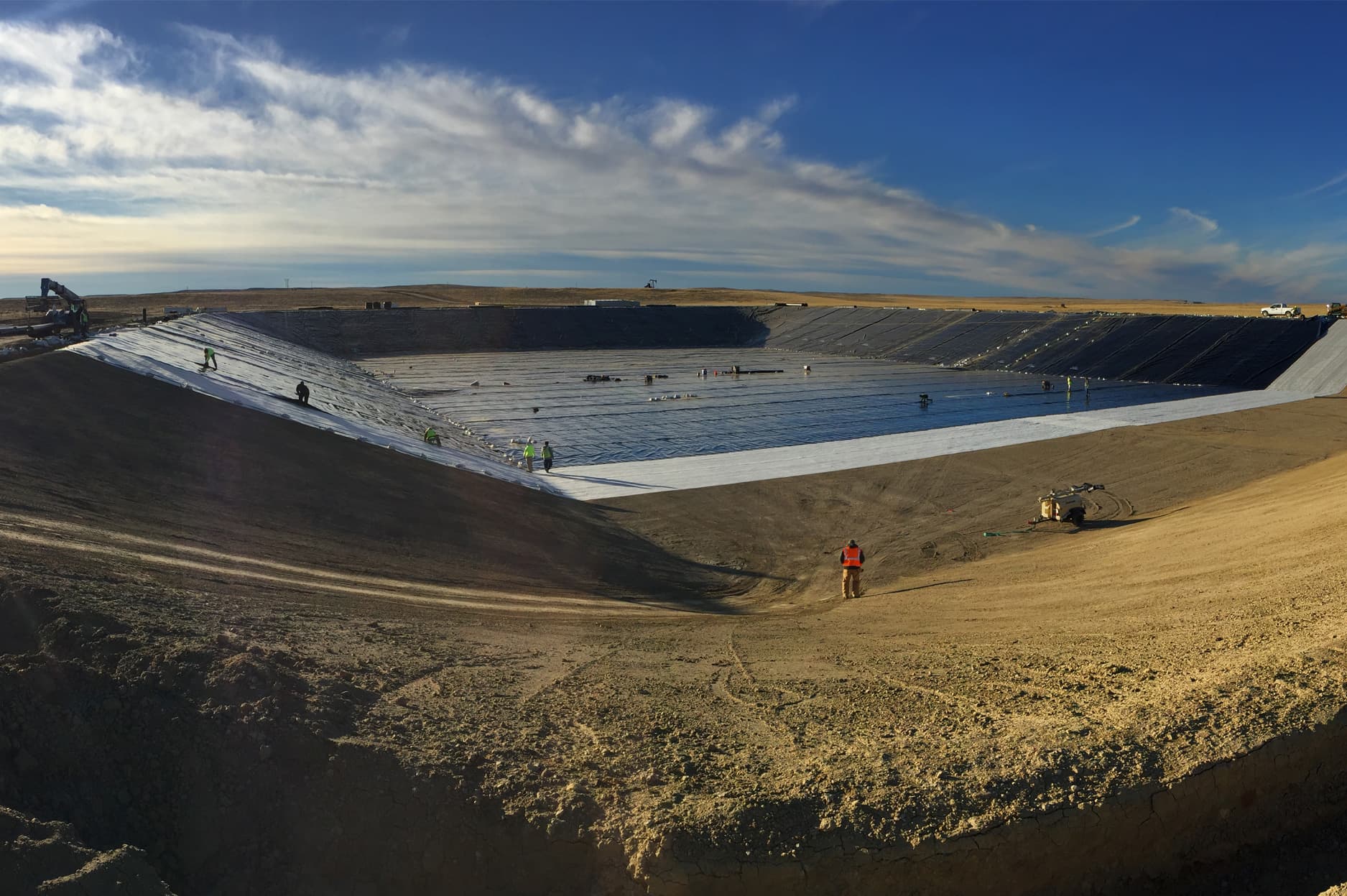
Pit Lining in Midland and the Permian Basin
EC Applications lines pits and ponds across the Permian Basin from its Midland office at 10320 W County Road 60, installing produced water, frac water, and drilling mud containment plus well-site secondary containment for West Texas operators. Prefabricated liner panels up to 25,000 square feet cut field seams and time on location.
Pit lining built around Permian schedules
The Permian Basin does not wait on liner crews. When a frac schedule moves up or a produced water pond needs capacity before the next pad comes online, the containment work has to keep pace. EC Applications supports the Midland Basin, the Delaware Basin, and the wider West Texas oilfield from its Midland office at 10320 W County Road 60, putting crews and material within driving distance of most Permian well sites instead of trucking everything in from out of state.
The biggest schedule lever is prefabrication. Liner panels are shop-fabricated at sizes up to 25,000 square feet or 4,000 pounds per panel, which means a large share of the seaming that would normally happen in the field is finished in the shop before material ships to location. Fewer field seams means fewer hours on location, fewer weather delays, and fewer welds exposed to blowing sand and West Texas temperature swings. For standard pit and corral geometries, off-the-shelf panel inventory shortens lead times further.
Produced water and frac water containment
Produced water is the hardest fluid most Permian pits will ever hold. High total dissolved solids, chlorides, and hydrocarbon carryover will degrade a liner that was chosen for fresh water service. For produced water ponds and recycling impoundments, EC Applications typically installs chemically resistant geomembranes such as HDPE, XR geomembrane, or reinforced polypropylene, selected against the actual fluid chemistry and intended service life rather than a one-size default.
Frac water and makeup water are more forgiving, and fresh water corrals and frac ponds are routinely lined with HDPE, LLDPE, or reinforced polyethylene. As operators recycle more produced water into completions, material selection should follow the worst fluid the pond will see, not the best. Because ECA fabricates and installs the full range of materials, the recommendation is driven by the application rather than by what a single-material shop happens to stock.
Drilling mud pits and reserve pits
Drilling mud ponds and reserve pits see a different kind of abuse: solids loading, agitation, and cleanout equipment working directly against the liner at the end of the well. These pits are typically lined with HDPE or reinforced polypropylene chosen for puncture resistance and toughness under mechanical contact, with thickness and texture matched to the subgrade and the cleanout method the operator plans to use.
For rigs moving pad to pad, reusable prefabricated liners can be pulled, inspected, and redeployed, while single-use liners are specified where the pit will be closed in place.
Texas pit rules: RRC Statewide Rule 8 and the 2025 waste regulations
Oilfield pits in Texas are regulated by the Railroad Commission of Texas. Statewide Rule 8, the commission's water protection rule, has long governed which pits are authorized by rule and which require a permit. In 2024 the RRC adopted a comprehensive update to its oil and gas waste management rules in 16 TAC Chapter 4, effective July 1, 2025, which carries pit permitting forward and adds explicit design expectations, including liner standards, for many categories of authorized and permitted pits.
The practical takeaway is that lined pits are increasingly the default expectation rather than the exception. EC Applications installs liner systems to the specification your permit or pit registration calls for and documents the installation, including seam testing, so the containment file stands up when the regulator or the landowner asks for it. Operators should confirm current requirements for their specific pit type with the RRC, since authorization categories and permit conditions vary.
Secondary containment for tank batteries and well sites
Containment in the Permian does not stop at the pit. Facilities storing oil above federal thresholds fall under the SPCC requirements of 40 CFR Part 112, which call for containment sized to hold the largest tank plus freeboard for precipitation. A geomembrane liner inside the containment berm turns an earthen ring into a system that actually holds a release instead of letting it soak into the caliche.
EC Applications installs well-site secondary containment two ways: full field-installed liners for larger tank batteries, and prefabricated drop-in liners that arrive folded, unfold inside the berm, and go into service the same day. The drop-in approach fits the Permian pattern of standardized battery layouts repeated across dozens of pads, where a fabricated liner built to a known geometry beats a custom field install on both cost and schedule.
Local office
Licensing
- CSLB License #894068 (California)
- CSLB License #1003207 (California)
What we install in Midland and the Permian Basin
Frequently asked questions
More places we work
Have a site in Midland and the Permian Basin?
Tell us about the application and our team will scope the right containment approach with you, from materials to installation.