
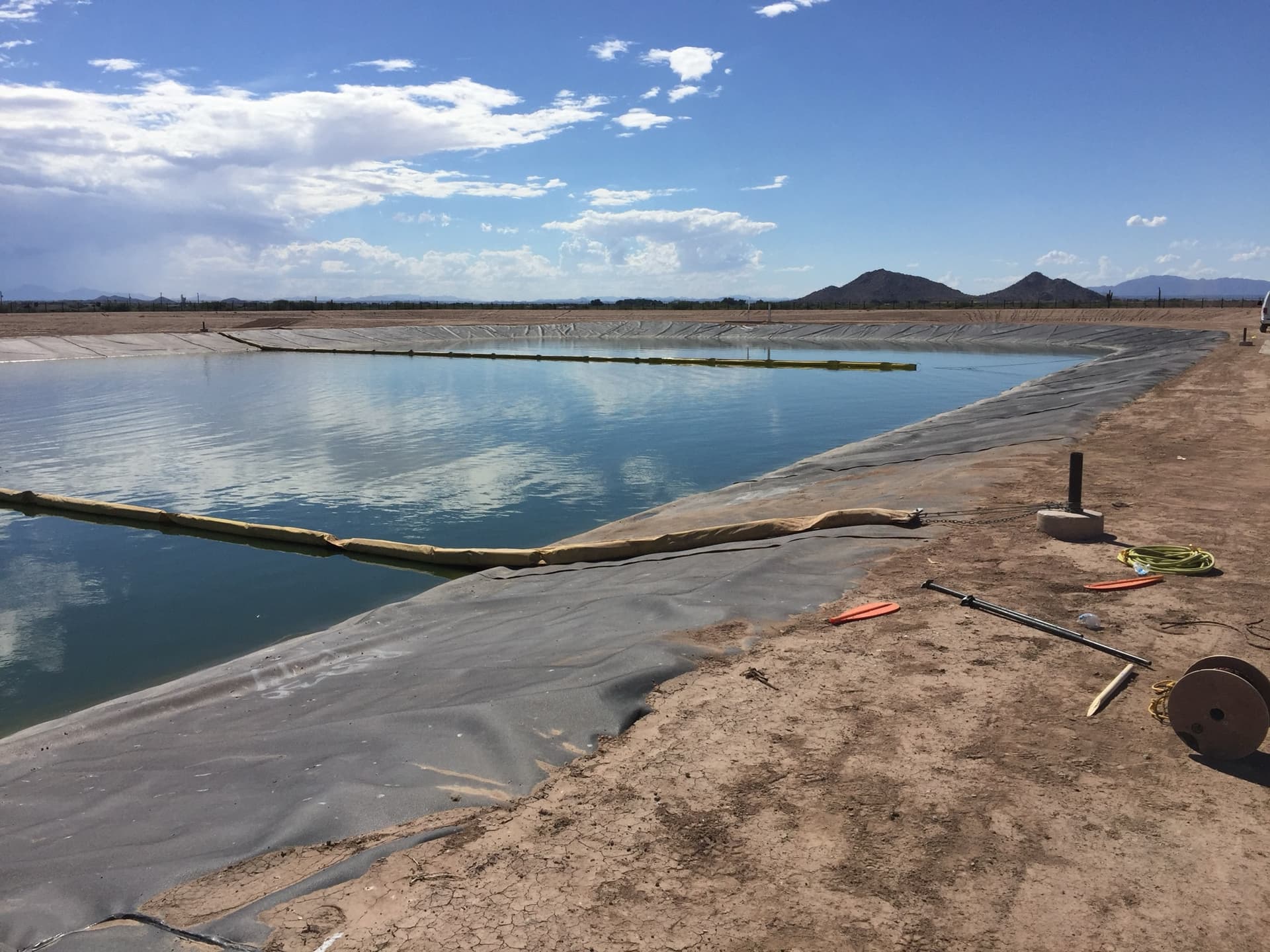
Wastewater Lagoon Liner Installation
A wastewater lagoon liner is a geomembrane barrier, typically HDPE, LLDPE, reinforced polypropylene, or an XR geomembrane, installed across the floor and slopes of a lagoon to stop wastewater from seeping into soil and groundwater. EC Applications installs and repairs lagoon liners for municipal and industrial storage lagoons, holding ponds, clarification and treated-water systems, and sediment basins, and adds floating covers where odor or biogas control is required. Crews handle both new construction and the relining of aging or leaking lagoons.
What wastewater containment work does EC Applications perform?
EC Applications designs and installs geomembrane containment for the full range of wastewater structures: storage lagoons, holding ponds, treated-water and irrigation storage, clarification systems, and sediment basins. The scope covers single lined systems, composite lined systems, and lined concrete vaults, channels, and tanks. Baffle curtains and floating covers integrate with the liner system where hydraulic short-circuiting, odor, or biogas is a concern.
Wastewater is a growing concern for municipalities: storm runoff, raw wastewater, and treated water held for irrigation reuse all have to be contained to protect groundwater and satisfy discharge permits. ECA supports both new facilities and upgrades to existing facilities that no longer meet current regulatory standards, working from offices in California, Texas, and Nevada.
Which liner materials suit wastewater lagoons?
HDPE is the default choice for most wastewater lagoons because it combines high chemical resistance, UV stability, and long service life at a competitive cost, typically in 40 to 80 mil thicknesses with textured sheet used on slopes for friction. LLDPE offers more flexibility and elongation, which helps over soft subgrades where some settlement is expected. Reinforced polypropylene and XR geomembranes suit exposed applications, mechanically attached details, and prefabricated panels, while PVC remains an option for buried liners with complex geometry.
Material selection comes down to the wastewater chemistry, temperature, exposure (covered or exposed to sunlight), subgrade condition, and whether the liner must accommodate equipment, covers, or baffle attachments. EC Applications installs smooth and textured HDPE and LLDPE, drain liners, reinforced and unreinforced polypropylene, XR geomembranes, PVC, and polyethylene products, so the material recommendation follows the application rather than a single product line.
Should an aging lagoon be relined or replaced?
In most cases a leaking or degraded lagoon can be relined in place rather than excavated and rebuilt, which is significantly faster and less costly. The decision depends on the condition of the existing liner and subgrade, the lagoon's remaining structural life, and whether the facility can be taken out of service long enough for the work. If the embankments and geometry are sound, the typical remediation is to dewater and clean the lagoon, remove or repair the failed liner, restore the subgrade, and install a new geomembrane, sometimes over a cushion geotextile laid across the old surface.
Full replacement makes sense when the lagoon needs more capacity, the slopes or berms have eroded beyond repair, or sludge and subgrade contamination make in-place preparation impractical. ECA evaluates both paths during site review so owners can compare cost, outage time, and permit implications before committing.
How is an existing lagoon prepared before relining?
Preparation drives liner performance. The lagoon is first dewatered and accumulated sludge is removed so crews can inspect the floor and slopes. The subgrade is then proof-rolled and regraded to a smooth, firm surface free of rocks, roots, debris, and standing water, since punctures and settlement are the leading causes of premature liner failure. Anchor trenches are cut or re-established at the crest to lock the new liner in place, and penetrations such as inlet and outlet pipes are exposed and detailed with prefabricated boots.
Where the old geomembrane stays in place, a nonwoven geotextile cushion is typically deployed over it to isolate the new liner from wrinkles and hard points. Only after the surface passes inspection does geomembrane deployment and seaming begin.
What QA and leak testing is performed on lagoon liners?
Every field seam is tested, not sampled visually. Fusion-welded seams are pressure tested along the air channel, extrusion welds are vacuum-box tested, and destructive seam samples are taken at specified intervals and tested for shear and peel strength per ASTM D6392. Trial welds qualify each welding machine and technician at the start of each shift and whenever conditions change.
The result is a documented QA record: panel placement logs, seam maps, test results, and repair locations, which supports the engineer's certification and the owner's permit file. For facilities that require it, electrical leak location surveys per the ASTM D7002 and D7007 methods can pinpoint any remaining defects in the installed liner before the lagoon is returned to service.
Can odor and biogas covers be added to a wastewater lagoon?
Yes. A floating geomembrane cover can be added to a lined lagoon to contain odors, capture biogas from anaerobic treatment, keep rainwater and debris out, and reduce evaporation. Covers are engineered with floats, ballast, and tensioning so they ride on the water surface through changing levels, and gas collection piping can route captured biogas to a flare or energy recovery system. Because ECA installs both the liner and the cover, the perimeter attachment, gas handling details, and access points are designed as one system rather than retrofitted around someone else's work. Baffle curtains can be added at the same time to improve flow paths and treatment residence time.
Prepare a lagoon lining inquiry
Send the site location, pond dimensions, permit conditions, liner specification, and stored-liquid information. Include the condition of the existing liner and the construction window so the installation scope can account for access and site preparation.
Applications
- Municipal wastewater storage lagoons
- Industrial holding and process ponds
- Treated-water and irrigation reuse storage
- Clarification systems and clarifying tanks
- Sediment and stormwater basins
- Anaerobic lagoons with floating gas covers
- Lined concrete vaults, channels, and tanks
- Lagoon relining and remediation
Quality assurance
Installation quality is verified against the project specification using the applicable ASTM and GRI test methods, with documented QA records at handoff.
Materials we install
- HDPE / LLDPE
- polyethylene
- polypropylene
- PVC
- XR geomembranes
Why ECA for this work
- Two CSLB-licensed entities: California licenses #894068 and #1003207.
- In-house specialty fabrication shop for prefabricated panels and custom geosynthetic products.
- Offices in Anaheim, California; Midland, Texas; and Sparks, Nevada, serving sites nationwide.
Related resources
- Wastewater lagoon lining in the water and wastewater market
- Wastewater lagoon liner installation in California
- Wastewater containment for Texas facilities
- Lagoon liner materials compared: HDPE, LLDPE, RPP, and XR-5
- Agricultural liner requirements: NRCS 521 thickness, venting, and leak detection
- Lagoon and wastewater liner requirements by state
- Field testing and project closeout records
Material and system specifications
| Material | Typical thickness | Where it fits |
|---|---|---|
| HDPE (smooth / textured) | 40 to 80 mil | Primary liner for most lagoons; high chemical and UV resistance, textured sheet for slope friction |
| LLDPE | 40 to 60 mil | Flexible liner over soft subgrades where settlement or deformation is expected |
| Reinforced polypropylene (RPP) | 36 to 45 mil | Exposed liners and floating covers; lies flat and takes mechanical attachments well |
| XR geomembrane | 30 to 45 mil | Prefabricated panels and demanding chemical exposure |
| PVC | 30 to 60 mil | Buried liners with complex geometry and detailed penetrations |
How the work gets done
- 1
Site review and material selection
Assess the lagoon geometry, wastewater chemistry, subgrade, and permit requirements, then recommend the liner system and whether relining or replacement fits the facility.
- 2
Dewatering, cleaning, and subgrade preparation
Dewater the lagoon, remove sludge, repair or remove the failed liner, and proof-roll the subgrade to a smooth surface free of rocks, debris, and standing water.
- 3
Geomembrane deployment
Deploy liner panels per the approved layout, set anchor trenches at the crest, and place geotextile cushion where the new liner goes over existing material.
- 4
Seaming and detail work
Fusion-weld panel seams, extrusion-weld patches and details, and fabricate boots around pipes and other penetrations.
- 5
QA testing and documentation
Air-pressure and vacuum-box test every seam, pull destructive samples for shear and peel per ASTM D6392, and deliver the panel and seam QA record.
- 6
Covers, baffles, and return to service
Install floating covers, gas collection, and baffle curtains where specified, complete final inspection, and support refilling and startup.
Frequently asked questions
More of what we install
Ready to scope your wastewater containment project?
Our crews handle engineering, fabrication, field installation, and maintenance. Tell us about your site and we will scope it with you.