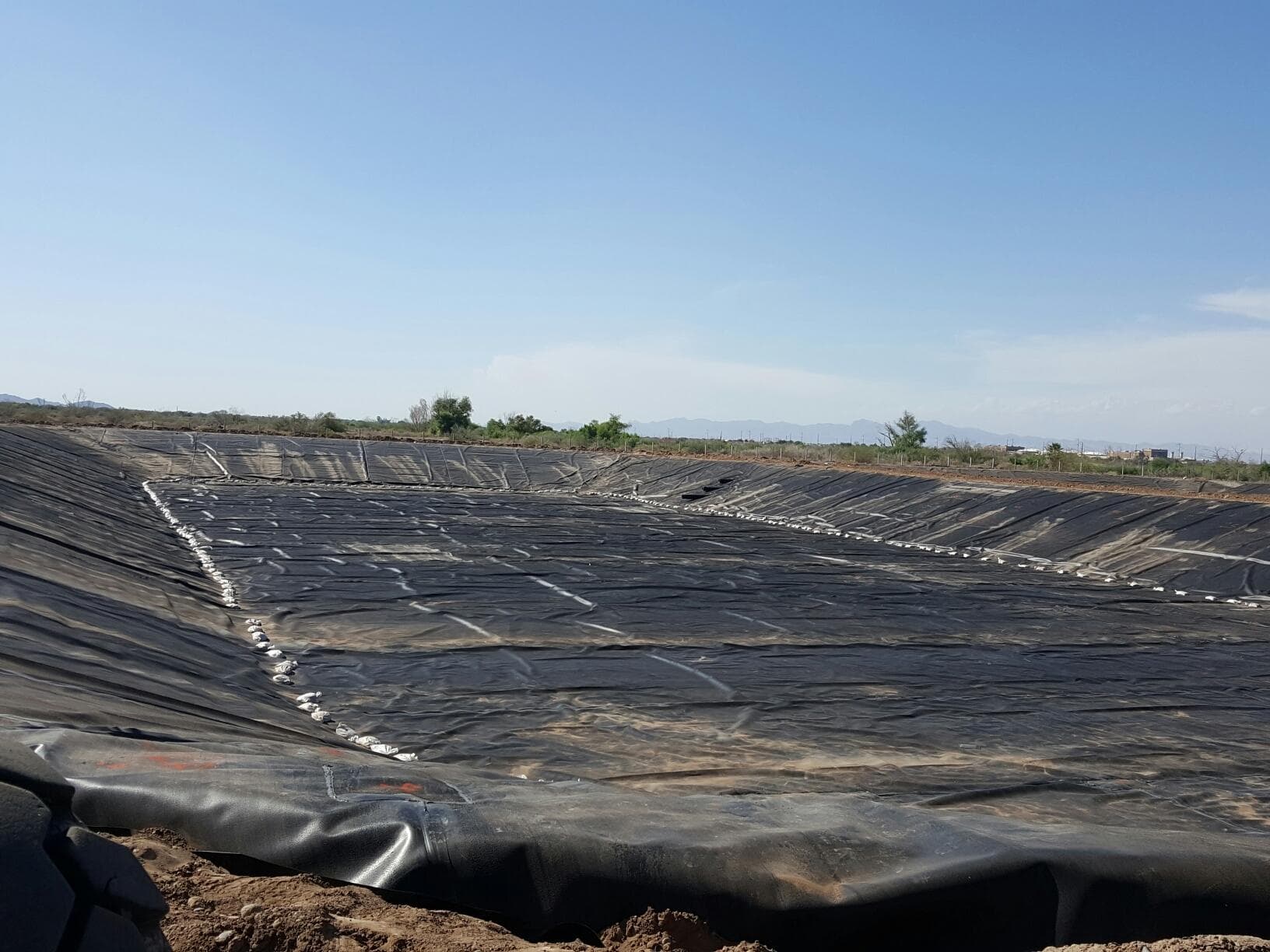
Geosynthetic-lined containment basin installed by EC Applications

Geomembrane liner installation, nationwide

EC Applications installs geomembrane liners and floating covers across the United States. Our crews work on lagoons, mining containment, landfills, and water and wastewater infrastructure, with offices in California, Texas, and Nevada.

A liner installation is more than a material order

The installation scope connects the specified geomembrane to the actual site: panel layout, prepared surfaces, seams, penetrations, attachments, testing, and handoff records. For an owner or engineer choosing a contractor, the useful question is whether that team can document the work your design requires.

ECA provides field installation, with fabrication and cover work scoped to the project. Its documented quality program includes panel and seam traceability, field testing, and a dedicated on-site Quality Control Technician. Project specifications and manufacturer requirements set the procedures; the owner and engineer define acceptance and independent construction quality assurance.

View ECA's five sample quality control forms from its HDPE / LLDPE Installation Manual, Rev 1/2019, for the fields used to record seams, tests, repairs, and panel placement.

Use the scope guide and project examples below to prepare your shortlist. The complete service directory follows the guide.

Match the installation scope to your site

A contractor shortlist is useful when it matches the work. Start with the application, then compare the material, field details, and documents each installer will provide. These are four areas of ECA's documented installation capability.

Lagoon liners and covers

Lagoon lining, floating covers, cover attachments, and repair work.

Bring to the scope review: Stored liquid, cover duty, operating levels, penetrations, and the available outage window.

ECA's floating-cover capability sheet describes potable-water, odor-control, and biogas applications, including defined-sump, cable-tensioned, and pressure-dome covers.

Mining

Heap-leach pads, tailings impoundments, process ponds, solution channels, and mechanical attachments.

Bring to the scope review: Liner cross section, solution chemistry, slopes, drainage layers, and construction sequence.

ECA's mining capability sheet lists single and composite liner systems, geomembranes, GCL, geotextiles, geonets, and drainage geocomposites.

Landfills

Cell liners, closure systems, and leachate containment.

Bring to the scope review: Permitted design, approved CQA plan, layer sequence, test requirements, and hold points.

ECA's May 2025 qualifications package documents landfill-cell, closure, and leachate-pond installation experience in its QC lead's project background.

Water and wastewater

Reservoir and canal liners, wastewater lagoons, and floating covers.

Bring to the scope review: Substrate, attachment details, water-contact requirements, access, and shutdown constraints.

The Jefferson Reservoir and Friant-Kern Canal case studies below document ECA's reinforced-polypropylene installation work.

Published work, with the installation scope attached

Friant-Kern Canal, California

ECA's case study records installation of 160,000 square feet of 45 mil reinforced polypropylene liner in Visalia, completed in 2023. The work formed part of the canal's geosynthetic supply and installation project.

Relevant experience: reinforced geomembrane installation on water-conveyance infrastructure.

View the canal installation

Jefferson Reservoir, Washington

ECA's case study describes a 45 mil reinforced polypropylene bottom liner inside the City of Wenatchee's concrete reservoir, completed in 2025. The liner was secured to the concrete with a batten bar attachment system.

Relevant experience: reinforced geomembrane lining and mechanical attachment inside an existing concrete structure.

View the reservoir installation

Source: EC Applications' two-page rPP case-study document, pages 1 and 2, checked September 23, 2026. The examples describe the liner work only. Ask for references that match your project's material, application, and details.

Public contract award: reservoir floating-cover replacement

El Dorado Irrigation District's November 10, 2025 board record reports its October 14, 2025 construction-contract award to EC Applications for the Reservoir 1 Floating Cover Emergency Replacement, project 25040.01. This records an awarded scope; it does not establish completion or performance.

Read EID's board record, consent item 3 (PDF)

Compare the bid before you compare the price

Use the same scope and qualification questions for every installer. A missing preparation task or an undefined testing allowance can leave bids covering different work.

Discuss your drawings and specificationDownload the bid qualification worksheet
Comparable installations
Ask for work with the specified material, attachment detail, and application. A reservoir lining and a landfill cell impose different construction constraints.
Material and installation submittals
Confirm the selected product, manufacturer requirements, panel layout, penetrations, and termination details before ordering or fabrication.
Named scope boundaries
Assign dewatering, cleaning, subgrade preparation, access, lifting, installation, testing, and protection of completed work. Put exclusions in the bid comparison.
Field welding and tests
Request the material-specific welding procedure, trial-weld requirements, production test methods, acceptance criteria, and repair/retest process.
Quality roles
Identify the installer's QC lead and the owner's or engineer's CQA representative. Agree who witnesses tests, releases hold points, and accepts the work.
Closeout records
Specify panel and seam maps, test results, repair records, and field logs. Agree the required format and handoff date before mobilization.

Manufacturer references: AGRU's HDPE installation guidance addresses installer experience, subgrade preparation, trial welding, and testing. Seaman's XR-5 sample specification covers submittals, fabrication, installer references, prepared surfaces, and seam inspection. Apply the requirements selected for your project.

The material changes the welding and testing plan

Thickness is only one part of the specification. Reinforcement, seam configuration, attachment details, and the selected product affect fabrication and field testing.

Examples of material-specific installation requirements, subject to the approved project specification
Material exampleWhat the source distinguishesSource
HDPEAGRU describes fusion welding, extrusion welding where needed, trial welds, and production seam testing before covering the liner. Repairs are retested.AGRU installation guidance
Reinforced XR-5Seaman's sample specification describes heat or RF factory seams, hot-air field seaming, and air-lance or vacuum inspection. An HDPE welding procedure does not establish the XR-5 procedure.XR-5 specification, sections 1.04, 1.11, and 1.12
Flexible polypropyleneASTM D6434 guides the selection of test methods for flexible polypropylene. Specify the actual product, reinforcement, seam type, and acceptance criteria for the job.ASTM D6434-25 scope

ECA's documented QC program uses numbered panel and seam records, field testing, and on-site QC oversight. The approved plan defines the methods and acceptance criteria for each installation. See the field QA/QC records and responsibilities.

Questions to settle before mobilization

Yes. EC Applications provides geosynthetic installation services nationwide, with offices in Anaheim, California; Midland, Texas; and Sparks, Nevada. Its work includes lagoon liners and covers, mining containment, landfill systems, and water and wastewater infrastructure. Send the project location, drawings, material specification, and schedule so ECA can confirm the installation scope and mobilization requirements.

Compare documented experience with your material and application, the proposed field team, manufacturer requirements, the welding and testing plan, and the closeout records. Confirm who is responsible for subgrade preparation, dewatering, access, and independent construction quality assurance. Request current project-specific qualifications rather than treating an old certificate or a general experience total as proof for every job.

No. The material, reinforcement, seam configuration, and manufacturer's instructions determine the welding and testing procedure. An HDPE fusion seam and a reinforced XR-5 seam can require different equipment and test methods. The approved project specification sets the acceptance criteria; the material name alone does not establish the complete procedure.

ECA's quality program describes numbered panels and seams, panel layout maps, test results, and field logs, with a dedicated on-site Quality Control Technician. The project QA/QC plan determines the required tests and acceptance criteria. Installer quality-control records support review by the project inspection team; they do not replace the owner's or engineer's acceptance process.

ECA's case studies document 45 mil reinforced-polypropylene liner installation at the Friant-Kern Canal in Visalia, California, completed in 2023, and a bottom liner mechanically attached with batten bars inside Jefferson Reservoir in Wenatchee, Washington, completed in 2025. Those examples show specific installation scopes, not a claim that the same detail is suitable for every reservoir or canal.

All installation services

Landfill Liner Systems

Single and composite-lined cells, caps, and leachate ponds for MSW, hazardous, and coal-ash sites.

Learn more

Floating Covers

Gas-capture, potable-water, and evaporation covers for ponds, lagoons, and digesters.

Learn more

Baffle Curtains

Flow-control baffles that eliminate dead zones and improve circulation in treatment basins.

Learn more

Methane Barriers

Under-slab and below-grade methane mitigation, installed to LADBS compliance.

Learn more

Mining

Heap-leach pads, tailings impoundments, solution channels, and evaporation ponds.

Learn more

Oil & Gas Containment

Frac-water, drilling-mud, and produced-water containment with panels up to 25,000 SF.

Learn more

Secondary Containment

Tank and facility containment, prefabricated drop-in or full field installs.

Learn more

Water Reservoirs

Lined concrete reservoirs, steel tanks, clearwells, and earthen raw-water reservoirs.

Learn more

Wastewater Containment

Storage lagoons, holding ponds, and sediment basins with odor and biogas covers.

Learn more

Tunnels

Induction-welded tunnel lining with 30% fewer field seams for leak-free, seismic-ready systems.

Learn more

Specialty Fabrication

Prefabricated geomembranes, fuel bladders, geotubes, and custom environmental barriers.

Learn more

EPS Lightweight Fill

EPS geofoam installation for road embankments, bridge approaches, and retaining walls.

Learn more

Liner Repair and Leak Location

Leak location support, extrusion-welded repairs, and seam retesting for existing liners.

Learn more

Erosion Control

Turf reinforcement mats, blankets, and geotextiles for slopes, channels, and closure covers.

Learn more

Drop-In Berm Liners

One-piece shop-fabricated liners dropped into containment berms with minimal field welding.

Learn more

SPCC Containment Compliance

Sufficiently impervious liner retrofits and capacity checks for SPCC-regulated storage.

Learn more

Tank Farm and Substation Containment

Facility-scale containment for tank farms, terminals, and transformer yards.

Learn more

Not sure which system fits your site?

Tell us about the application and our team will scope the right containment approach with you, from materials to installation.