
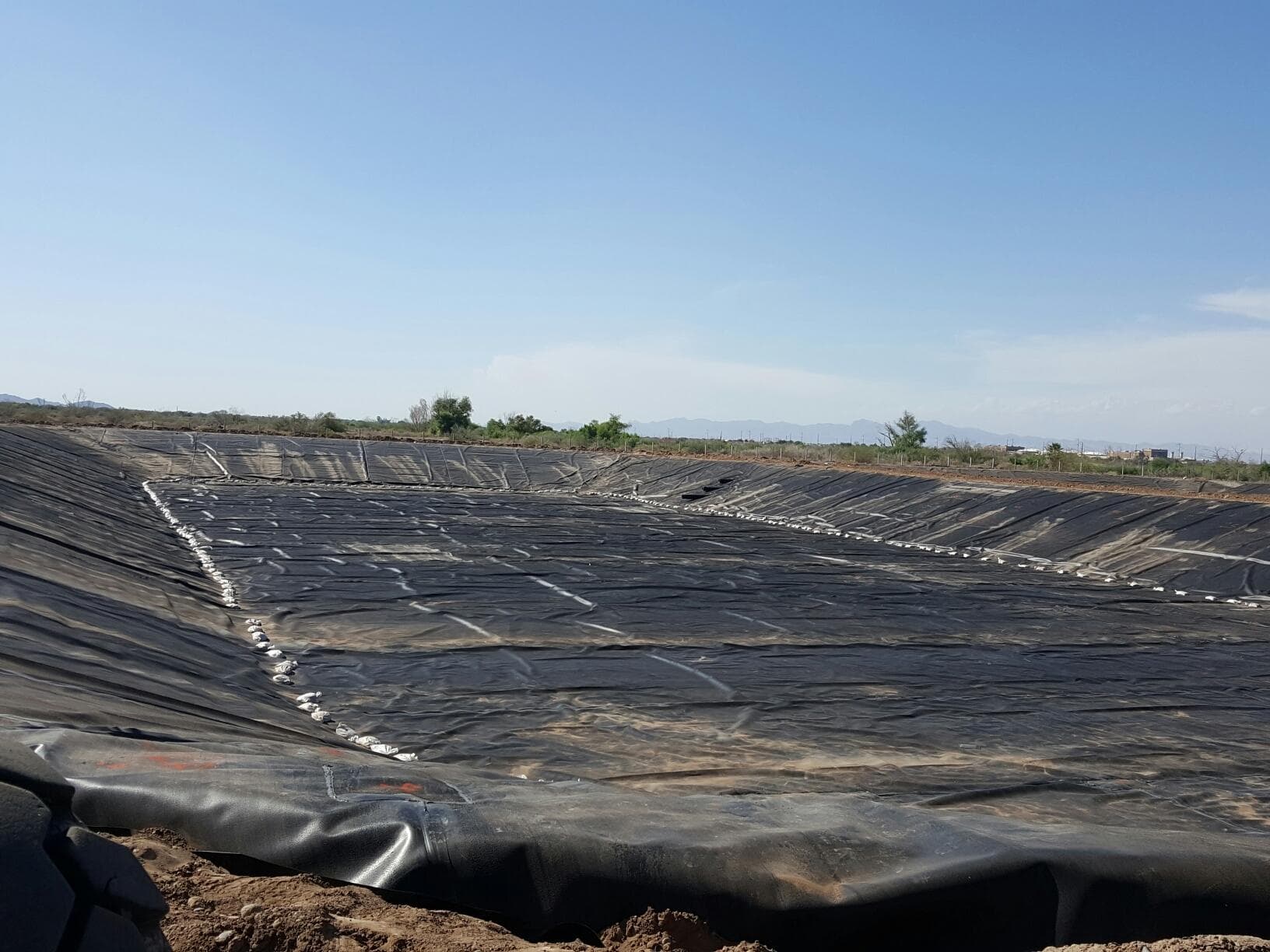
Secondary Containment Liner Installer
A secondary containment liner is an impervious geomembrane barrier installed around tanks and fuel storage to capture leaks and spills before they reach soil or groundwater. EC Applications designs, installs, and maintains custom-fabricated secondary containment systems, delivered either as prefabricated drop-in liners or as full field installations, for fuel storage, tank farms, wastewater, oil and gas, mining, and water facilities across California, Texas, Nevada, and the United States.
Leer esta página en EspañolWhat is a secondary containment liner and when is one required?
A secondary containment liner is a flexible geomembrane installed inside a berm, dike, vault, or channel that surrounds a storage tank, so that if the primary tank or its piping fails, the released liquid is held inside the lined area instead of soaking into the ground. For facilities that store oil or fuel, the federal SPCC rule (40 CFR Part 112) generally applies once aboveground storage capacity exceeds 1,320 gallons, and it requires secondary containment that is sufficiently impervious to contain a discharge until it can be cleaned up. Earthen berms alone rarely meet that standard; lining the containment area with a chemically compatible geomembrane is the accepted way to make it sufficiently impervious.
Beyond SPCC, secondary containment liners are required or specified for chemical storage under fire codes and many state and local programs, and they are standard practice at tank farms, fueling facilities, generator and transformer pads, and industrial process areas. EC Applications has handled containment applications of this kind across fuel storage, wastewater, oil and gas, mining, and water reservoir facilities, working from offices in Anaheim, California, Midland, Texas, and Sparks, Nevada.
Prefabricated drop-in system or full field install: which fits your site?
Choose a prefabricated drop-in system when the containment geometry is regular and access allows a shop-built liner to be placed and attached quickly; choose a full field install when the area is large, the geometry is complex, or the design calls for a composite or double-lined system. EC Applications offers both.
Prefabricated tank liners and drop-in containment liners are fabricated in the shop to the dimensions of the berm or vault, with corners, boots, and specialized parts built in under controlled conditions. That shifts most of the welding off the site, shortens the on-site schedule, and is often the practical choice for retrofits at operating facilities where downtime and hot work must be minimized.
Full field installation is the right approach for larger tank farms and engineered containment structures. Crews prepare the subgrade or concrete surface, deploy geotextile cushion where specified, weld the geomembrane panels in place, and terminate the liner with mechanical or embedment attachment systems. Field-installed work covers single-lined systems, composite-lined systems with drainage or leak detection layers, concrete vaults and channels, and liner tie-ins to tank foundations.
Which liner materials are compatible with fuels and chemicals?
Material selection starts with the stored liquid: geomembranes that perform well in water service can fail quickly in hydrocarbon contact, so the liner must be matched to the chemical exposure, the exposure duration, and the site conditions. For fuel and hydrocarbon service, XR-type ethylene interpolymer alloy geomembranes are the common specification for long-term contact, while HDPE offers broad chemical resistance at low cost for many containment chemistries. Reinforced polypropylene and PVC suit water-based and many wastewater applications, and spray-applied membranes bond directly to concrete vaults and channels where a sheet liner is impractical.
EC Applications installs smooth and textured HDPE and LLDPE, drain liners, reinforced and unreinforced polypropylene, XR geomembranes, PVC, polyethylene products, geotextiles and geocomposites, and liquid boot systems. Because secondary containment liners are often exposed to sunlight and foot traffic rather than buried, UV resistance and puncture performance matter alongside chemical compatibility, and the final selection should be confirmed against the manufacturer's chemical resistance data for the specific stored product.
How are tanks, pipes, and penetrations sealed into the liner?
Every pipe, support leg, and structure that passes through a containment liner is sealed with a custom-fabricated boot: a shaped geomembrane fitting welded to the field liner and clamped to the penetration with stainless steel bands over a compatible sealant. EC Applications fabricates custom boots and specialized parts in the shop or in the field to fit each penetration, which is where most containment systems succeed or fail.
At walls, foundations, and concrete structures, the liner is terminated with mechanical attachment (batten bars anchored through the geomembrane into the concrete with a gasket seal) or with embedment attachment (polyethylene embed strip cast into the concrete so the liner can be welded directly to the structure). Open-top floating roof systems can be added over containment sumps and tanks to control evaporation and rainwater. Field seams are tested as they are made, using trial welds and nondestructive testing such as air pressure testing of dual-track fusion seams and vacuum box testing of extrusion seams, so the finished system is verified tight before the containment goes back into service.
Can containment be installed or retrofitted around in-service tanks?
Yes. Most secondary containment work is retrofit work at operating facilities, and the installation plan is built around keeping the facility running. Prefabricated drop-in liners minimize on-site welding and schedule, work can be sequenced one containment cell at a time so tanks stay in service, and hot work, access, and spill controls are coordinated with the facility's EHS requirements. EC Applications also provides ongoing repair and maintenance for existing containment liners: patching damage, rebooting penetrations, resealing terminations, and retesting seams, so an aging system can be brought back to spec without full replacement.
Applications
- Fuel storage and tank farm containment
- Prefabricated tank liners and drop-in systems
- Concrete vaults, channels, and sumps
- Single-lined and composite-lined containment systems
- Custom boots and penetration seals
- Open-top floating roof systems
- Spray-applied membrane containment
- Oil and gas well site and tank battery containment
- Wastewater and chemical storage areas
- Mining and water reservoir containment
Material specifications
Quality assurance
Installation quality is verified against the project specification using the applicable ASTM and GRI test methods, with documented QA records at handoff.
Materials we install
- HDPE / LLDPE
- PVC
- polypropylene
- geomembranes
- geotextiles
Why ECA for this work
- Two CSLB-licensed entities: California licenses #894068 and #1003207.
- In-house specialty fabrication shop for prefabricated panels and custom geosynthetic products.
- Offices in Anaheim, California; Midland, Texas; and Sparks, Nevada, serving sites nationwide.
Related resources
- SPCC secondary containment for power and utility sites
- Well site secondary containment in Texas
- Secondary containment liner installation in California
- SPCC secondary containment requirements guide
- Secondary containment liners for mine fuel, reagent, and process tanks
- Lagoon and wastewater pond liner requirements by state
- In-house geomembrane welding and liner installation crews
Material and system specifications
| Material | Typical containment service | Notes |
|---|---|---|
| XR ethylene interpolymer alloy geomembrane | Fuels, oils, and long-term hydrocarbon contact | Reinforced, high puncture and tensile strength (ASTM D751), the common spec for fuel containment |
| HDPE, smooth or textured | Broad chemical service, large field-installed containments | High chemical resistance, dual-track fusion seams air tested per ASTM D5820 |
| LLDPE | Containments needing more flexibility than HDPE | Better conformance to subgrade and structures, similar chemical resistance family |
| Reinforced polypropylene | Water, wastewater, and many aqueous chemicals | Good UV exposure performance for exposed berm liners, not for long-term hydrocarbon contact |
| PVC | Water-based service and buried applications | Economical and flexible, verify chemical compatibility for each stored product |
| Spray-applied membrane | Concrete vaults, channels, and complex shapes | No field seams, bonds to prepared concrete where sheet liner attachment is impractical |
How the work gets done
- 1
Site assessment and compatibility review
Confirm the stored products, containment geometry, substrate condition, and regulatory drivers, then match liner materials to the chemical exposure using manufacturer compatibility data.
- 2
Design and capacity check
Verify the lined containment provides the required net volume, largest tank plus freeboard for precipitation, accounting for displacement by other tanks and equipment inside the berm.
- 3
Fabrication
Build prefabricated panels, tank liners, custom boots, and specialized parts in the shop to fit the containment, moving welds into controlled conditions and off the critical path.
- 4
Installation
Prepare the subgrade or concrete, deploy cushion geotextile where specified, place and weld the geomembrane, seal penetrations with boots, and terminate with mechanical or embedment attachments.
- 5
Seam testing and QA documentation
Qualify welders with trial welds, nondestructively test every field seam by air pressure or vacuum box, destructively test per ASTM D6392 where specified, and turn over as-built QA records.
- 6
Maintenance and repair
Inspect, patch, reboot penetrations, reseal terminations, and retest existing containment liners so systems stay serviceable over the life of the facility.
Frequently asked questions
More of what we install
Ready to scope your secondary containment project?
Our crews handle engineering, fabrication, field installation, and maintenance. Tell us about your site and we will scope it with you.