
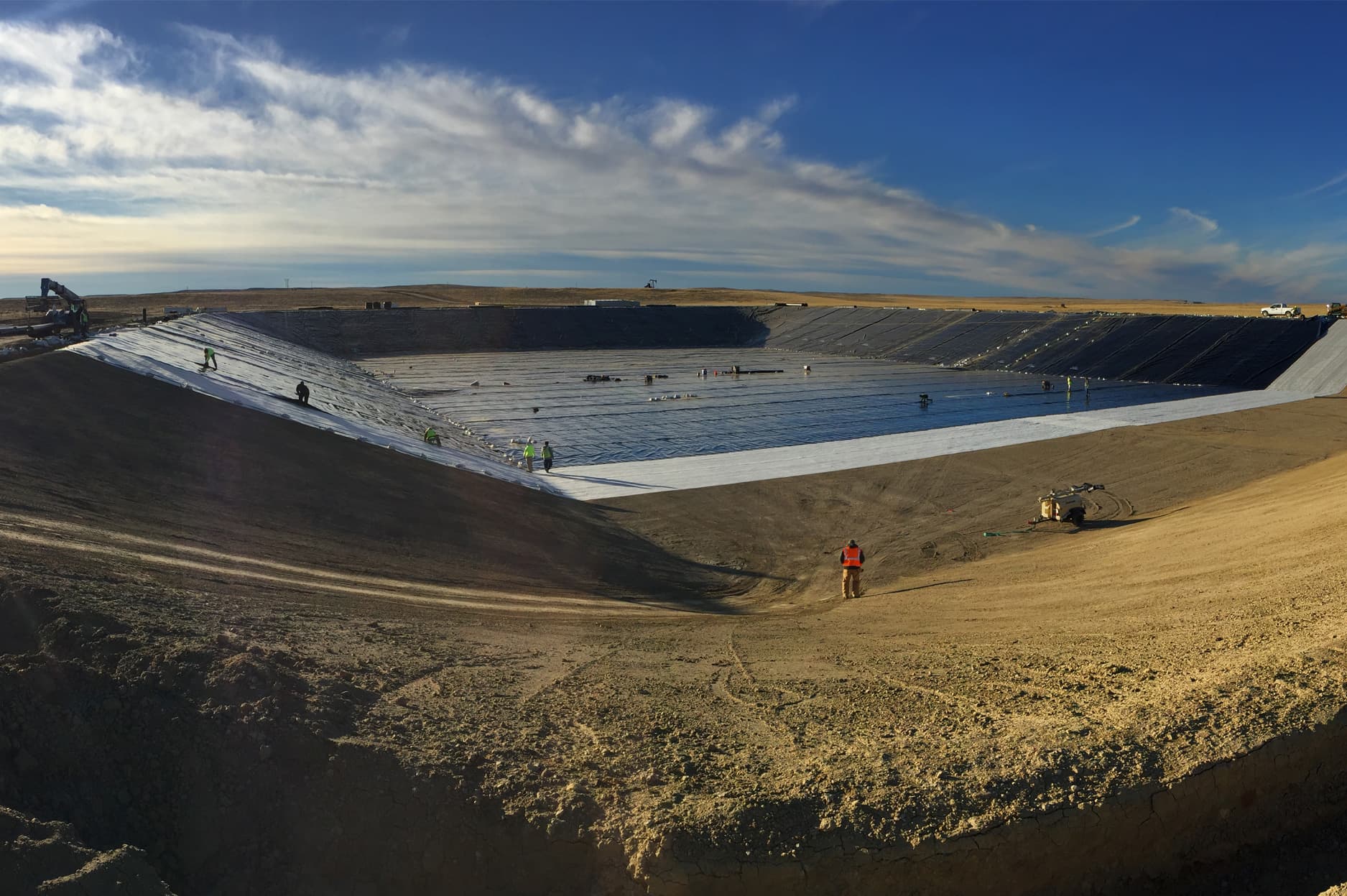
Geomembrane Liner Installer in Texas
EC Applications installs secondary containment liners for oil and gas sites in Texas from its Midland office, lining tank batteries, well-site berms, frac water ponds, drilling mud pits, and produced water pits across the Midland Basin, Delaware Basin, and wider West Texas oilfield, with statewide mobilization for municipal and industrial lining work.
Geomembrane liner installation across Texas
EC Applications is a geomembrane liner installer serving Texas from an office in Midland, with additional offices in Anaheim, California and Sparks, Nevada. The Midland location puts installation crews and lining material in the middle of the Permian Basin, where most Texas containment work concentrates, while statewide mobilization covers municipal, industrial, and agricultural lining projects from the Panhandle to the Gulf Coast.
The company engineers, fabricates, and installs the full range of containment geosynthetics used in Texas: smooth and textured HDPE and LLDPE, reinforced polypropylene, XR geomembrane, reinforced polyethylene, PVC, geosynthetic clay liner, geotextiles, geonet, and geocomposite. Because panels are fabricated in-house at sizes up to 25,000 square feet, most pit and pond liners arrive as a small number of large prefabricated panels instead of dozens of rolls that have to be seamed together in the field.
Produced water pit liners and frac pond liners in the Permian Basin
Produced water is the hardest fluid most Texas containment systems will ever hold: high total dissolved solids, chlorides well above seawater, and hydrocarbon carryover that attacks the wrong membrane. Pit lining West Texas operators can rely on starts with material selection matched to that chemistry, typically HDPE or a chemically resistant membrane such as XR geomembrane for produced water service, with HDPE, LLDPE, or reinforced polyethylene handling fresh and frac makeup water.
Texas pit construction operates under Railroad Commission of Texas oversight. Statewide Rule 8 has long governed water protection at oil and gas sites, and the RRC's updated waste management rules in 16 TAC Chapter 4 set permitting, liner, and monitoring expectations for produced water recycling pits and other authorized pits. A liner system built to those expectations, with documented material, seaming, and testing, is the difference between a pit that permits cleanly and one that stalls.
Speed matters as much as chemistry in the Permian. Prefabricated panels folded and palletized in the shop mean a frac pond or produced water pit can be deployed and welded out in a fraction of the time field-seamed rolls require, and off-the-shelf inventory for common pit and corral sizes can ship immediately. Fewer field seams also means fewer welds made in West Texas wind and dust, which is where liner defects tend to originate.
Oilfield secondary containment for Texas well sites and tank batteries
Tank batteries, chemical storage, and pump pads in Texas need engineered secondary containment that captures leaks and overfills before they reach soil. Federal SPCC rules under 40 CFR 112 drive containment sizing at facilities storing oil above threshold volumes, and lined earthen berms or prefabricated drop-in liners inside steel containment walls are the standard ways to meet them.
EC Applications installs both permanent field-welded containment systems and prefabricated drop-in liners built to the berm geometry, including boots and seals at pipe penetrations. For standard tank battery layouts, drop-in systems can be fabricated to dimension in the shop and shipped ready to place, which keeps containment work off the critical path when a battery is being set or expanded. Crews and stocked liner material work out of Midland for the Midland Basin, the Delaware Basin, and the wider West Texas oilfield, and mobilize statewide for containment work outside the Permian.
Municipal and industrial lining work across Texas
Texas lining work is not limited to the oilfield. EC Applications lines wastewater lagoons, holding ponds, evaporation ponds, and industrial secondary containment for municipal and industrial facilities across the state, where TCEQ permitting typically defines the liner and leak detection requirements. The same materials, fabrication capability, and installation crews that serve Permian operators handle these projects, from a single lagoon reline to multi-cell pond systems.
For any Texas project, the process starts the same way: fluid chemistry, site conditions, and schedule determine the membrane, and prefabrication determines how fast it goes in. Send the dimensions and the application and the team will scope material options and an installation plan.
Offices serving Texas
Licensing
- CSLB License #894068 (California)
- CSLB License #1003207 (California)
What we install in Texas
Frequently asked questions
More places we work
Have a site in Texas?
Tell us about the application and our team will scope the right containment approach with you, from materials to installation.