
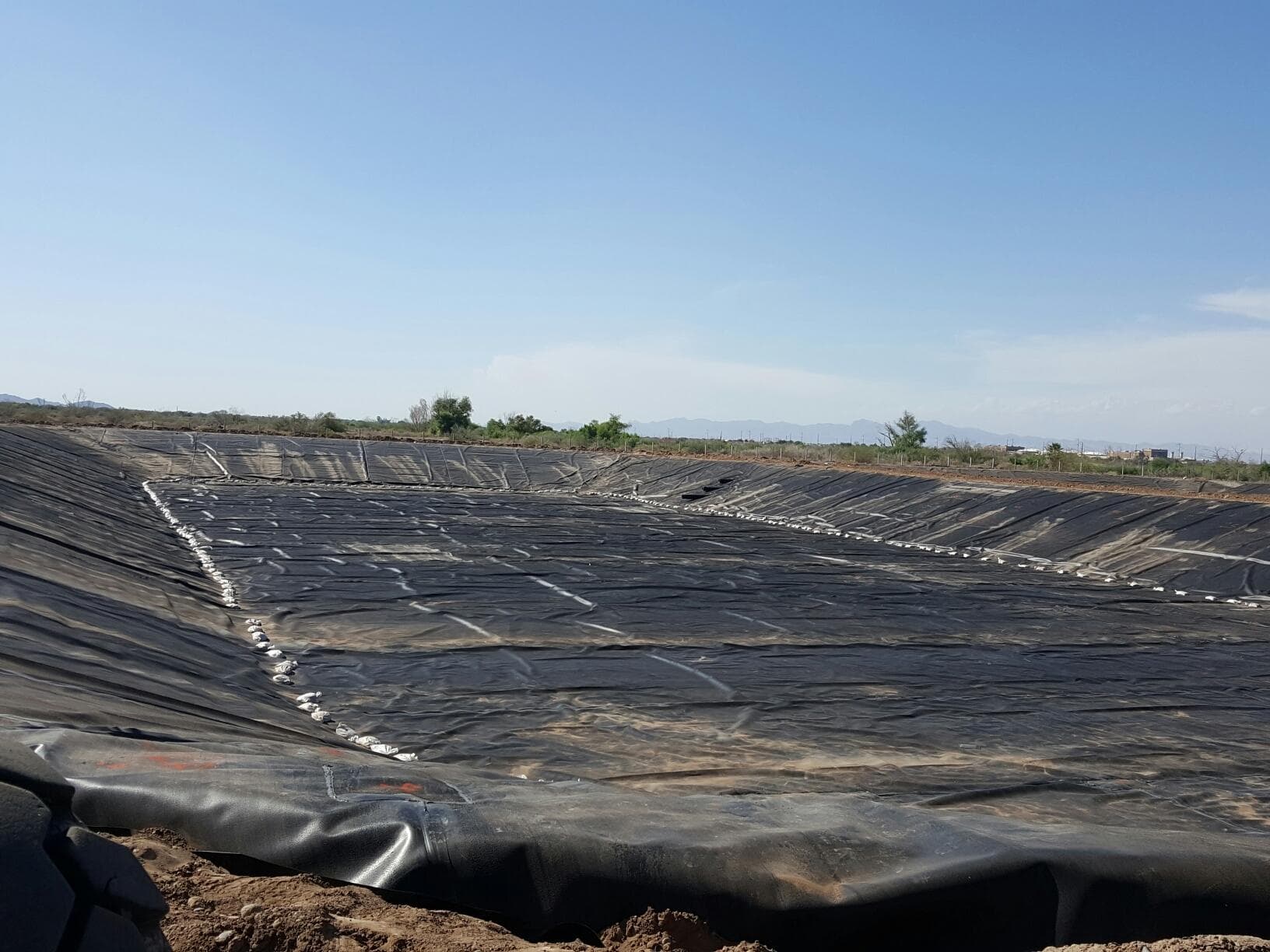
Geomembrane Liner Installer in Nevada
EC Applications installs geosynthetic liners for mining containment ponds in Nevada from its Sparks office east of Reno. Crews line heap leach pads, pregnant and barren solution ponds, tailings impoundments, evaporation ponds, storm and event ponds, solution channels, and floor sumps, and test and document every field seam for the NDEP permit file.
Who installs geosynthetic liners for mining containment ponds in Nevada?
EC Applications does, from its office at 150 Isidor Court in Sparks, on the I-80 corridor just east of Reno. Crews install the geomembrane, geotextile, and geosynthetic clay liner systems for heap leach pads, pregnant and barren solution ponds, tailings impoundments, evaporation ponds, storm and event ponds, solution channels, and floor sumps on Nevada mine sites.
The Sparks location puts crews within direct interstate reach of the mining districts that drive most of the state's containment work: the Carlin Trend and the broader Elko and Winnemucca corridors to the east, the Walker Lane belt to the south, and industrial and municipal sites across the Truckee Meadows.
Nevada containment work is dominated by mining, and the liner systems that serve it are engineered around one requirement: keeping process solution in the circuit. EC Applications installs the geomembranes, geotextiles, and geosynthetic clay liners that make up heap leach pads, tailings impoundments, ponds, and solution conveyance channels, and backs the installation with the seam testing and QA documentation that Nevada permitting requires.
Heap leach pads, tailings, and pond liner systems
Heap leach pads are the core of Nevada gold and copper recovery, and the liner is the floor of the entire economic model. A typical pad section pairs a prepared subgrade or compacted soil liner with a geomembrane, often with a geotextile cushion protecting the membrane from overliner drainage rock. Every gallon of pregnant solution that escapes through a bad seam is lost metal as well as a compliance problem, so seam quality and leak prevention pay for themselves in recovery.
Tailings storage facilities follow a similar logic at larger scale. Lined impoundments, raises, and expansions all depend on field seaming that performs under sustained head and decades of service. EC Applications also lines the supporting water infrastructure a mine runs on: pregnant and barren solution ponds, evaporation ponds, storm water and event ponds, solution channels, and floor sumps.
Crews handle both new construction and work on operating facilities, including liner repair, panel replacement, pad expansions, and tie-ins to existing geomembrane, where sequencing around live process solution and production schedules matters as much as the welding itself.
NDEP zero-discharge permitting and liner QA
Nevada regulates mining fluid management through the Nevada Division of Environmental Protection's Bureau of Mining Regulation and Reclamation, and the governing standard is zero discharge: process fluids may not degrade waters of the state. Water Pollution Control Permits issued under NAC 445A require engineered containment for every fluid management component, from the leach pad itself to the smallest overflow pond.
That standard shapes liner design directly. Composite liner sections, leak collection and recovery layers under high-head areas, and documented construction quality assurance are standard practice on Nevada mine sites. Field QA typically includes trial welds, nondestructive air pressure and vacuum box testing of every seam, and destructive seam sampling at specified intervals, all recorded in a CQA report the engineer of record submits with the permit file. EC Applications builds that documentation trail into every installation rather than treating it as paperwork after the fact.
Nevada mining containment specifics: liners, seam testing, and state references
Liner selection follows the fluid and the duty. Crews install smooth and textured HDPE and LLDPE, reinforced polypropylene, XR geomembranes, GCL, PVC, geotextiles, GeoNet, and geocomposite drainage layers. HDPE at 60 to 100 mil is common for leach pads and ponds, textured sheet goes on slopes for interface friction, and LLDPE is selected where the liner must conform to settlement under ore load. Pregnant and barren solution ponds are commonly built double lined, with a GeoNet or geocomposite leak detection layer between the primary and secondary geomembranes.
Seam testing on a Nevada mine follows the project CQA plan: trial welds qualify each welder and machine before production seaming, dual-track fusion seams are air pressure tested per ASTM D5820, extrusion welds and repairs are vacuum box tested per ASTM D5641, and destructive samples are tested for shear and peel strength per ASTM D6392. Rolls arrive with manufacturer certifications against GRI GM13, and panel logs, repair maps, and as-built drawings go into the operator's CQA report.
The state references behind those designs sit on the Nevada row of our liner requirements by state table. NAC 445A.435 and 445A.438 cover mining process ponds under the Water Pollution Control Permit program. NDEP guidance WTS-37 sets 60 mil primary and 40 mil secondary HDPE or equivalent for holding and detention basins, with a 500 gallons per acre per day action limit on the primary liner, and WTS-5 sets a 60 mil geomembrane minimum for treatment ponds. Both are guidance applied by permit condition, so the permit writer's requirement governs.
Installing through Nevada winters, wind, and altitude
Most Nevada mine sites sit between 4,500 and 7,000 feet, where large daily temperature swings, wind, and winter cold all work against geomembrane installation. Thermal expansion and contraction of the sheet has to be managed with appropriate slack and panel layout, and fusion welding parameters change with ambient and material temperature. Industry practice, reflected in standard specifications, restricts seaming outside acceptable temperature ranges unless the contractor demonstrates acceptable trial welds under the actual field conditions.
Experienced high-desert crews plan around those constraints: scheduling welds for the workable window of the day, preheating where the specification allows it, and managing wind uplift with sandbag and ballast plans so deployed panels stay put. The practical result for owners is a production schedule that holds up in October at 6,000 feet, not just in a bid table.
Industrial and municipal containment in Reno-Sparks
Beyond the mining districts, EC Applications serves industrial and municipal clients across the Reno-Sparks area and northern Nevada with the same crews and equipment. That includes secondary containment liners for fuel and chemical storage, process and fire water pond liners, storm water basins, and wastewater lagoon systems for smaller utilities and industrial operators.
Prefabricated panels and custom-fabricated geosynthetic products can be produced in advance and shipped to remote sites, which shortens field schedules on small and mid-size projects where extended field seaming does not make sense. For project scoping anywhere in Nevada, the Sparks office is the direct line.
Offices serving Nevada
Licensing
- CSLB License #894068 (California)
- CSLB License #1003207 (California)
What we install in Nevada
Frequently asked questions
More places we work
Have a site in Nevada?
Tell us about the application and our team will scope the right containment approach with you, from materials to installation.