
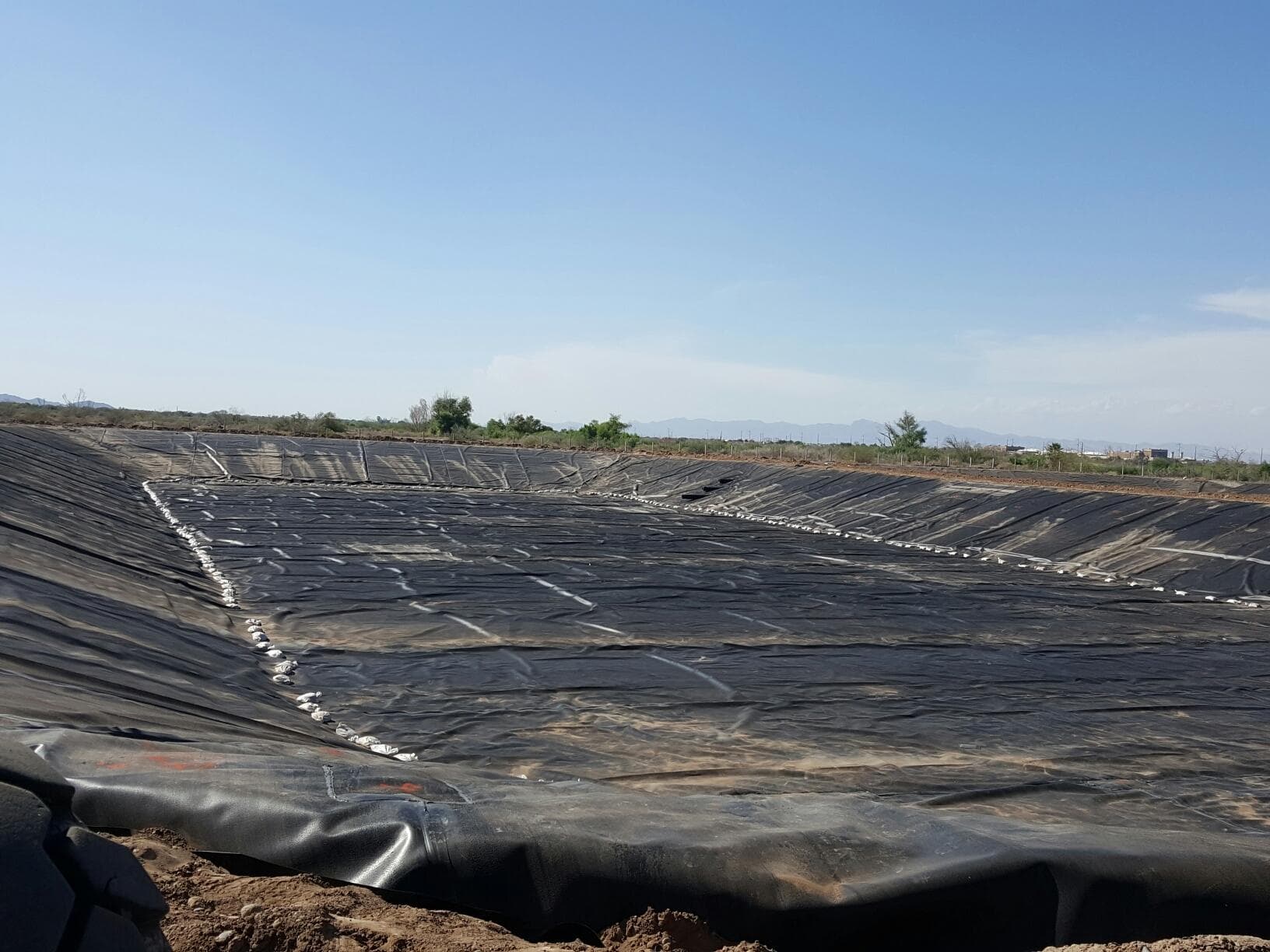
Drop-In Berm Liner Installation
A drop-in berm liner is a one-piece geomembrane liner fabricated in the shop to the exact dimensions of a containment berm, dike, or vault, then delivered to the site, placed, and attached with minimal field welding. EC Applications fabricates and installs drop-in berm liners for fuel storage, tank batteries, generator and transformer pads, and chemical containment across California, Texas, and Nevada, with corners, boots, and fittings built in under controlled shop conditions.
What is a drop-in berm liner and when is it the right fit?
Most secondary containment berms are regular shapes: rectangles with known wall heights around one or a few tanks. For that geometry, the liner does not need to be welded together panel by panel in the field. It can be measured, fabricated as a single piece in the shop with the corners and penetration boots already built in, folded, shipped, and dropped into the berm, where the remaining work is placement, fitting, and attachment rather than production welding.
The drop-in approach fits retrofits at operating facilities better than any other method, because it moves the welding, and the hot work permits, fire watches, and downtime that come with it, off the site and into the shop. It suits fuel storage berms, tank battery containment at well sites, generator and transformer pads, and chemical storage areas where the containment shape is regular and access allows the fabricated liner to be placed. Where the containment is very large, geometrically complex, or specified as a composite system with drainage or leak detection layers, a full field installation is the better tool, and EC Applications does both.
How shop fabrication works
The process starts with field dimensions: wall heights, floor dimensions, corner angles, and the location and size of every pipe, support leg, and structure that passes through the containment. The shop then fabricates the liner to those dimensions, welding floor and wall sections into one piece, prefabricating boxed corners so the liner sits into the berm without bunching, and building penetration boots into the panel where the measurements call for them.
Shop welding happens under controlled conditions, on clean tables, out of the wind and weather, with the same trial-weld and testing discipline used in the field. EC Applications fabricates panels up to 25,000 square feet along with custom boots and specialized fittings, which covers the large majority of containment berms as a single piece and keeps even big containments to a handful of field-fitted joints.
Materials for fuel and chemical service
Berm liners spend their lives exposed to sun and weather while waiting to contain a spill, so the material has to carry two ratings at once: chemical compatibility with the stored product and UV endurance in exposed service. For fuel and hydrocarbon duty, XR-type ethylene interpolymer alloy geomembranes are the common specification, reinforced for puncture and tensile strength and proven in long-term exposed containment. Reinforced polypropylene serves water-based and many aqueous chemical duties with good exposed-service performance, and HDPE and LLDPE cover a broad range of containment chemistries.
The final selection is confirmed against the manufacturer's chemical resistance data for the specific stored product, the same discipline that applies on every containment project.
Installation at an operating facility
A typical drop-in installation runs in days, not weeks. The berm is cleared and inspected, sharp edges and deteriorated surfaces are corrected, and cushion geotextile goes down where the substrate calls for it. The fabricated liner is positioned, unfolded, and worked into the corners, boots are clamped to their penetrations with stainless steel bands over compatible sealant, and the perimeter is secured with the attachment the design specifies, batten bars into concrete, termination over the berm crest, or anchor trenching in earthen berms.
Because the welding already happened in the shop, tanks can often stay in service while their containment is lined, and multi-cell facilities are sequenced one containment at a time. Field-fitted joints and boots are tested before the containment goes back into duty, and the liner can be inspected, patched, and rebooted over its service life like any other geomembrane system.
One shop, three field offices
Liners are fabricated in EC Applications' own shop and installed by the company's crews, dispatched from Anaheim, California; Midland, Texas; and Sparks, Nevada. In the Permian Basin, that pairing supports tank battery and well-site containment on drilling and completion schedules; in California and Nevada, it serves fuel storage, generator pads, and industrial chemical containment where facility downtime is the cost that matters.
For containment questions beyond the berm itself, SPCC applicability, capacity math, or whether an existing lined berm still passes, see the secondary containment and SPCC compliance pages, or start with a site visit.
Applications
- Fuel storage berm and dike liners
- Tank battery containment at well sites
- Generator and transformer pad containment
- Chemical storage area liners
- Concrete vault and sump drop-ins
- Portable and temporary containment berms
- Retrofit lining of existing earthen berms
- Prefabricated corner and boot assemblies
Quality assurance
Installation quality is verified against the project specification using the applicable ASTM and GRI test methods, with documented QA records at handoff.
Materials we install
- XR geomembranes
- polypropylene
- HDPE / LLDPE
- PVC
Why ECA for this work
- Two CSLB-licensed entities: California licenses #894068 and #1003207.
- In-house specialty fabrication shop for prefabricated panels and custom geosynthetic products.
- Offices in Anaheim, California; Midland, Texas; and Sparks, Nevada, serving sites nationwide.
Material and system specifications
| Material | Typical service | Notes |
|---|---|---|
| XR ethylene interpolymer alloy | Fuels, oils, long-term hydrocarbon exposure | Reinforced, high puncture and tensile strength (ASTM D751), the common fuel containment spec |
| Reinforced polypropylene | Water-based and many aqueous chemicals | Good exposed-service UV performance, fabricates well into large one-piece liners |
| HDPE / LLDPE | Broad chemical containment duties | High chemical resistance; LLDPE conforms better to corners and substrate |
| PVC | Water-based service | Economical and flexible; confirm compatibility for each stored product |
How the work gets done
- 1
Measure
Field-verify berm dimensions, corner geometry, and every penetration location so the fabricated liner fits the containment it is going into.
- 2
Select the material
Match the membrane to the stored product and the exposure using manufacturer chemical resistance data.
- 3
Fabricate
Weld the liner as one piece in the shop, with boxed corners and penetration boots built in, tested under controlled conditions.
- 4
Prepare the berm
Clear, inspect, and correct the containment surface and place cushion geotextile where specified.
- 5
Place and attach
Position and fit the liner, clamp boots to penetrations, and secure the perimeter with battens, crest termination, or anchor trench.
- 6
Test and return to service
Test field-fitted joints and boots, document the installation, and put the containment back in duty, often without tank downtime.
Frequently asked questions
More of what we install
Ready to scope your drop-in berm liners project?
Our crews handle engineering, fabrication, field installation, and maintenance. Tell us about your site and we will scope it with you.