On this page
A 500 barrel frac tank holds about 21,000 gallons. Full of water, that is roughly 175,000 pounds of liquid resting on a rear axle and a front skid, usually on ground that was graded the week the tank arrived.
The tanks were built for oilfield completions, but they show up wherever a site needs storage quickly. Landfills use them for leachate when ponds or treatment systems run short of capacity. Mines use them for dewatering and process water. Some sites stage them for wash water or fuel. The containment under them has to be planned as fast as the tanks are delivered.
What is in the tank decides which rule applies
Oil brings in the federal SPCC rule. 40 CFR Part 112 applies once a facility's aboveground oil storage exceeds 1,320 gallons, counting every container of 55 gallons or more. One frac tank of diesel or oily water clears that threshold about sixteen times over. The rule defines oil as oil of any kind or in any form, so a mixed liquid needs a deliberate call in the SPCC plan, not an assumption.
Mines and landfills fall under the rule's requirements for onshore facilities other than oil production, in section 112.8. Paragraph (c)(11) covers mobile and portable oil storage containers. They must be positioned to prevent a discharge, and except for mobile refuelers and other non-transportation-related tank trucks, they need a secondary means of containment, such as a dike or catchment basin, sized for the largest single compartment or container plus sufficient freeboard for precipitation.
Leachate and mine water are a different question. They are not oil, so SPCC does not size their containment. That comes from the state solid waste or mining permit, the facility operating plan, and the engineer of record. Whether temporary leachate or process water storage needs containment, and how much, is worth settling before the first tank is set.
Sizing the berm
The rule fixes the basis but not a freeboard number. Many plans use 110 percent of the largest tank as a working figure. That is industry practice, not rule text, and EPA recommends keeping the actual calculation with the plan.
The arithmetic is simple to start. 21,000 gallons is about 2,800 cubic feet. On a 50 by 60 foot berm floor, that is just under a foot of liquid before any freeboard is added. It gets harder when several tanks share one berm, because the tanks that did not fail still take up volume below the top of the wall.
- Capacity of the largest single tank or compartment.
- Displacement of every other tank, pump, and piece of equipment up to the wall height.
- Precipitation freeboard on the storm basis the plan adopts.
- Truck access: a drive-over wall section or ramp holds less than a full-height wall, so its height sets the usable volume.
What the tanks do to a liner
A frac tank is not a static tank. It is backed into position by a truck, and other trucks pull up to its valve end to fill and empty it. Nearly all of its weight lands on a few small areas: the rear wheels and the front skid. Those are the spots where a liner is most exposed, and the riskiest moments are when a tank is set or moved.
The defense is layering. A cushion geotextile goes below the geomembrane on a smooth, rock-free floor. A protective layer goes on top wherever wheels and skids sit, either a heavy geotextile, a sacrificial wear sheet, or ground mats. Where trucks cross the berm wall, a drive-over section keeps tires off the liner edge. The valve end is where drips collect, so a replaceable wear panel there takes the abuse instead of the primary liner.
Rain is the other liquid
An open berm collects rain, and the rain uses up the freeboard that was sized for the next storm. For oil containment, section 112.8(c)(3) does not allow uncontaminated rainwater to be drained from a diked area to a storm drain or open water unless the bypass valve is normally sealed closed, the water is inspected first, the valve is opened and resealed under responsible supervision, and records are kept.
Portable berms have no valve, so the water is pumped out. Either way, inspecting and removing rainwater has to be part of the site routine. At a desert mine, long dry spells make the routine easy to skip, and the berm still has to be empty when a storm does arrive.
Portable berm or lined earthen berm
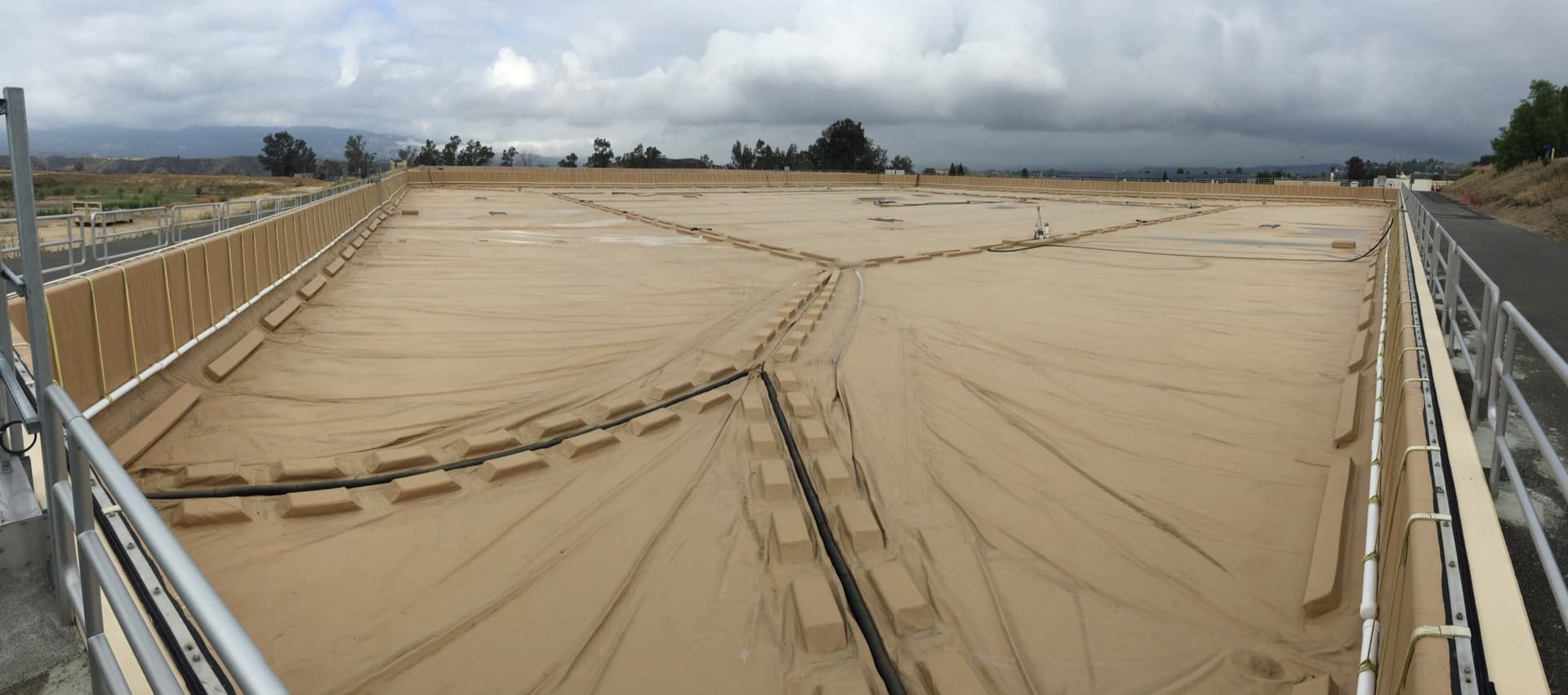
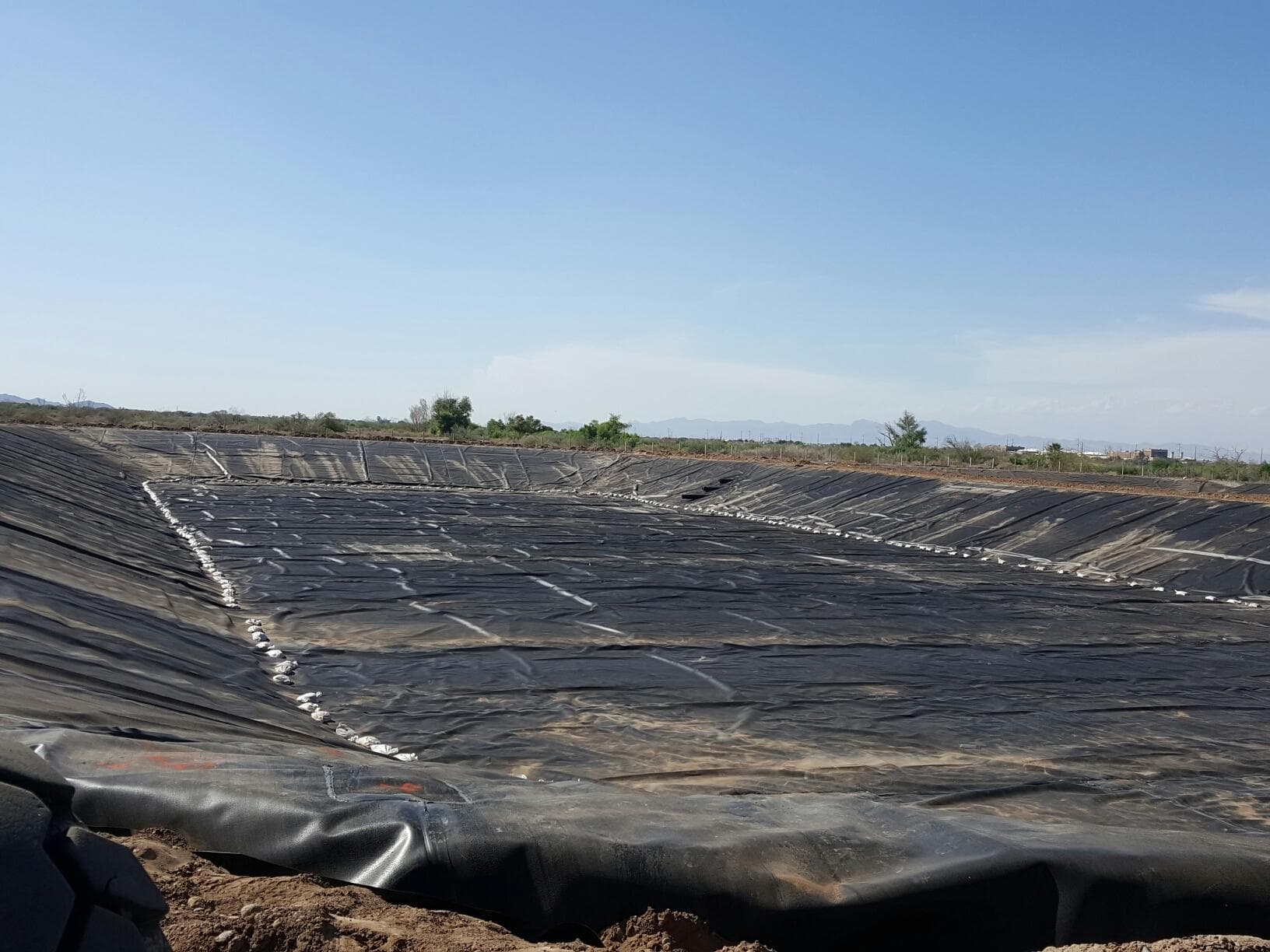
The choice comes down to how long the tanks stay. For a few weeks of storage, a shop-built portable berm is placed in hours, holds one or two tanks, and moves when they move. When tanks stay for a season or longer, a graded earthen or concrete berm lined with a drop-in or field-welded geomembrane gives more volume per square foot, stands up better to traffic, and can be inspected as a permanent structure.
Material follows the liquid. XR-type ethylene interpolymer alloy membranes are the common specification for fuel and hydrocarbon service. HDPE, the usual geomembrane in landfill base liners, handles leachate, and reinforced polypropylene covers water and many aqueous chemistries. Reinforced sheet adds the tear and puncture strength that wheel loads demand. Every selection should be confirmed against the manufacturer's chemical resistance data for the actual stored liquid.
Where EC Applications fits
EC Applications fabricates portable containment berms, drop-in secondary containment liners, and collapsible bladders in its own shop, with single panels up to 25,000 square feet, and field-installs lined berms where a site needs permanent containment. Crews work from Anaheim, California, Midland, Texas, and Sparks, Nevada.
The hard part of frac tank containment is rarely the liner itself. It is the sequence: grade, cushion, liner, protection, then tanks set and trucks in without a skid dragged across the floor. Getting that order right on the first day is what keeps the containment tight for the months that follow. Our crews are the most experienced in the industry. They consistently deliver high quality installations with unparalleled customer service.