On this page
Every uncovered finished water reservoir in the United States had to be covered, treated, or operating under a state-approved schedule by April 1, 2009. The deadline came from the Long Term 2 Enhanced Surface Water Treatment Rule, published in January 2006. The covers that went on to meet it are seventeen years old this year.
That arithmetic is most of what has happened to the floating cover market since. A large share of the potable water covers in service went in as one compliance wave, which means they are aging toward the end of their design lives on roughly the same schedule. Utilities that have never bought a floating cover are finding out they already own one, and that it is closer to replacement than to new.
What the rule actually required
Systems storing treated water in open reservoirs were given three ways to comply. Cover the reservoir. Treat the reservoir discharge to inactivate 4-log virus, 3-log Giardia lamblia, and 2-log Cryptosporidium. Or get on a state-approved schedule to do one of those two.
Most systems covered. Treating a discharge means building a second treatment step on finished water and running it forever, with the operating cost and the operator hours that carries. A cover is a capital project with a maintenance tail, and it closes the exposure pathways that put open finished water storage in the rule to begin with: bird and animal waste, human activity around the basin, insects, airborne deposition, and the sunlight that drives algae growth in stored treated water.
The replacement clock
A floating cover does not fail on a date. It ages out of its design life, and on a potable reservoir the consequence of running past that point is contamination of stored drinking water rather than a slow decline in performance.
The cover EC Applications replaced at El Dorado Irrigation District was around 30 years old and had exceeded its useful design life. The second fact is the one that condemned it. For a utility building a capital plan that distinction sets the budget year: track the rated life against the cover's observed condition, and treat calendar age as background.
A second cover is a harder job than the first
When the original cover went on, the basin was usually empty and either new or recently rehabilitated. A replacement happens on a structure that has been in service for decades, inside an outage window the utility has to schedule around system demand, with a base liner underneath whose real condition nobody can confirm until the cover comes off.
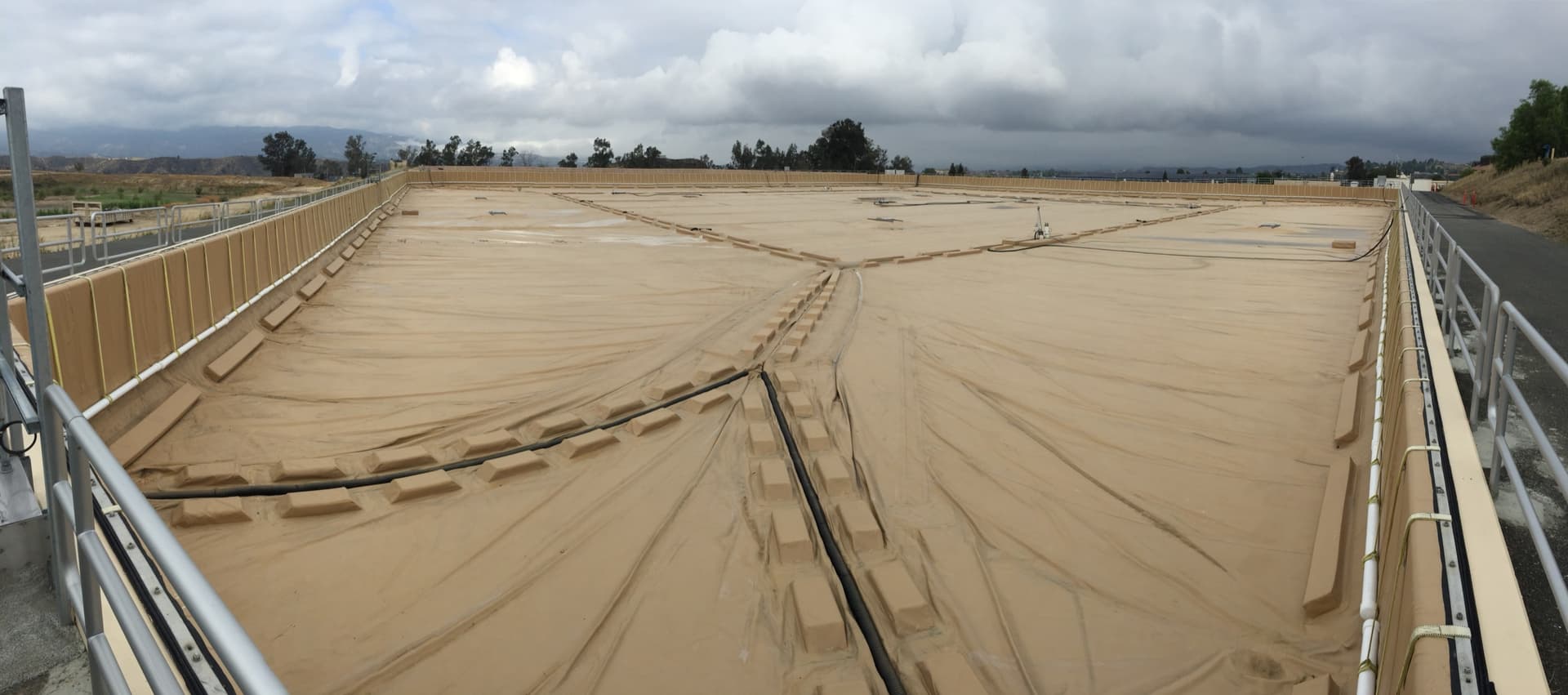
That uncertainty drives the scope. At El Dorado the work was a base liner and a floating cover on a reservoir just under two acres, and it took just under four acres of geosynthetics. The base liner runs the floor, climbs every side slope, and terminates in an anchor at the top of the embankment. The cover carries deliberate slack so it can float through the full operating range and still hold a fixed perimeter. Plan area is the wrong number to estimate from.
The outage is also the only time the liner under that cover is reachable. A utility that replaces the cover and leaves an aging liner in place has spent the expensive part of the shutdown and kept the risk it was trying to retire.
The other half of the market never touches drinking water
Raw water storage buys covers for a different reason. Across the arid West that reason is evaporation, and the depths involved are large enough to carry a capital project without any regulatory push behind them.
USGS measured evaporation at Lake Mead by eddy covariance from March 2010 through February 2012 and recorded 81.65 inches in the first year and 74.07 inches in the second. Design work on smaller reservoirs still leans on NOAA Technical Report NWS 33, the 1982 free water surface evaporation atlas by Farnsworth, Thompson, and Peck, which maps annual free-water evaporation across the contiguous states. Over much of the Southwest those maps put an open pond several feet of depth a year into the air.
Continuous geomembrane covers and modular floating elements are not interchangeable here, and the published field work shows the gap. Floating discs, spheres, and lattice modules suppress evaporation by roughly 65 to 80 percent, because water keeps evaporating through the spaces between elements. A continuous membrane anchored at the perimeter removes the free water surface rather than shading it. For an operator whose water right or process makeup is the binding constraint, the distance between 70 percent and effectively all of it is the entire decision.
What the material choice locks in
Potable water service inverts the usual order of liner selection. On a containment pond you start from the exposure and the mechanical demands, pick a material that meets them, then confirm compatibility with what is stored. On a finished water reservoir you start from the short list of materials approved for drinking water contact and ask which of those can also take decades of direct UV on a floating surface.
At El Dorado the answer was Seaman's XR-PW, specified for the primary liner, the cover, and all of the appurtenances. Running one material through all three makes every joint in the system a weld between identical sheets, made with one welding procedure and checked against one set of trial weld criteria. Hatches, vents, sumps, and perimeter terminations close with a heat weld instead of a mechanical seal, and they weather at the same rate as the sheet they interrupt.
Re-weldability belongs in that evaluation and rarely appears on a submittal table. A floating cover is a maintenance item for its entire service life. It gets walked during inspections, it takes storm and debris damage, and it gets modified whenever the utility changes something below it. If the sheet cannot be re-welded after it has weathered, every one of those repairs falls back on a patch system that ages on a different curve than the cover around it.
Planning around the clock
If you operate a covered finished water reservoir, carry the cover as a capital replacement item on a design-life clock rather than a maintenance line. Get a condition assessment while the failure mode is still seepage and wear, then set the outage on your own schedule instead of an emergency one. Once the basin is drained, do the liner, the appurtenances, and the cover in the same window, because the next chance is another service life away.
On raw water the math is simpler. Put the annual evaporation depth for your location against the surface area and the delivered value of the water. The cover either pays or it does not, and in the Southwest it usually does.
EC Applications fabricates and installs floating covers and reservoir liners from its headquarters in Anaheim, California, with offices in Midland, Texas, and Sparks, Nevada, holding California contractor licenses CSLB #894068 and CSLB #1003207. Panels are shop-fabricated in sizes up to 25,000 square feet before crews mobilize, which moves most of the seaming off open water and shortens the field schedule.