On this page
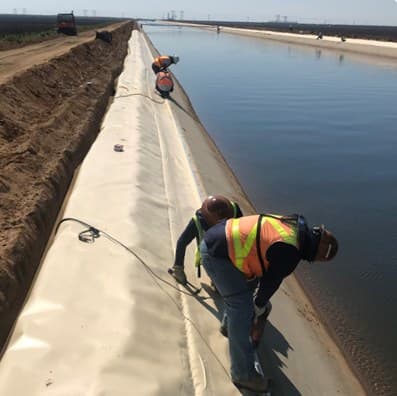
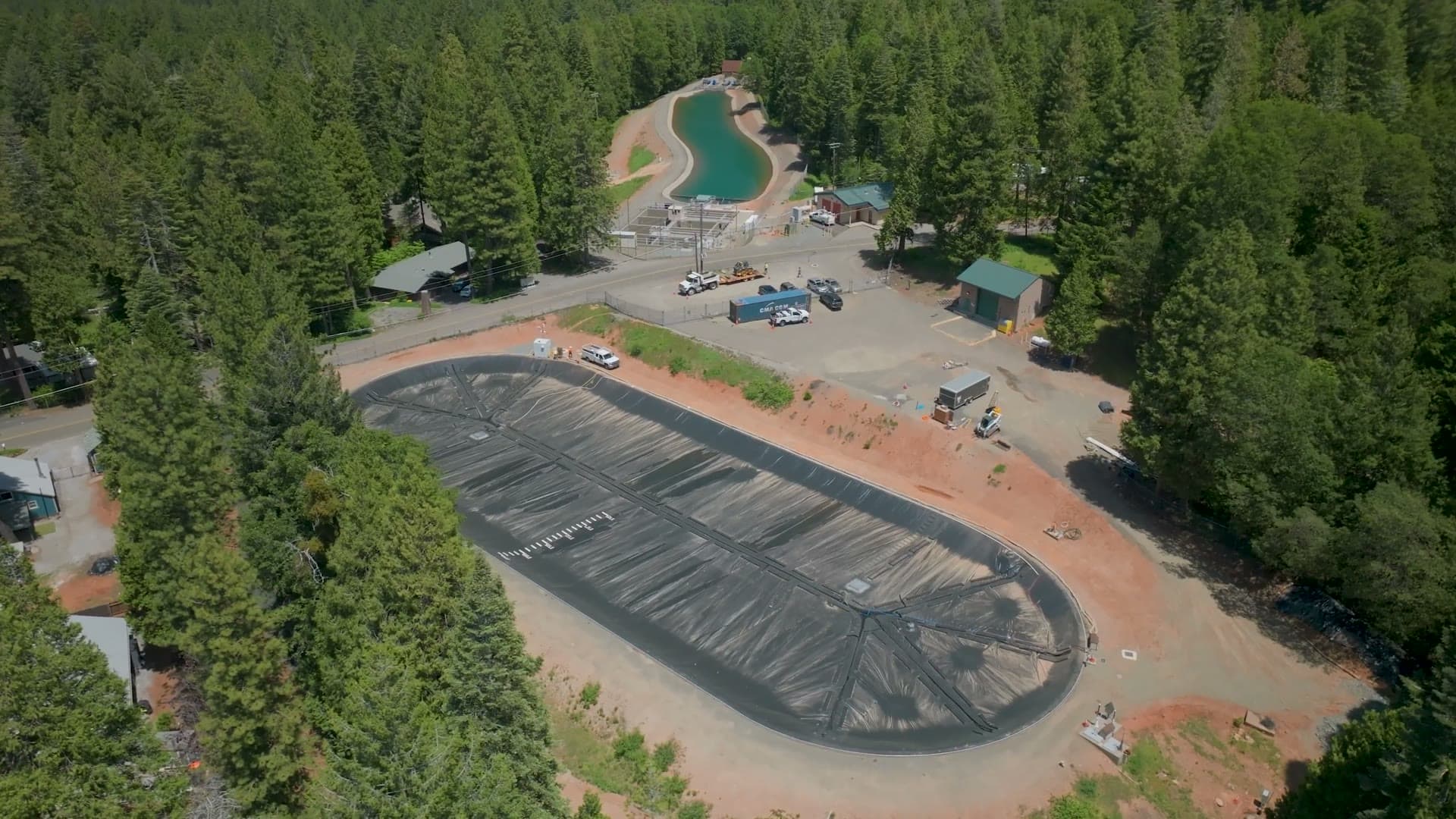
The floating cover on a potable water reservoir at El Dorado Irrigation District was some 30 years old, had exceeded its useful design life, and was in urgent need of repair to keep the stored drinking water from being contaminated. EC Applications installed the replacement system: base liner and floating cover on a reservoir just under two acres in size, just under four acres of geosynthetics in total. Carollo Engineers was the design engineer and carried out the detailed design, working with Seaman Corporation on material selection and with EC Applications on construction.
Four acres of material on a two-acre reservoir
The two numbers look inconsistent until you count what actually gets lined. The base liner does not stop at the water surface. It runs the floor, up every side slope, and out to an anchor at the top of the embankment, so on a reservoir with meaningful side slopes the wetted and anchored area is well above the plan area of the water.
The cover adds the second layer. A floating cover is not cut to the exact surface area either, because it has to accommodate the water level moving up and down beneath it and still terminate at a fixed perimeter. The slack is part of the design. Between a liner that wraps the basin and a cover that has to float through the operating range, a two-acre reservoir becomes a four-acre geosynthetics job, and that is the number that governs schedule, seam footage, and testing.
One material for the liner, the cover, and the appurtenances
Seaman's XR-PW was chosen for all of it.
- The primary liner system
- The floating cover
- All of the appurtenances
Specifying one material across all three is a decision with consequences in the field. Every joint in the system becomes a weld between identical sheets, made with one welding procedure, checked against one set of trial weld criteria. Nobody has to work out how a cover material bonds to a different liner material at the perimeter, and there is no dissimilar-material transition to detail with clamps or adhesives where the two meet.
That matters most at the appurtenances. Hatches, vents, sumps, and perimeter terminations are where a covered reservoir gets complicated, because each one interrupts a continuous sheet. When the appurtenance is fabricated from the same material as the sheet it interrupts, the detail closes with a heat weld instead of a mechanical seal, and it ages at the same rate as everything around it.
What NSF approval does to material selection
XR-PW is one of only a few products carrying NSF approval for potable water use, and on this reservoir that constraint came first. The liner is in continuous contact with finished drinking water across the whole floor and slopes. So is the underside of the cover. There is no part of the system that water does not touch.
This inverts how liner selection usually runs. On a containment pond you start from the exposure and the mechanical demands, pick a material that meets them, then confirm compatibility with whatever is stored. On potable water you start from the short list of materials approved for drinking water contact and then ask which of those can also handle 30 years of UV exposure on a floating cover, weld reliably in the field, and hold dimension under wind and water movement. The approved list does the first cut, and it is not a long list.
Welds you can make again in twenty years
The property that carried the most weight on this job is one that does not show up on a submittal table. XR-PW seams efficiently at the time of original installation and can be re-welded throughout the life of the reservoir using the same heat welds used for routine repairs. Day one and year 20 use the same tool and the same procedure.
A floating cover on an active reservoir is a maintenance item for its entire service life. It gets walked on during inspections, it takes storm and debris damage, and it gets modified when the utility changes something about the structure below. Every one of those events is a repair. If the material cannot be re-welded once it has weathered, those repairs fall back on patch systems that rely on adhesives or mechanical clamping. Each patch is then its own detail with its own life expectancy, and twenty years of that leaves a cover made up of dissimilar repairs.
A re-weldable sheet keeps the repair identical to the original construction. The crew that fixes a tear in year 20 makes the same weld the install crew made, and the repaired area is the same material and the same joint as the sheet around it. On an asset a utility intends to run for decades, re-weldability belongs in the design-life column.
Three parties, one material decision
The material call was made jointly. Carollo Engineers carried the detailed design and worked with Seaman Corporation on selection and with EC Applications on construction, so the constructability of the choice was on the table while the choice was still open.
“We worked with Seaman on the material selection and ECA on the construction. We wanted a robust material that would last a very long time and give a good return to EID.”
Peter von Bucher, Vice President, Carollo Engineers
Involving the installer during selection is what keeps a specified material from becoming a field problem. Weld window, panel size, how the sheet behaves on a slope in the heat, and how a boot gets built around a penetration are all installation questions that get answered better before the material is locked than after.
The trigger is design life, not age
The old cover was around 30 years old, but age is not what condemned it. It had exceeded its useful design life, and the consequence of that on a potable reservoir is contamination of stored drinking water rather than a slow loss of performance. Those are different risk profiles and they call for different replacement timing.
For a utility running a covered reservoir, that changes what to watch. Track the cover against its design life and its observed condition rather than a replacement year on a spreadsheet, and plan the outage while the failure mode is still seepage or wear. When the outage does come, the basin is drained and accessible, which is the cheapest time the liner underneath will ever be reachable. Every year after commissioning is a maintenance year, so specify a material you will still be able to weld in year 20.
“The installation is performing quite well. The owner and the engineer are both thrilled with the final product.”
Chris Fore, Vice President, EC Applications
EC Applications is a geosynthetics installation contractor that self-performs liner and floating cover work, headquartered in Anaheim, California, with offices in Midland, Texas, and Sparks, Nevada, and holding California contractor licenses CSLB #894068 and CSLB #1003207.