On this page
The Friant-Kern Canal carries water 152 miles down California's eastern San Joaquin Valley. Decades of groundwater pumping caused the land beneath a stretch of it to sink, and a canal that sinks does not simply move down evenly. It loses grade. By the time the problem was fully characterized, subsidence had reduced the canal's carrying capacity by as much as 60 percent in certain areas.
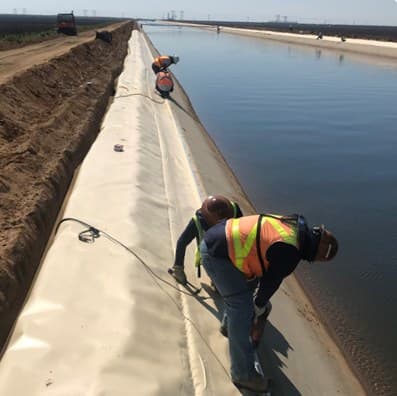
As part of the 2018 Friant-Kern Canal Geosynthetic Supply and Installation Project in Visalia, California, EC Applications installed 160,000 square feet of 45 mil reinforced polypropylene liner. The work was completed in 2023 and supported the Friant Water Authority and the U.S. Bureau of Reclamation in executing a multi-phase repair plan, aimed at mitigating water loss and preparing the canal for more extensive rehabilitation.
Why subsidence is a lining problem
An unlined or degraded canal loses water two ways. Some soaks into the bed and banks, which is seepage loss, and some is simply never delivered because the channel can no longer carry design flow. Subsidence causes the second problem directly: the canal's invert elevation changes relative to its delivery points, and flow that depended on gravity no longer arrives.
Lining does not fix grade. What it does is remove seepage from the equation while the larger civil work proceeds, and it protects the repaired section from the erosion that accelerates when a channel is operating outside its design condition. On a canal that has to stay in service through a multi-year rehabilitation, that distinction is the whole reason a liner goes in early rather than last.
Why reinforced polypropylene
Reinforced polypropylene carries a scrim inside the sheet, so its strength comes from the reinforcement rather than from thickness alone. That is why a 45 mil rPP sheet performs where a far thicker unreinforced sheet would be the wrong answer. Three properties matter on canal work specifically.
- It stays flexible across a wide temperature range, which matters on long exposed runs in the San Joaquin Valley where surface temperatures swing hard between day and night.
- It can be shop-fabricated into large panels and folded for transport, moving most of the seaming off the jobsite and cutting the number of field welds that need destructive testing.
- It tolerates the differential movement that a subsiding foundation keeps imposing, where a stiffer, more stress-crack-sensitive sheet would be working against the site.
On a canal with active subsidence, choosing a material that accommodates movement rather than resisting it is not a preference. It is the design condition.
Working on infrastructure that stays in service
A canal repair is scheduled around water deliveries, not around the contractor. Work windows are set by when the reach can be dewatered without cutting off the districts downstream, which means the schedule is short, fixed, and unforgiving. Panel layout, material staging, and crew size all get planned backward from the date the water comes back.
It also means the work is coordinated across federal, state, and local agencies at once. The Bureau of Reclamation owns the facility, the Friant Water Authority operates it, and the water districts it serves have their own delivery obligations. Getting a single installation standard agreed and then met across that group is a real part of the job, and it is the part that does not show up in a square footage number.
What we would tell an owner planning similar work
- Settle the material before bidding. rPP, HDPE, and LLDPE draw different bidder lists and different prices, and on a subsiding foundation the choice is a design decision rather than a cost decision.
- Plan the schedule from the water delivery date backward, and make the dewatering window a contract term rather than an assumption.
- Define subgrade acceptance in writing. On a channel that has moved, what counts as an acceptable surface is exactly the thing that will be argued about later.
- Require the full seam testing record as a deliverable. On federal facilities it becomes part of the permanent project file, and reconstructing it at closeout is far more expensive than collecting it as you go.
Friant-Kern is aging water infrastructure that has to keep delivering while it is being repaired. That is the common case on American canals, reservoirs, and conveyance systems, and it is the condition most liner work on public water infrastructure now has to meet.