On this page
The Jefferson Reservoir is an 8-million-gallon concrete structure, roughly 30 feet tall and 220 feet in diameter, holding treated water for the City of Wenatchee, Washington. To address maintenance needs, the City engaged EC Applications to work with a contractor to install 50,000 square feet of 45 mil reinforced polypropylene bottom liner, secured to the concrete with a batten bar attachment system. The work was completed in 2025.
Lining an existing concrete reservoir is a different trade from lining an earthen basin, and most of what makes it hard has nothing to do with the geomembrane.
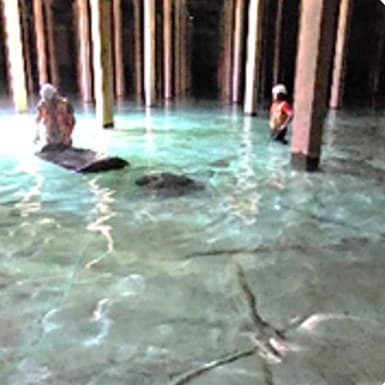
Everything happens inside a confined space
A covered concrete reservoir with limited access points is a permit-required confined space. That single fact reshapes the whole job. Crews enter under confined space entry protocols, with ventilation running, safety spotters posted at access points, and communication maintained continuously so anyone inside can be located and reached. Personal protective equipment includes hard hats, harnesses, gloves, and respiratory protection as conditions require.
Practically, this caps how many people can be productive at once and it lengthens every cycle. Material has to be lowered in. Equipment has to be lowered in. Crews rotate. A production rate that would be routine in an open basin does not transfer, and an installer who bids the job at open-field rates will either lose money or start cutting the protocols that make it safe. It is worth asking bidders directly how they staged a comparable confined space job.
Across 2022, 2023, and 2024, over roughly 596,000 hours worked, EC Applications recorded zero fatalities, zero lost work day incidents, and zero lost work days. Confined space work is where that record either holds or does not.
The substrate decides the schedule
Before any panel goes down, the concrete gets inspected for debris, standing moisture, and surface irregularities. On an earthen subgrade a problem area can be reworked with equipment already on site. On concrete the remedies are different and slower, and every one of them sits on the critical path because nothing can be deployed over an unaccepted surface.
This is the clearest argument for a written subgrade acceptance signed before deployment, per area. It takes minutes and it settles in advance the single most common contractual dispute on liner work: who accepted the surface, and when.
Why a batten bar system
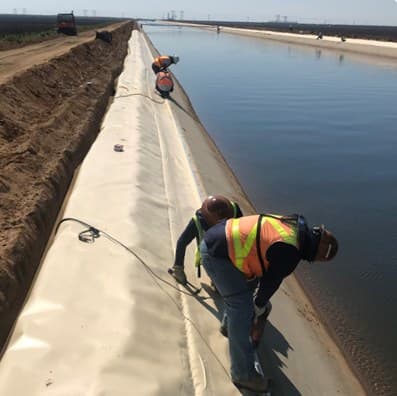
In an earthen basin, a liner is terminated in an anchor trench: the sheet runs up the slope, into a trench, and gets buried. A concrete tank has no trench to dig. The termination has to be mechanical, and a batten bar system is the standard answer. The membrane is clamped against the concrete by a bar bolted through it, with a sealant behind the seal line, so the load transfers into the structure through hardware rather than through friction and soil weight.
Two consequences follow. The termination detail becomes a structural connection, so anchor embedment, bar spacing, and bolt torque all matter and all get inspected. And on reinforced sheet, the batten detail is designed to load the internal scrim rather than bare membrane, which is one more reason reinforced polypropylene suits this application better than an unreinforced sheet of similar thickness.
Potable water changes the material shortlist
When the stored fluid is drinking water, the membrane has to carry the appropriate potable water approval, and that requirement narrows the field considerably before any other criterion is applied. It is the first question to settle on a potable project, not the last, because it determines which products can even be bid.
What an owner should plan for
- Treat confined space entry as a schedule driver rather than a safety line item, and ask bidders how they staged a comparable job.
- Inspect and formally accept the concrete before deployment, in writing, area by area.
- Settle the potable water approval requirement before bidding, since it decides the material shortlist.
- Detail the batten bar termination as a structural connection, with embedment, spacing, and torque specified and inspected.
- Plan the outage around the reservoir's role in the distribution system. On a single-reservoir system the outage window, not the liner, is the constraint.
Municipal storage is aging across the country, and most of it has to be rehabilitated while the system keeps delivering. Getting the confined space plan, the substrate acceptance, and the termination detail right in advance is what keeps that kind of work inside its window.