
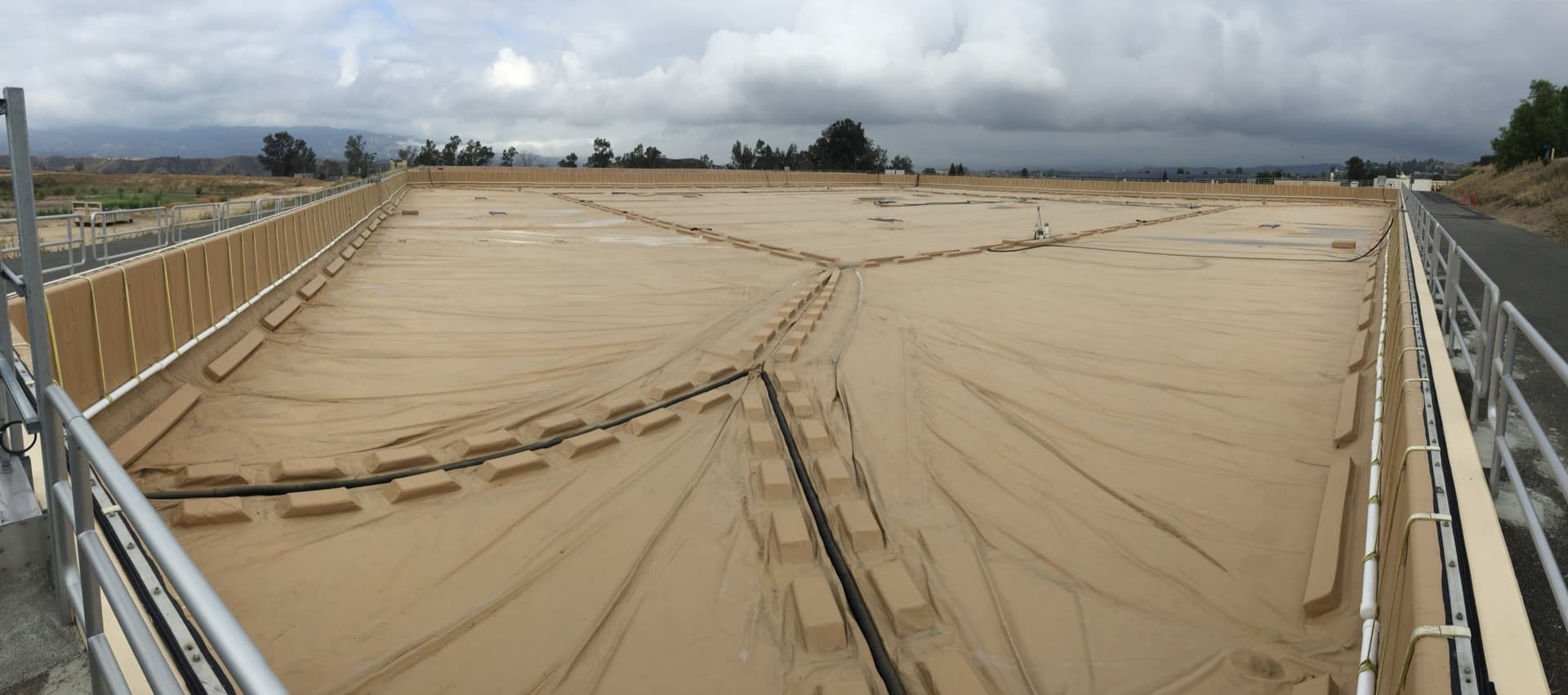
Floating Cover Installation
Floating covers are geomembrane systems installed on the surface of ponds, lagoons, digesters, and reservoirs to protect stored water, capture biogas, and control evaporation, odor, and algae. EC Applications fabricates, installs, and maintains floating covers for potable water storage, chemical containment, and biogas collection, delivered as a single design-to-construction-to-maintenance service from offices in California, Texas, and Nevada.
Leer esta página en EspañolFloating-cover replacement starts with the operating plan
El Dorado Irrigation District's November 10, 2025 board record identifies an October 14 construction-contract award to EC Applications for the Reservoir 1 Floating Cover Emergency Replacement, project 25040.01. The record establishes the awarded work; it does not establish completed installation or operating performance.
Source: EID board record, consent item 3, November 10, 2025.
Read the Reservoir 1 award record (PDF)A detail to resolve before installation
A replacement scope needs the existing membrane, anchorage, floats, sumps, and penetrations identified before fabrication. ECA's floating-cover capability document lists defined-sump, cable-tensioned, and pressure-dome systems. Establish the operating liquid levels and rainwater or gas-handling duty before choosing the configuration; a material name alone does not define the cover.
Coordinate the cover with reservoir liningWhat to send for a quote
Send the site location, basin plan, operating level range, cover duty, specified membrane, and attachment drawings. For replacement work, include inspection photos, removal responsibilities, staging space, and the available outage window. EC Applications serves projects nationwide.
Agree on the handoff records
Define the required seam and repair records, as-built attachments and penetrations, and maintenance instructions in the bid scope. Identify who checks drainage or gas collection and who authorizes return to service. Use the worksheet to assign each responsibility before mobilization.
Discuss this installationWhat problems does a floating cover solve?
A floating cover isolates the liquid surface from sunlight, air, wildlife, and rainfall, which addresses several problems at once: evaporation loss, algae growth, odor emissions, heat loss, and contamination of stored water. On anaerobic lagoons and digesters, the same membrane becomes a gas collection surface that captures biogas instead of venting it to atmosphere.
For potable water utilities, a cover keeps birds, debris, and airborne contamination out of finished water and blocks the sunlight that drives algae blooms and disinfection byproduct chemistry. For industrial and agricultural operators, covers control odor at the source, retain process heat, and preserve water inventory in evaporation-prone climates. Because a floating membrane rides on the liquid itself, it works at any water level and is typically far less expensive than building a fixed roof over the same footprint.
EC Applications has installed floating covers across this full range of duties: potable water storage, odor control, biogas collection, chemical containment, evaporation control, heat loss prevention, liquid and semi-solid storage, and algae control.
Which materials are used for potable water, chemical, and biogas covers?
Material selection follows the duty. Potable water covers are built from membranes rated for drinking water contact, most commonly CSPE (Hypalon) and CoverFlex, both proven over decades of reservoir service in direct sunlight. Chemical containment covers use XR Geomembrane, an ethylene interpolymer alloy with high resistance to hydrocarbons and aggressive liquids. Biogas and wastewater covers are typically reinforced polypropylene, HDPE, or reinforced polyethylene, selected for weld quality, gas tightness, and resistance to the sulfur compounds in digester gas.
EC Applications has extensive experience installing CSPE (Hypalon), XR Geomembrane, reinforced and unreinforced polypropylene, CoverFlex, reinforced and unreinforced polyethylene, and HDPE covers. Because large custom panels are fabricated in controlled conditions before crews mobilize, most seaming happens in the shop rather than over open water, which improves seam quality and shortens the field schedule.
How does a biogas collection cover work?
A biogas collection cover seals the surface of an anaerobic lagoon or digester so the methane-rich gas produced by digestion collects under the membrane instead of escaping. The cover is anchored at the perimeter, and gas rises to collection points where piping draws it off to a flare, boiler, or gas conditioning system. Float and ballast networks on the cover manage where gas accumulates and keep the membrane geometry stable as gas production and liquid level change.
Pressure dome covers take this further: the membrane is inflated by the gas itself into a dome that provides storage volume and steady delivery pressure to downstream equipment. EC Applications installs both flat gas collection covers and pressure dome covers, including the anchor trenches, gas piping penetrations, and condensate management details that determine whether a biogas cover performs over its service life.
What floating cover configurations are available?
EC Applications provides complete solutions for three principal configurations. Defined sump covers use a network of floats and weights to create engineered channels that direct rainwater to sump pumps, the standard approach for potable water reservoirs where stormwater must be removed from the cover surface. Cable tensioned covers use tensioning cables to hold the membrane in a controlled geometry, suited to ponds with fluctuating levels or irregular shapes. Pressure dome covers are gas-inflated structures used for biogas collection and storage.
Configuration is chosen during design based on what the cover must do: manage rainwater, track a moving liquid level, or store gas. Getting this right up front, along with anchorage details and access provisions for maintenance crews, is most of what separates a cover that lasts decades from one that fails early.
What maintenance does a floating cover need?
A floating cover needs routine, scheduled attention: inspection of seams, boots, and perimeter anchors, removal of accumulated rainwater and debris, verification that floats and ballast remain positioned, and checks of sump pumps and gas piping. On potable water covers this is not optional, state and government regulations require documented inspection and maintenance of covered reservoirs.
In addition to installing floating covers, EC Applications provides routine maintenance to keep covers in compliance with those regulations. That allows plant staff to focus on operations while the cover is inspected, repaired, and documented by the same professionals who build these systems. With sound design and consistent maintenance, floating covers routinely deliver service lives measured in decades, and when a membrane does reach end of life it can be replaced, often reusing the existing perimeter anchorage.
Applications
- Potable water storage reservoirs
- Biogas collection on digesters and anaerobic lagoons
- Odor control
- Chemical containment
- Evaporation control
- Heat loss prevention
- Algae growth prevention
- Liquid and semi-solid storage
- Wastewater ponds and lagoons
Quality assurance
Installation quality is verified against the project specification using the applicable ASTM and GRI test methods, with documented QA records at handoff.
Materials we install
- CSPE (Hypalon)
- XR Geomembrane
- polypropylene
- HDPE
- CoverFlex
Why ECA for this work
- Two CSLB-licensed entities: California licenses #894068 and #1003207.
- In-house specialty fabrication shop for prefabricated panels and custom geosynthetic products.
- Offices in Anaheim, California; Midland, Texas; and Sparks, Nevada, serving sites nationwide.
Material and system specifications
| Material | Typical duty | Why it is selected |
|---|---|---|
| CSPE (Hypalon) | Potable water storage | Decades of proven UV performance in exposed reservoir service, drinking water contact |
| CoverFlex | Potable water storage | Flexible reinforced membrane suited to defined sump potable covers |
| XR Geomembrane | Chemical containment | Ethylene interpolymer alloy with high chemical and hydrocarbon resistance |
| Reinforced polypropylene | Water, wastewater, prefabricated covers | Scrim reinforcement and large factory-fabricated panels with broad chemical resistance |
| HDPE and reinforced polyethylene | Biogas and wastewater covers | Weldable, gas-tight, and resistant to digester gas constituents |
How the work gets done
- 1
Design and material selection
Define the cover duty (potable, chemical, biogas), select the membrane and configuration, and engineer floats, ballast, sumps, and perimeter anchorage.
- 2
Fabrication
Fabricate large custom panels under controlled shop conditions so the majority of seams are factory welds rather than field welds over water.
- 3
Deployment and field seaming
Deploy panels across the pond or reservoir, complete field seams, and install float and ballast networks, boots, and penetrations.
- 4
Anchorage and testing
Secure the perimeter anchorage, install sump and gas collection hardware, and test seams and penetrations before the cover goes into service.
- 5
Maintenance program
Provide routine inspection, rainwater and debris management, and documented repairs to keep the cover compliant with state and government regulations.
Frequently asked questions
More of what we install
Ready to scope your floating covers project?
Our crews handle engineering, fabrication, field installation, and maintenance. Tell us about your site and we will scope it with you.