
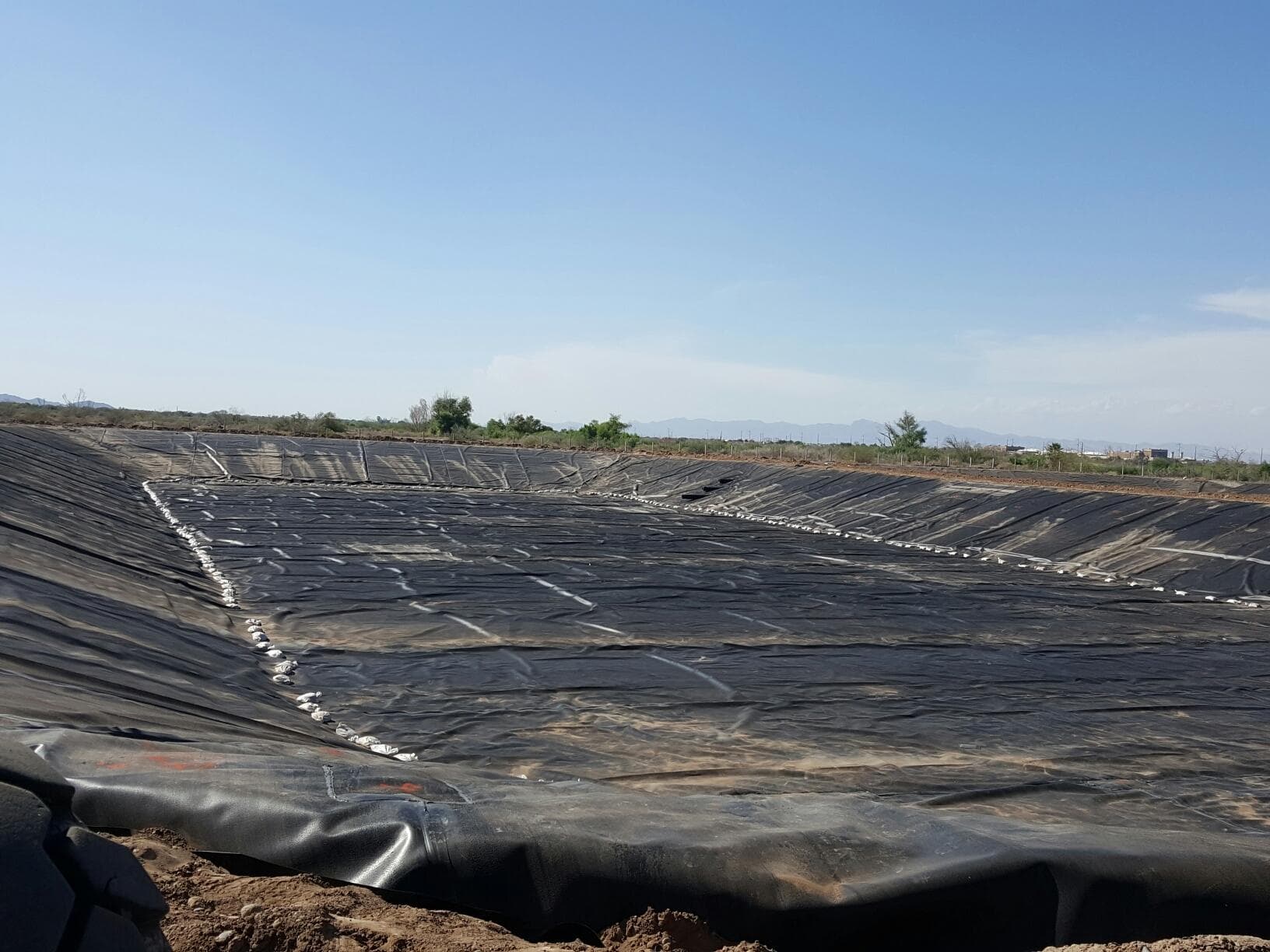
Heap Leach Pad Liner Installation
A heap leach pad liner is the engineered geomembrane system that contains process solution under a heap leach operation, protecting groundwater while routing metal-bearing solution to recovery. EC Applications installs and maintains mining liner systems for heap leach pads, tailings impoundments, solution channels, evaporation and solution ponds, floor sumps, and tanks, working with smooth and textured HDPE and LLDPE, reinforced polypropylene, XR geomembranes, GCL, PVC, geotextiles, GeoNet, and geocomposites.
Heap leach pad experience with the full liner section
ECA's May 2025 relevant-experience form lists the Mooney HLP Expansions in Ely, Nevada, for KG Mining. It records supply and installation of HDPE and geosynthetic clay liner, with start and completion dates from August 2022 to January 2023. The reference covers installation scope; it does not report recovery performance.
Source: EC Applications qualifications package, May 6, 2025, Attachment 6, GCL relevant-experience form.
Request a reference for your mining liner scopeA detail to resolve before installation
Review the specified barrier and drainage layers together with the overliner sequence. AGRU's HDPE guidance calls for trial welds, production seam testing before covering, and retesting repairs. Set an inspection hold point before the next trade covers the liner. The approved design must settle material compatibility, loading, and slope interfaces for the actual mine.
Read AGRU guidance on HDPE field installationWhat to send for a quote
Send the mine location, phase boundaries, liner section, process solution data, slopes, sumps, and channel drawings. Identify tie-ins to older liner, access restrictions, the overliner schedule, and the CQA plan. ECA supports mining liner installation nationwide.
Agree on the handoff records
Specify material traceability, panel and seam maps, trial-weld and production-test records, and the repair register. Agree on who releases each phase for overliner placement and how installer QC records enter the independent CQA report. Installation records alone do not establish permit acceptance.
Discuss this installationWhat liner system does a heap leach pad use?
A heap leach pad typically uses a composite liner system: a prepared, compacted subgrade or low-permeability soil layer (or a geosynthetic clay liner), a primary geomembrane of smooth or textured HDPE or LLDPE, and an overliner drainage layer with collection piping that carries pregnant solution to lined channels and ponds. The geomembrane is the critical barrier, and its performance depends as much on installation quality as on the material itself.
Textured geomembrane is commonly specified on pad side slopes for interface friction against soil and overliner layers, while smooth sheet is used on flatter floor areas where deployment speed and seam quality govern. LLDPE is often selected where the liner must conform to settlement under ore load; HDPE is favored for chemical resistance to acidic or cyanide process solutions. EC Applications installs both single lined and composite lined systems and coordinates liner work with the earthwork, piping, and overliner contractors so the containment system goes down in the right sequence.
Because a leach pad liner also serves metal recovery, leakage is a production loss as well as an environmental risk. Every gallon of pregnant solution that escapes the pad is metal that never reaches the process plant, which is why leach pad specifications typically carry tighter construction quality assurance requirements than many other containment applications.
How do tailings impoundment liners differ from leach pads?
A tailings impoundment liner is designed for long-term static containment of process tailings and reclaim water, while a leach pad liner is designed for active solution recovery under stacked ore. The tailings liner must survive decades of sustained hydraulic head, consolidation settlement, and eventual closure, so designs emphasize puncture protection, subgrade preparation, and durable seams rather than drainage and recovery.
Tailings storage facilities are frequently lined in phases as the facility rises, which means new geomembrane panels must be tied into liner installed years earlier. That work demands careful surface preparation of the existing sheet, trial welds on the aged material, and seam testing that proves the new-to-old connection performs like a factory seam. EC Applications performs both new construction lining and phased expansions, including raises and lateral expansions on operating facilities.
Material selection also differs. Tailings applications often pair a geomembrane with a geosynthetic clay liner or compacted clay to form a composite barrier, and may add geotextile cushion layers where angular subgrade or riprap could damage the sheet. Where tailings chemistry is aggressive, reinforced polypropylene or XR geomembranes can be specified in place of polyethylene.
How are solution channels, ponds, and floor sumps lined?
Solution channels, trenches, and sumps are lined with the same geomembrane family as the pad they serve, but with details that handle concentrated flow: anchor trenches sized for hydraulic forces, mechanical attachments at concrete structures, and pipe boots welded around penetrations. Pregnant and barren solution ponds, which hold the highest-value and highest-risk liquids on site, are commonly built as double lined systems with a leak detection layer (GeoNet or geocomposite) between primary and secondary geomembranes so any leakage through the primary liner is captured and measured.
Floor sumps and tank containment bring the liner into contact with concrete, steel, and constant mechanical activity. EC Applications installs mechanical attachments, batten systems, and concrete protective liner (CPL) where the geomembrane must terminate against or protect hard structures. Evaporation ponds and event (storm) ponds round out the site water balance and are lined to the same standard so upset flows stay contained.
Floating covers can be added to solution and evaporation ponds to limit evaporation of process solution, keep wildlife out of cyanide-bearing water, and control dilution from precipitation. ECA installs floating cover systems as part of its mining containment scope.
What QA and seam testing protects a mining liner?
Mining liner installation is governed by a construction quality assurance (CQA) program: trial welds qualify each welder and machine before production seaming, every fusion seam is nondestructively tested, and destructive samples are cut on a set frequency and tested for seam shear and peel strength. Dual-track fusion seams are pressure tested along the air channel (ASTM D5820), extrusion seams and repairs are vacuum box tested (ASTM D5641), and destructive seam samples are tested per ASTM D6392.
Beyond seams, CQA covers the full installation record: panel placement logs, subgrade acceptance, material conformance testing against the project specification, repair mapping, and as-built panel drawings. On leach pads this documentation is what the operator hands the regulator to demonstrate the containment system was built as permitted.
Good QA protects recovery economics as much as compliance. A leach pad that leaks loses pregnant solution and invites agency scrutiny; a pad with a clean CQA record and tight seams keeps solution in the circuit and the operation in good standing. That is why experienced installation crews and documented seam testing matter more in mining than in almost any other lining market.
Can liners be repaired or expanded on an operating mine?
Yes. Geomembrane liners on operating mines can be repaired, extended, and raised without shutting down the whole facility. Typical work includes extrusion-welded patches over punctures and stress cracks, replacement of weathered panels above the solution line, tie-ins of new pad expansion phases to existing liner, and relining of channels, sumps, and ponds during scheduled maintenance windows.
Heap leach pads in particular are expanded in phases over the mine life as ore reserves grow, and each phase must weld cleanly into the previous one. EC Applications performs phased expansions and repair work on operating facilities and can provide routine liner maintenance to keep sites in compliance with state and federal regulations.
Crews working on operating mine sites complete the site's safety orientation and work under the operator's permitting and access controls. ECA's Sparks, Nevada office positions crews close to the northern Nevada mining districts, with additional support from its California and Texas operations.
Applications
- Heap leach pads and phased pad expansions
- Tailings impoundments and storage facilities
- Solution channels and trenches
- Pregnant and barren solution ponds
- Evaporation ponds
- Storm and event ponds
- Floor sumps
- Tank lining and containment
- Floating covers on process ponds
Material specifications
Quality assurance
Installation quality is verified against the project specification using the applicable ASTM and GRI test methods, with documented QA records at handoff.
Materials we install
- HDPE / LLDPE
- polypropylene
- GCL
- PVC
- geotextiles
- geocomposites
Why ECA for this work
- Two CSLB-licensed entities: California licenses #894068 and #1003207.
- In-house specialty fabrication shop for prefabricated panels and custom geosynthetic products.
- Offices in Anaheim, California; Midland, Texas; and Sparks, Nevada, serving sites nationwide.
Related resources
- Mining containment: heap leach, tailings, and evaporation ponds
- Heap leach pad lining for Nevada mining operations
- Mining liner crews based in Sparks and Reno
- Heap leach pad liners 101: how pad lining works
- Best liner materials for heap leach pads, ranked
- Double-lined solution pond leak detection and action leakage rates
Material and system specifications
| Property | Test Method | Notes |
|---|---|---|
| Thickness | ASTM D5199 | 60 to 100 mil common for leach pads and ponds |
| Tensile properties | ASTM D6693 | Break and yield strength and elongation |
| Puncture resistance | ASTM D4833 | Critical under overliner and ore loads |
| Tear resistance | ASTM D1004 | Resistance to tear propagation |
| Stress crack resistance | ASTM D5397 | Notched constant tensile load test |
| Carbon black content | ASTM D4218 | UV stability for exposed liner |
| Seam shear and peel | ASTM D6392 | Destructive testing of field seams |
How the work gets done
- 1
Subgrade acceptance
Inspect and accept the prepared subgrade, low-permeability soil layer, or GCL before any geomembrane deploys, and document surface condition panel by panel.
- 2
Panel deployment
Deploy geomembrane panels to the approved layout, controlling for wind, temperature, and wrinkles, with textured sheet on slopes where specified.
- 3
Seaming
Weld panels with dual-track fusion equipment, using extrusion welding for details, patches, and pipe boots; qualify every welder and machine with trial welds each shift.
- 4
Seam testing and CQA
Pressure test fusion seams (ASTM D5820), vacuum box test extrusion welds (ASTM D5641), and cut destructive samples for shear and peel testing (ASTM D6392), logging all results.
- 5
Details and attachments
Complete anchor trenches, mechanical attachments to concrete and steel, sump details, and leak detection layers on double lined ponds.
- 6
Documentation and closeout
Deliver as-built panel drawings, seam and repair logs, and material conformance records for the operator's CQA report to the regulator.
Frequently asked questions
More of what we install
Ready to scope your mining project?
Our crews handle engineering, fabrication, field installation, and maintenance. Tell us about your site and we will scope it with you.