
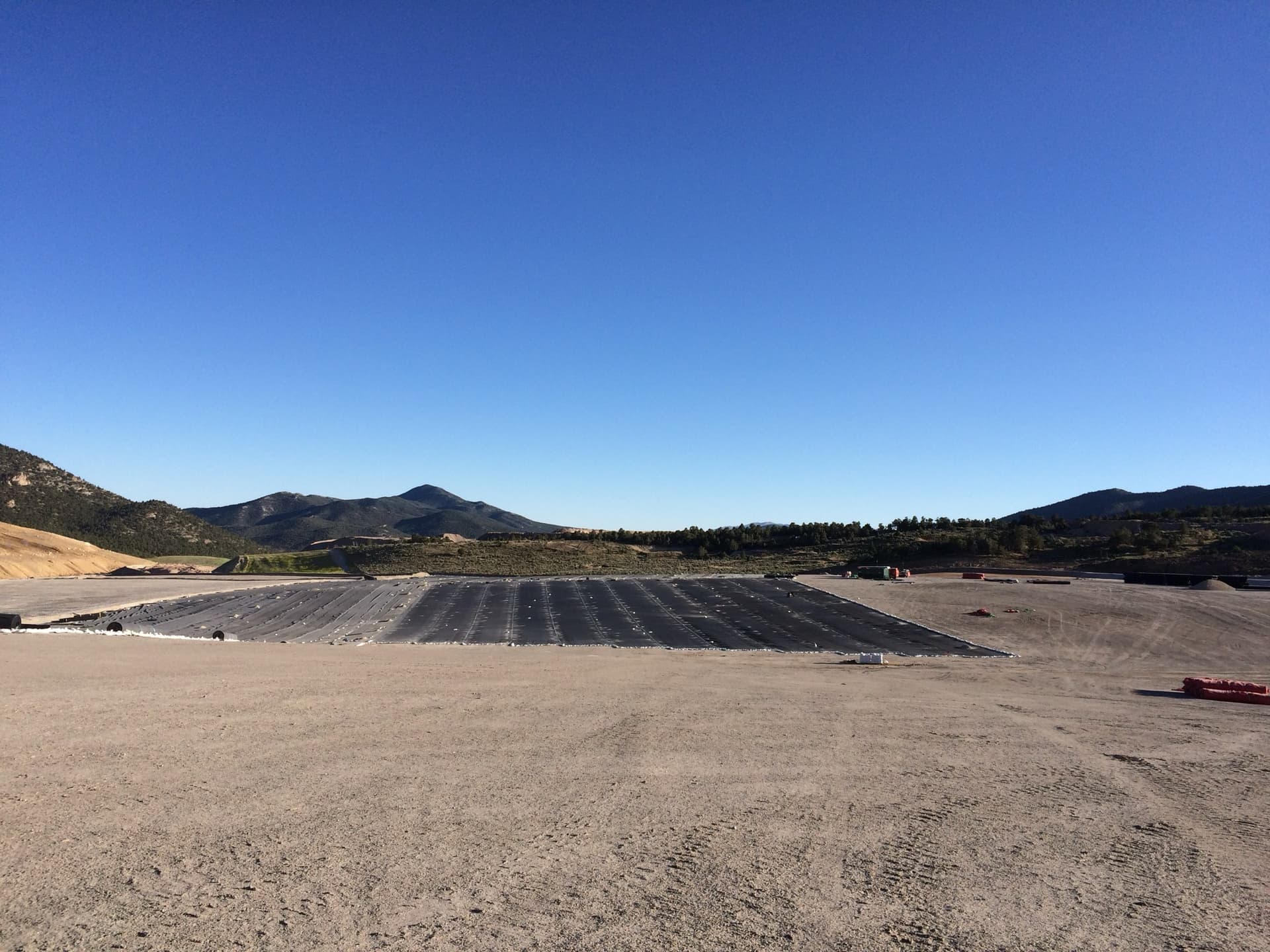
Geosynthetic Erosion Control Installation
Geosynthetic erosion control uses engineered materials, turf reinforcement mats, erosion control blankets, geotextiles, and geocomposites, to hold soil in place on slopes, channels, and embankments until vegetation establishes or permanently where vegetation alone cannot resist the flow. EC Applications installs these systems across California, Texas, and Nevada, and the work is in the company's name: it was founded as Erosion Control Applications, Inc., the entity that still holds California contractor license #894068.
What is geosynthetic erosion control?
Erosion control on a constructed slope or channel is a materials problem: water and wind remove soil faster than vegetation can anchor it, so an engineered layer has to carry the load until roots take over, or carry it permanently where flows are too fast for grass alone. The geosynthetic toolkit for that job includes erosion control blankets that protect seed and soil while vegetation establishes, turf reinforcement mats (TRMs) that stay in the ground and let a vegetated lining resist flows that would otherwise demand rock or concrete, geotextiles that separate and filter under riprap and armor, and geocomposites that drain water out of a slope before it can destabilize the face.
EC Applications installs the geosynthetic side of those designs. Seeding, hydroseeding, and landscape establishment belong to the project's landscape or general contractor; the anchored mats, blankets, fabrics, and drainage layers they depend on are the scope this page covers.
The name on the license
Erosion control is where this company started. EC Applications was founded as Erosion Control Applications, Inc., and that entity still holds California CSLB license #894068 alongside EC Applications, LLC's license #1003207. Decades of erosion-control installation experience sit behind the geosynthetics work the company is known for today, and the same field discipline applies: proper subgrade preparation, correct anchoring and overlap, and terminations that survive the first real storm.
That history matters practically, because erosion control installation fails at the details. A TRM that is not keyed into an anchor trench at the crest lifts in the first high flow. A blanket stapled at the wrong pattern for the slope sloughs with the soil it was meant to hold. Crews that have built these systems for years install them to the manufacturer's anchoring schedule and the project specification, not to habit.
Slope protection and vegetated reinforcement
On cut and fill slopes, embankments, and pond and basin perimeters, the choice runs from temporary to permanent. Degradable erosion control blankets protect the surface for one or more growing seasons and then disappear into the established vegetation. Permanent TRMs remain as a synthetic root zone, raising the shear stress a vegetated surface can take so that grass-lined slopes and spillways can do work that would otherwise require hard armor.
The same logic extends to closure work. A landfill final cover ends in a vegetated soil layer that must resist erosion for the long term, and slope protection over geomembrane-lined grades is part of getting a closure cap to perform. EC Applications installs erosion control layers as part of lined systems it builds, on landfill caps, basin slopes, and reservoir embankments, as well as on standalone erosion control scopes.
Channels, shorelines, and armor underlayment
Drainage channels, ditches, and basin inlets and outlets concentrate flow, and concentrated flow moves soil. Channel linings run from TRM-reinforced vegetation for moderate flows to riprap and structural armor where velocities demand it. Under rock, the geotextile is not optional: a properly selected woven or nonwoven fabric separates the armor from the subgrade and filters water leaving the soil, so the rock does not simply sink into the bank it was placed to protect.
EC Applications installs geotextiles and geocomposites as underlayment for riprap and armor, lines channels with TRMs and blankets, and details the transitions, terminations, and check slots where channel linings actually earn their keep.
Where erosion control meets containment
Most of the company's erosion control work arrives attached to containment: protecting the soil veneer over a lined landfill cap, stabilizing the perimeter slopes of a lined pond or reservoir, armoring the stormwater channels that keep runoff away from a containment system, or dressing the disturbed ground a lining project leaves behind. Handling both scopes with one contractor keeps the interface details, where a mat meets a geomembrane anchor trench, where a channel lining ties into a lined basin, under one responsibility.
Crews mobilize from Anaheim, California; Midland, Texas; and Sparks, Nevada, the same offices that serve the company's lining work across the West.
Applications
- Turf reinforcement mat (TRM) installation on slopes and channels
- Erosion control blankets for vegetation establishment
- Geotextile underlayment for riprap and armor
- Geocomposite drainage for slope stability
- Landfill closure cap erosion protection
- Pond, basin, and reservoir perimeter slopes
- Drainage channel and ditch linings
- Embankment and cut slope protection
- Stormwater basin inlets and outlets
- Erosion protection over lined containment systems
Quality assurance
Installation quality is verified against the project specification using the applicable ASTM and GRI test methods, with documented QA records at handoff.
Materials we install
- turf reinforcement mats
- erosion control blankets
- geotextiles
- geocomposites
Why ECA for this work
- Two CSLB-licensed entities: California licenses #894068 and #1003207.
- In-house specialty fabrication shop for prefabricated panels and custom geosynthetic products.
- Offices in Anaheim, California; Midland, Texas; and Sparks, Nevada, serving sites nationwide.
Material and system specifications
| Material | Typical duty | Permanence |
|---|---|---|
| Erosion control blanket (straw, coir, or blend) | Surface protection while vegetation establishes on slopes | Temporary, degrades over one or more seasons |
| Turf reinforcement mat (TRM) | Vegetated slopes and channels carrying flows beyond what grass alone resists | Permanent synthetic reinforcement |
| Woven geotextile | Separation and reinforcement under riprap and armor | Permanent |
| Nonwoven geotextile | Filtration and cushion under rock and over prepared subgrades | Permanent |
| Geocomposite drain | Intercepting and draining water within a slope or behind a face | Permanent |
How the work gets done
- 1
Review the design
Confirm the specified materials, anchoring schedule, and flow assumptions against the site's slopes, soils, and drainage before mobilizing.
- 2
Prepare the surface
Fine-grade and compact the subgrade and cut anchor trenches and check slots; erosion control materials only perform in full contact with the soil.
- 3
Install and anchor
Deploy blankets, mats, or fabrics with the specified overlaps, staple or pin patterns, and keyed terminations at crests, toes, and edges.
- 4
Detail the transitions
Tie linings into structures, armor, anchor trenches, and adjacent geomembrane systems, the points where erosion starts if left loose.
- 5
Document and hand off
Record materials and coverage for the project file and coordinate with the seeding or landscape contractor taking the surface to final vegetation.
Frequently asked questions
More of what we install
Ready to scope your erosion control project?
Our crews handle engineering, fabrication, field installation, and maintenance. Tell us about your site and we will scope it with you.