
Landfill Liner Contractor
Landfill liners are engineered geomembrane systems that keep leachate and waste out of groundwater and soil. EC Applications installs single-lined and composite-lined cells, closure caps, leachate ponds, and leachate channels for municipal solid waste, hazardous waste, coal ash, CAMU, and canyon fill sites, on both new construction and expansions.
Landfill cell experience across the geosynthetic layers
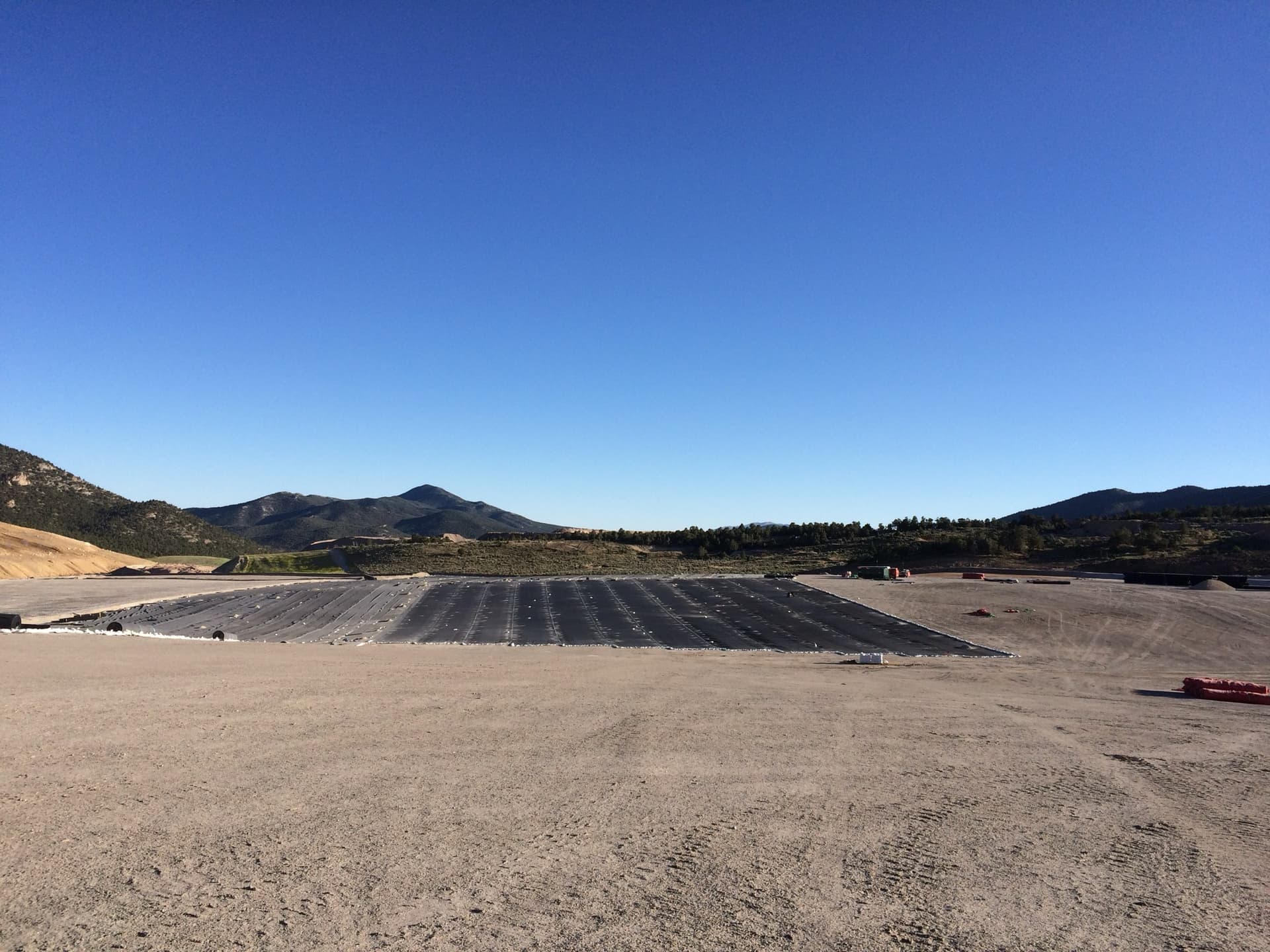
ECA's May 2025 qualifications package lists Western Elite Landfill Cells 22 and 25 in Alamo, Nevada. Its relevant-experience form records supply and installation of HDPE, geocomposite, geotextile, and GCL, with work dated December 2022 to January 2023. This is a cell-lining reference, separate from a closure-cap reference.
Source: EC Applications qualifications package, May 6, 2025, Attachment 6, GCL relevant-experience form.
Los Angeles County Sanitation Districts also names EC Applications as the awardee for its 2022 Calabasas Landfill protective-membrane replacement, project 04000. The specified scope was replacement of approximately 400,000 square feet using District-purchased membrane and ballast. That public record establishes an award for protective-membrane work, not completed construction or a new base liner.
Read the Calabasas protective-membrane awardA detail to resolve before installation
A cell floor, closure cap, and leachate pond need different details. Identify the layer sequence, drainage outlets, penetrations, and tie-ins on the approved drawings. For HDPE, AGRU describes subgrade inspection and seam testing before the membrane is covered. Schedule that inspection access before drainage material or cover soil placement.
Review AGRU subgrade and seam-testing guidanceWhat to send for a quote
Provide the landfill location, cell or closure plans, approved section, geosynthetic specifications, drainage details, and phase boundaries. Include existing liner connections, gas-well or pipe penetrations, earthwork schedule, and CQA hold points. ECA serves landfill projects nationwide.
Agree on the handoff records
Name the required material certificates, panel maps, seam-test results, repair records, and layer inspection releases. Assign responsibility for the final CQA report and owner or engineer acceptance. Use the bid worksheet to separate installation QC from independent inspection and certification.
Discuss this installationWhat is a composite landfill liner system?
A composite landfill liner system pairs a geomembrane, most often 60 mil HDPE, directly against a low-permeability soil layer, either compacted clay or a geosynthetic clay liner (GCL). The two layers work together: the geomembrane blocks bulk flow of leachate, while the clay component slows and attenuates anything that passes through a defect. That intimate-contact pairing is why composite systems perform far better than either layer alone, and why federal Subtitle D regulations for municipal solid waste landfills are built around the composite concept.
EC Applications installs the full composite section as one coordinated scope: subgrade acceptance, GCL or clay interface verification, geomembrane deployment and welding, and the drainage geosynthetics above it, including geonets, geocomposites, drain liner, and protective geotextile cushions. Building the whole system with one installer keeps interface responsibility, panel layout, and quality documentation in one set of hands.
Single-lined vs composite-lined cells: when is each used?
The waste stream and the governing regulation decide the liner section. Municipal solid waste cells regulated under Subtitle D are typically built as composite-lined systems, and hazardous waste facilities carry even more stringent lining and leak detection requirements under Subtitle C. Single-lined systems, a geomembrane over prepared subgrade without the clay component, are generally reserved for lower-risk containment such as certain monofills, canyon fill configurations, and interim or process containment where the permit allows it.
EC Applications installs both single-lined and composite-lined systems and works to the project's approved design, whichever section the engineer of record and the regulator have specified. On expansions, crews also tie new cell liners into existing lined areas with mechanical attachments and welded transitions so the containment envelope stays continuous as the facility grows.
What goes into a landfill cap or closure?
A landfill cap is the lid on the containment system. Once a cell reaches final grade, a geomembrane closure cap is installed over the waste mass to cut off infiltration, which reduces leachate generation from percolating rainwater, and to contain the landfill gas produced as waste decomposes. Less water entering the waste means less leachate to collect and treat for the life of the facility, which is why capping is one of the highest-payback investments a landfill owner makes.
Closure systems can combine geomembranes, drainage geocomposites, geotextiles, and engineered turf cover systems such as ClosureTurf in place of a traditional vegetated soil cover. EC Applications installs closure caps as part of its landfill scope, from tie-in at the perimeter anchor trench to the penetrations for gas wells and other appurtenances.
How are leachate ponds and channels lined?
Leachate ponds and conveyance channels hold the most aggressive liquid on a landfill site, so they are lined with chemically resistant geomembranes, typically HDPE or LLDPE, welded into a continuous monolithic barrier and terminated in anchor trenches or with mechanical attachments to concrete structures. Pipe penetrations, sump areas, and inlet structures are detailed with prefabricated boots and extrusion-welded connections so there is no unwelded pathway out of the containment.
EC Applications builds leachate ponds and leachate channels as part of new landfill construction and as standalone retrofit projects, including double-lined pond sections with leak detection drainage layers where the permit requires them.
Which landfill site types does EC Applications line?
EC Applications lines municipal solid waste (MSW) landfills, hazardous waste facilities, coal ash disposal sites, corrective action management units (CAMU), and canyon fill projects, covering both new construction and facility expansions. The materials serviced span the full landfill toolkit: smooth and textured HDPE and LLDPE, drain liner, XR geomembranes, reinforced and unreinforced polypropylene, geosynthetic clay liners, concrete protective liner, PVC, woven and nonwoven geotextiles, geonet, geocomposites, and ClosureTurf.
Coal ash work in particular has grown as utilities close and retrofit surface impoundments under the federal CCR rule, which pushes ash containment toward composite-lined sections similar to MSW practice. Crews mobilize from offices in Anaheim, California; Midland, Texas; and Sparks, Nevada.
How is CQA and seam testing handled on landfill liners?
Every field seam on a landfill liner is tested. Landfill projects run under a construction quality assurance (CQA) program, usually with an independent third-party monitor, and the installer's job is to produce the weld quality and the documentation that program demands. Fusion welds are made with dual-track wedge welders that leave an air channel between the tracks, and each seam is pressure tested per ASTM D5820. Extrusion welds at details, patches, and penetrations are vacuum-box or spark tested. Destructive seam samples are cut at specified intervals and tested for shear and peel strength per ASTM D6392.
Trial welds qualify each welder and machine at the start of every shift, and every panel, seam, test, and repair is logged into as-built records the CQA engineer can certify to the regulator. That documentation is what turns an installed liner into a permitted, operating landfill cell.
Applications
- Single-lined cells
- Composite-lined cells
- Landfill closure caps
- Leachate ponds
- Leachate channels
- Municipal solid waste sites
- Hazardous waste sites
- Coal ash disposal sites
- CAMU projects
- Canyon fill projects
Material specifications
Quality assurance
Installation quality is verified against the project specification using the applicable ASTM and GRI test methods, with documented QA records at handoff.
Materials we install
- Smooth & textured HDPE / LLDPE
- Smooth & textured drain liner
- XR geomembranes
- Reinforced & unreinforced polypropylene
- Geosynthetic clay liners (GCL)
- Concrete protective liner (CPL)
- PVC
- Woven & non-woven geotextiles
- GeoNet
- Geocomposites
- ClosureTurf
Why ECA for this work
- Two CSLB-licensed entities: California licenses #894068 and #1003207.
- In-house specialty fabrication shop for prefabricated panels and custom geosynthetic products.
- Offices in Anaheim, California; Midland, Texas; and Sparks, Nevada, serving sites nationwide.
Related resources
- Landfill containment for MSW, hazardous, and coal ash sites
- Landfill liner installation in California
- What Subtitle D requires of a landfill final cover: permeability, closure deadlines, and post-closure care
- CCR rule coal ash pond liner requirements: composite liners, retrofits, and closure caps
- HDPE geomembrane wrinkles in landfill composite liners: cover timing, ballast, and leakage
- Geomembrane vs compacted clay for landfill lining
Material and system specifications
| Material | Typical duty in landfill systems |
|---|---|
| Smooth and textured HDPE / LLDPE | Primary geomembrane for cell floors, side slopes, caps, and leachate ponds; textured grades for slope stability |
| Geosynthetic clay liner (GCL) | Low-permeability component of composite liner sections, in place of or with compacted clay |
| Drain liner, geonet, geocomposites | Leachate collection and leak detection drainage layers above and between geomembranes |
| Woven and nonwoven geotextiles | Cushion and separation layers protecting geomembranes from subgrade and drainage stone |
| XR geomembranes, reinforced polypropylene, PVC | Specialty duty where chemical exposure, prefabrication, or flexibility drives selection |
| Concrete protective liner (CPL) | Cast-in liner protection for concrete sumps, channels, and structures in leachate service |
| ClosureTurf | Engineered turf final cover over closure cap geomembranes, replacing vegetated soil covers |
How the work gets done
- 1
Subgrade and interface acceptance
Verify the prepared subgrade, compacted clay, or GCL surface meets the specification before any geomembrane deploys, and document acceptance with the CQA monitor.
- 2
Panel layout and deployment
Deploy geomembrane panels to an approved layout that minimizes field seams, orients seams down slopes, and keeps panels anchored against wind.
- 3
Seaming
Weld panels with dual-track fusion welders; complete details, patches, boots, and mechanical attachments with extrusion welding, qualified by trial welds each shift.
- 4
Nondestructive testing
Air-channel pressure test every fusion seam per ASTM D5820 and vacuum-box or spark test extrusion welds, so 100 percent of seams are verified.
- 5
Destructive testing and CQA records
Cut destructive samples at specified intervals for ASTM D6392 shear and peel testing, and log all panels, seams, tests, and repairs into certifiable as-built documentation.
- 6
Overlying layers and tie-ins
Install geotextiles, drainage geosynthetics, and protective cover, and complete anchor trenches and tie-ins to existing lined areas.
Frequently asked questions
More of what we install
Ready to scope your landfill liner systems project?
Our crews handle engineering, fabrication, field installation, and maintenance. Tell us about your site and we will scope it with you.