
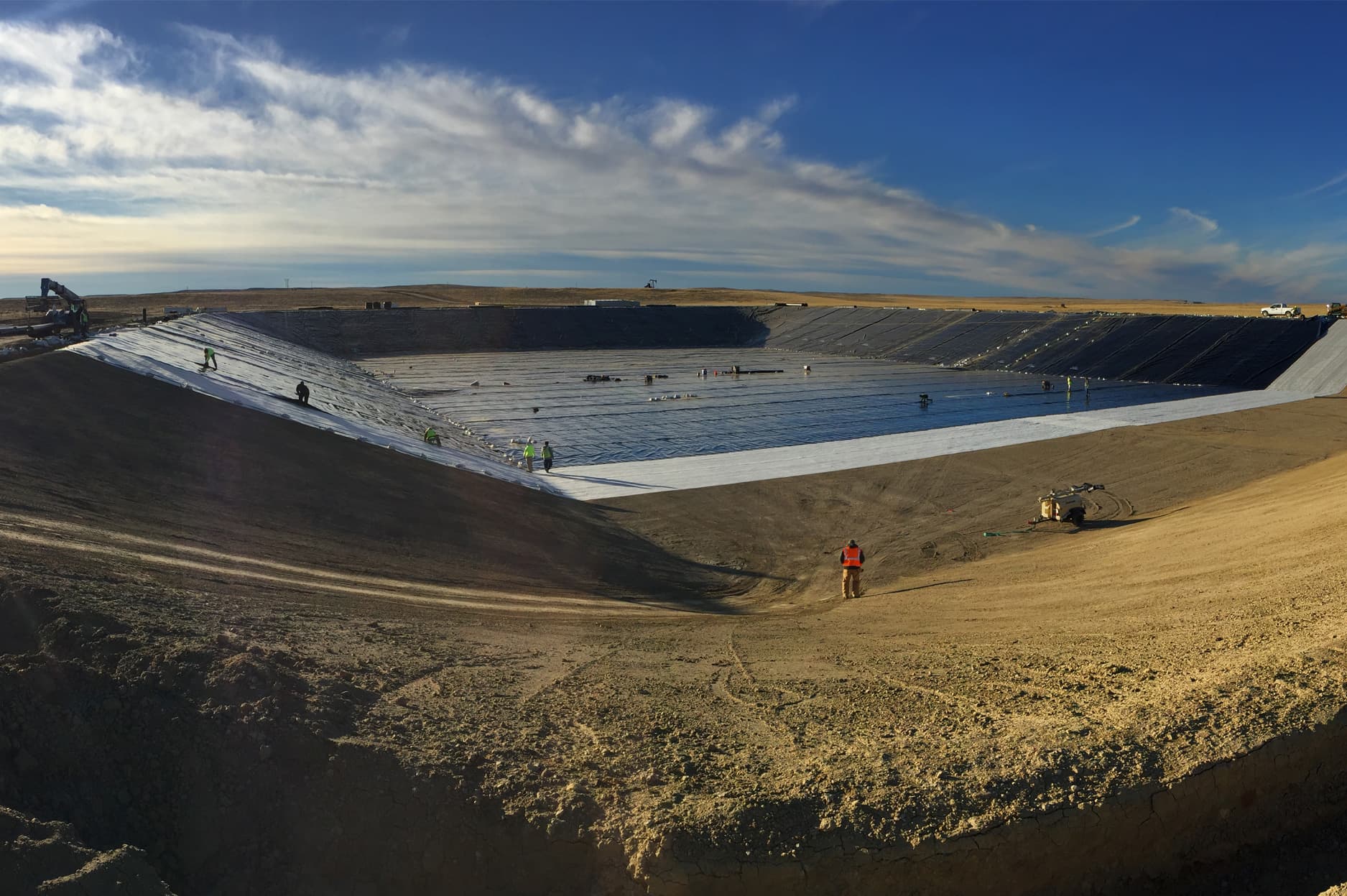
Tank Farm and Substation Containment Liners
Tank farms and electrical substations both store enough oil to fall under the SPCC rule, and both need containment that performs at facility scale: multi-cell lined berms around storage tanks, and lined pits and berms around oil-filled transformers. EC Applications installs and maintains geomembrane containment systems for tank farms, fuel terminals, generating stations, and substations across California, Texas, and Nevada, from single transformer pads to field-installed multi-cell containment with drainage and leak detection layers.
What containment does a tank farm need?
A tank farm multiplies every containment problem a single tank has. The bermed area is larger, the geometry is broken up by tank foundations, piping runs, and access ways, and the capacity check has to net out the displacement of every tank and structure inside each cell while still holding the largest tank plus freeboard. At that scale, containment is usually a field-installed system: geomembrane panels welded in place over prepared subgrade or concrete, with geotextile cushion where specified, and composite designs that add drainage or leak detection layers under the primary barrier where the engineering calls for them.
The details decide whether the system works. Liner tie-ins at tank ring walls and foundations, boots at every pipe and support penetration, terminations at walls and curbs, and transitions between cells all have to be fabricated and tested, not improvised. EC Applications self-performs that work, from the shop-fabricated boots and corners to the field seams, each nondestructively tested before the containment returns to duty.
Substations and transformer containment
Electrical substations hold oil in a form that surprises facility owners at SPCC time: transformer insulating oil. The rule counts oil-filled operational equipment toward a facility's aboveground storage, and large power transformers each hold thousands of gallons, so substations and generating stations routinely need engineered containment around that equipment. The standard answer is a lined containment pit or berm under and around the transformer, sized for the oil volume plus precipitation and built to stay functional around energized equipment.
Containment at substations has its own constraints: work around energized gear runs under the utility's clearances and safety rules, access is controlled, and outage windows are short and scheduled. Prefabricated drop-in liners earn their keep here, because shop fabrication keeps hot work and time inside the fence to a minimum. Rock-filled containment pits can be lined beneath the stone, and firewalls and separation structures are detailed into the liner rather than around it.
Retrofit work in operating facilities
Most tank farm and substation containment work is retrofit: the facility exists, the tanks and transformers are in service, and the containment underneath them no longer passes, or never existed. The installation plan is built around operations. Cells are lined one at a time so storage stays available, tie-ins are sequenced around piping and foundations that cannot move, hot work is minimized with shop fabrication and permitted where it cannot be avoided, and the crew works inside the facility's EHS and, at utilities, switching and clearance procedures.
Aging containment gets the same treatment as new work when it is repaired: existing liners are patched, rebooted, resealed, and retested rather than replaced wholesale where the material is still sound. EC Applications built its containment practice on exactly this kind of work, including secondary containment for a Hawaiian Electric fuel storage area, one of the company's documented projects.
Materials for oil, fuel, and exposed service
Tank farm and substation containment liners sit exposed for decades waiting for the spill they were built to catch, so the specification balances chemical compatibility against UV endurance and puncture resistance. XR-type ethylene interpolymer alloy geomembranes are the common choice for long-term fuel and oil contact in exposed service. HDPE and LLDPE serve large field-installed systems with broad chemical resistance, reinforced polypropylene handles aqueous duties with good exposed performance, and spray-applied membranes bond to concrete vaults, sumps, and channels where a sheet liner cannot attach practically.
Every selection is confirmed against manufacturer chemical resistance data for the stored product, whether that is diesel in a terminal tank or mineral insulating oil in a transformer.
Coverage across the West
Crews mobilize from Anaheim, California; Midland, Texas; and Sparks, Nevada. The Midland office serves Permian Basin tank batteries and terminal work on oilfield schedules, Anaheim covers California utility, terminal, and industrial facilities, and Sparks covers Nevada from the I-80 corridor to Las Vegas. Shop fabrication of panels, boots, and drop-in liners happens before mobilization, which is what keeps containment projects short on sites where every day inside the fence is coordinated.
For the fundamentals of containment lining, see the secondary containment service page; for compliance-driven upgrades and the capacity math, see the SPCC containment compliance page.
Applications
- Multi-cell tank farm containment systems
- Fuel terminal and bulk storage containment
- Transformer containment pits and berms
- Generating station fuel storage containment
- Composite systems with drainage and leak detection layers
- Liner tie-ins at ring walls and foundations
- Rock-filled containment pit liners
- Concrete vault, sump, and channel membranes
- Containment repair and rebooting in operating facilities
Quality assurance
Installation quality is verified against the project specification using the applicable ASTM and GRI test methods, with documented QA records at handoff.
Materials we install
- XR geomembranes
- HDPE / LLDPE
- polypropylene
- spray-applied membrane
Why ECA for this work
- Two CSLB-licensed entities: California licenses #894068 and #1003207.
- In-house specialty fabrication shop for prefabricated panels and custom geosynthetic products.
- Offices in Anaheim, California; Midland, Texas; and Sparks, Nevada, serving sites nationwide.
Material and system specifications
| Material | Typical duty | Notes |
|---|---|---|
| XR ethylene interpolymer alloy | Fuel, diesel, and transformer oil contact in exposed service | Reinforced, high puncture and tensile strength (ASTM D751), the common fuel containment spec |
| HDPE, smooth or textured | Large field-installed multi-cell systems | Broad chemical resistance; dual-track fusion seams air tested per ASTM D5820 |
| LLDPE | Systems needing conformance to foundations and penetrations | More flexible than HDPE with a similar resistance family |
| Reinforced polypropylene | Water-based and aqueous duties in exposed berms | Good UV exposure performance; not for long-term hydrocarbon contact |
| Spray-applied membrane | Concrete vaults, sumps, and channels | Seamless, bonds to prepared concrete where sheet attachment is impractical |
How the work gets done
- 1
Survey the facility
Map cells, tanks, transformers, penetrations, and foundations, and confirm the stored products and regulatory drivers for each containment area.
- 2
Design and capacity check
Verify each cell's net volume against the largest tank plus freeboard and match liner materials to the product using manufacturer compatibility data.
- 3
Fabricate
Build drop-in liners, panels, boots, and corners in the shop so hot work and schedule inside the fence stay minimal.
- 4
Sequence around operations
Line one cell at a time, coordinate outages and clearances at utility sites, and keep storage and equipment in service.
- 5
Install and terminate
Weld panels, tie into ring walls and structures, boot every penetration, and terminate with battens or embedment attachment.
- 6
Test and document
Nondestructively test seams and boots, pull destructive samples where specified, and turn over QA records for the facility's SPCC file.
Frequently asked questions
More of what we install
Ready to scope your tank farm and substation containment project?
Our crews handle engineering, fabrication, field installation, and maintenance. Tell us about your site and we will scope it with you.