
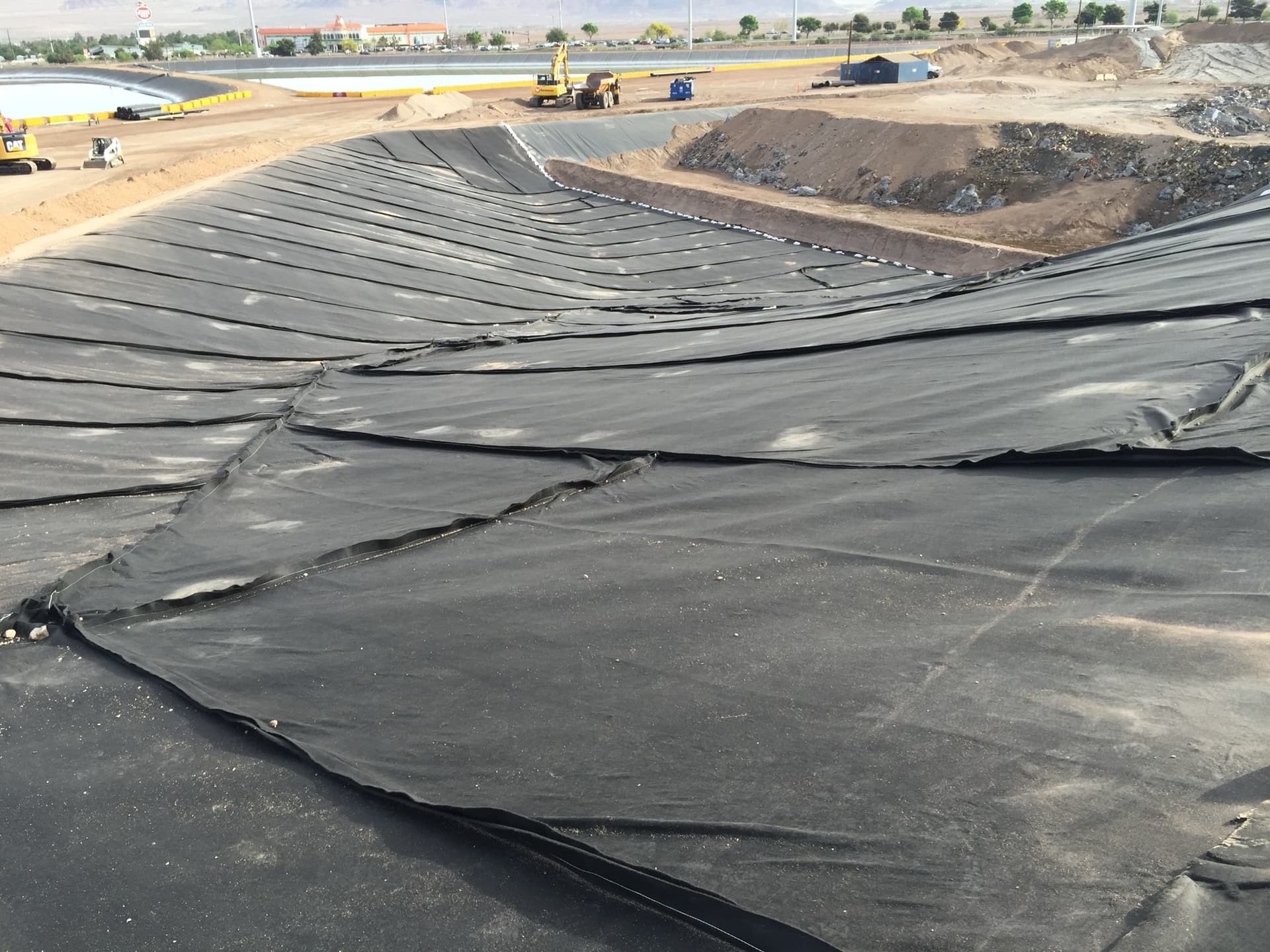
Custom Geomembrane Fabrication
Custom geomembrane fabrication is the shop production of geosynthetic products, prefabricated liner panels, fuel and water bladders, geotubes, portable containment berms, oil booms, turbidity barriers, and baffle curtains, welded under controlled conditions and shipped to the site ready to deploy. EC Applications fabricates these products from HDPE, LLDPE, polypropylene, PVC, XR geomembranes, EPDM, and CSPE (Hypalon), and offers design assistance to develop a product that fits the application when an off-the-shelf solution does not exist.
What can be prefabricated in the shop instead of welded in the field?
Any geomembrane assembly whose finished size and weight can still be folded, rolled, and freighted can be prefabricated in the shop, and a single prefabricated panel can reach up to 25,000 square feet. Shop fabrication moves the seaming work off the job site and into a controlled environment where wind, dust, moisture, and temperature swings do not interfere with weld quality, and where every seam can be tested before the material ever ships.
The practical payoff is on site. A pit, pond, or containment area lined with large prefabricated panels needs far fewer field seams, which means fewer weather delays, less field testing, a smaller crew window, and faster deployment. For remote locations, active facilities, and emergency response work, a panel that unfolds and drops into place is often the difference between a one-day install and a week of field welding.
Flexible materials such as reinforced polypropylene, PVC, XR geomembranes, EPDM, and CSPE fold compactly and are the most common candidates for large one-piece panels. Stiffer materials like HDPE are typically accordion-folded or supplied as factory-seamed sections sized to the handling equipment available at the site. During design, EC Applications balances panel size against site access, lifting capacity, and deployment method so the delivered product can actually be placed by the crew and equipment on hand.
What custom-fabricated products does EC Applications build?
EC Applications fabricates prefabricated geomembrane panels, portable secondary containment, portable liquid storage, fuel bladders, water bladders, geotubes for dewatering and sedimentation, oil booms, turbidity barriers, and baffle curtains. Each product is built to the dimensions, material, and fitting configuration the application requires rather than pulled from a fixed catalog.
Fuel bladders and water bladders are collapsible pillow-style tanks fabricated from reinforced, chemically compatible geomembranes. Fuel bladders provide temporary or long-term storage of diesel, gasoline, and other hydrocarbons at construction sites, remote operations, and emergency response staging areas, while water bladders store potable water, raw water, or process water where rigid tanks are impractical. Empty bladders fold to a fraction of their filled footprint, which makes them easy to transport, stage, and redeploy.
Geotubes are large geotextile containers used for dewatering and sedimentation. Slurry or sludge is pumped into the tube, water drains through the engineered fabric, and the retained solids consolidate inside for disposal or reuse. Oil booms and turbidity barriers are floating barriers that contain hydrocarbon sheens or suspended sediment on open water, and baffle curtains are suspended geomembrane walls that redirect flow inside ponds, tanks, and reservoirs. All of these are shop-welded products that ship complete with flotation, ballast, and connection hardware as the design requires.
Which materials can be custom fabricated?
EC Applications fabricates smooth and textured HDPE and LLDPE, smooth and textured drain liner, XR geomembranes, reinforced and unreinforced polypropylene, concrete protective liner (CPL), PVC, woven and non-woven geotextiles, CSPE (Hypalon), and EPDM. Material selection starts with the liquid being contained, then weighs UV exposure, temperature range, required flexibility, and how the finished product will be handled and deployed.
Reinforced materials, polypropylene, XR, and CSPE among them, carry a fabric scrim that adds tensile and tear strength, which suits bladders, portable berms, and floating barriers that are repeatedly folded, moved, and refilled. Unreinforced HDPE and LLDPE offer broad chemical resistance and low permeability for lining and containment panels. PVC and EPDM stay flexible in cold weather and conform to irregular shapes, and geotextiles serve as cushion, filtration, and the engineered fabric in geotubes.
Where a project involves fuels, produced water, leachate, or process chemicals, compatibility between the stored liquid and the membrane governs the choice. EC Applications reviews the service conditions during design assistance and recommends the material and reinforcement that will actually survive the duty, rather than defaulting to whatever is on the shelf.
What does portable and emergency containment look like?
Portable containment is a shop-fabricated berm, liner, or bladder that deploys in hours instead of the days a field-welded installation takes. Typical products include drop-in secondary containment liners for tanks and equipment, portable spill berms for fueling and maintenance areas, and collapsible bladders for temporary liquid storage. Because the welding and testing happen before shipment, the product arrives ready to unfold, position, and put into service.
Emergency containment covers fuel spill response and effluent emergencies, situations where a release is happening or imminent and containment cannot wait on fabrication lead time. Prefabricated berms, bladders, and oil booms staged in advance let operators isolate a spill, capture effluent, or protect a waterway immediately. EC Applications fabricates emergency and maintenance containment for fuel systems as well as effluent emergency containment for wastewater and industrial facilities, and can size products for the specific tanks, equipment, and volumes at a given site so the response gear on the shelf actually fits the risk.
Applications
- Prefabricated geomembrane panels
- Portable secondary containment
- Portable liquid storage
- Fuel bladders and water bladders
- Fuel spill emergency and maintenance containment
- Effluent emergency containment
- Geotubes for dewatering and sedimentation
- Oil booms and turbidity barriers
- Baffle curtains
Material specifications
Quality assurance
Installation quality is verified against the project specification using the applicable ASTM and GRI test methods, with documented QA records at handoff.
Materials we install
- HDPE / LLDPE
- polypropylene
- PVC
- geotextiles
- EPDM
- CSPE (Hypalon)
- concrete protective liners
Why ECA for this work
- Two CSLB-licensed entities: California licenses #894068 and #1003207.
- In-house specialty fabrication shop for prefabricated panels and custom geosynthetic products.
- Offices in Anaheim, California; Midland, Texas; and Sparks, Nevada, serving sites nationwide.
Material and system specifications
| Material | Forms | Typical fabricated products |
|---|---|---|
| HDPE / LLDPE | Smooth and textured | Prefabricated liner panels, drop-in containment liners |
| Drain liner | Smooth and textured | Drainage and containment composites |
| XR geomembranes | Reinforced | Fuel bladders, portable containment, floating barriers |
| Polypropylene | Reinforced and unreinforced | Large one-piece panels, baffle curtains, covers |
| PVC | Unreinforced | Prefabricated panels, flexible liners for irregular shapes |
| EPDM | Unreinforced | Cold-weather and conforming liner applications |
| CSPE (Hypalon) | Reinforced | Potable and chemical duty panels, floating barriers |
| Geotextiles | Woven and non-woven | Geotubes, cushion and filtration layers |
| Concrete protective liner (CPL) | Studded sheet | Cast-in liners for concrete structures |
How the work gets done
- 1
Application review
Define the liquid or material being contained, the service conditions, the deployment method, and the site constraints. EC Applications offers design assistance when the product needs to be developed from scratch.
- 2
Material selection
Match membrane, reinforcement, and geotextile components to chemical compatibility, UV exposure, temperature, and handling requirements.
- 3
Panel layout and shop drawings
Size panels and products to the site, up to 25,000 square feet per prefabricated panel, and detail fittings, sleeves, handles, flotation, and ballast.
- 4
Shop fabrication and QC
Weld the product under controlled shop conditions and test seams before shipment, so field crews receive a verified product rather than raw material.
- 5
Packaging, shipping, and deployment support
Fold or roll the finished product for freight, deliver to the site, and support deployment with EC Applications field crews where the project calls for it.
Frequently asked questions
More of what we install
Ready to scope your specialty fabrication project?
Our crews handle engineering, fabrication, field installation, and maintenance. Tell us about your site and we will scope it with you.