
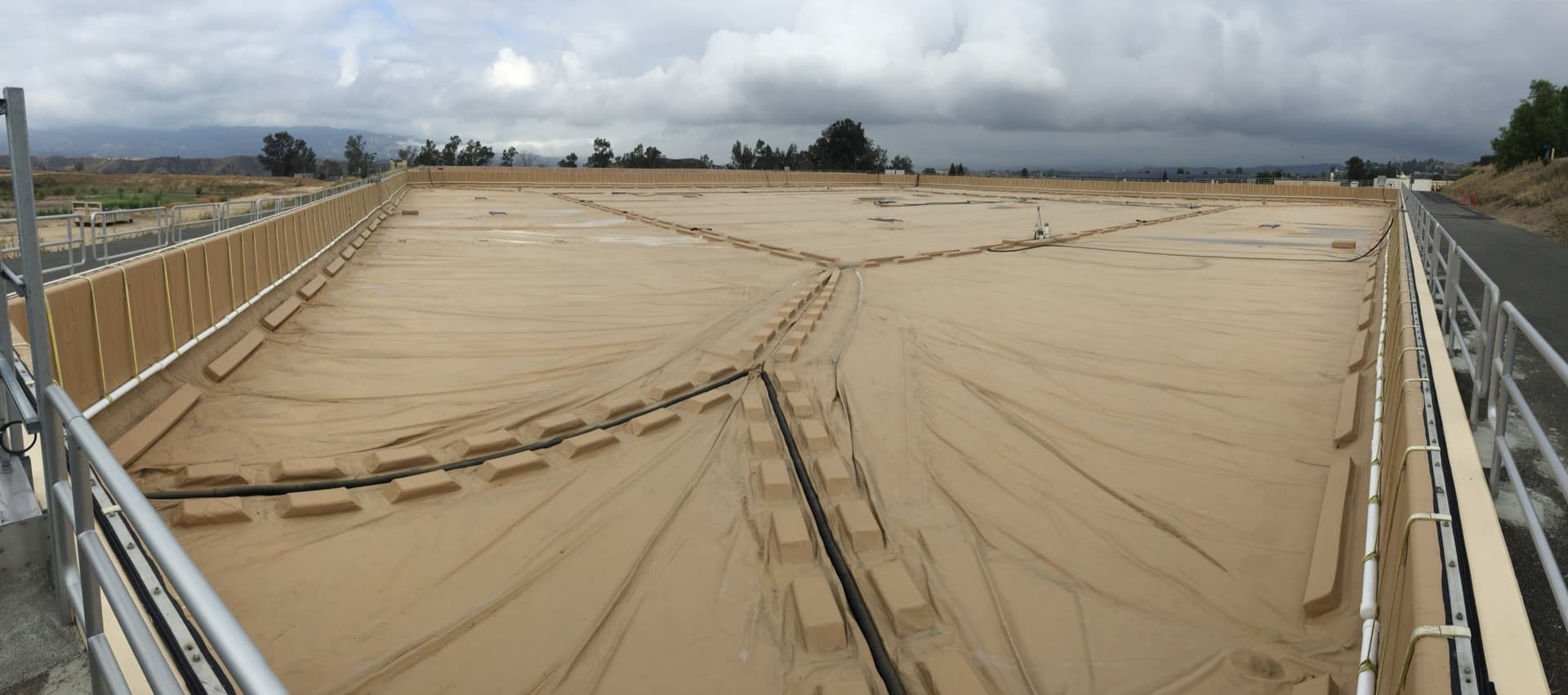
Baffle Curtain Installation
Baffle curtains are custom-fabricated geomembrane barriers that control flow and circulation in tanks, reservoirs, and wastewater treatment ponds. EC Applications installs both floating and fixed baffle systems that eliminate dead zones and increase contact time, a cost-effective retrofit for existing facilities that requires no dewatering.
What do baffle curtains do in a treatment pond or tank?
Baffle curtains are vertical geomembrane walls suspended in a basin, tank, or reservoir to redirect the path that water takes from inlet to outlet. Without baffles, incoming flow tends to short-circuit, taking the most direct route to the outlet while large volumes of the basin sit stagnant as dead zones. A baffle layout forces the flow into a longer serpentine path, so the full volume of the structure actually participates in treatment or storage turnover.
In wastewater treatment ponds and lagoons, that longer flow path increases effective detention time, which improves solids settling, biological treatment, and effluent consistency. In potable water tanks and reservoirs, baffles increase contact time between disinfectant and water, helping municipal treatment plants improve drinking water quality control and meet disinfection contact time requirements. In sediment basins, baffles slow and distribute flow so suspended solids have time to drop out before discharge.
The appeal of a baffle retrofit is economic. It corrects hydraulic performance problems in an existing structure for a fraction of the cost of building additional basin or tank capacity, and in most cases the facility stays in service during installation.
Can baffle curtains be installed without dewatering the basin?
Yes. Floating baffle curtains are designed to be deployed on a live basin. The curtain panels are factory fabricated to the specified depth and length, delivered folded or rolled, and then floated into position across the water surface. Flotation billets at the top of the curtain hold the panel at the surface while ballast at the bottom pulls it vertical through the water column, so the basin does not need to be drained, bypassed, or taken offline.
This matters most for wastewater lagoons and water storage reservoirs that cannot be removed from service without expensive bypass pumping or interruption to plant operations. A floating baffle retrofit lets the owner fix short-circuiting and dead zones while the facility keeps running.
Where a structure is already scheduled for an outage, or where the design calls for a fixed curtain attached to the floor and walls, EC Applications also installs fixed baffle systems in dewatered tanks and basins. Our crews perform both floating and fixed baffle installations and can advise which approach fits the structure, the outage window, and the budget.
What materials are baffle curtains made from?
EC Applications installs and services baffle curtains fabricated from XR geomembrane, CSPE (Hypalon), and reinforced polypropylene. All three are scrim-reinforced flexible membranes, meaning a woven fabric core is coated or laminated on both sides, which gives the curtain the tensile and tear strength to hang under ballast load and resist wind, wave action, and ice without stretching out of position.
Material selection depends on the service environment. XR geomembrane offers high tensile strength and broad chemical resistance, which suits industrial and wastewater duty. CSPE has a long service history in exposed water containment applications and remains flexible over decades of UV exposure. Reinforced polypropylene is a widely used, economical choice for floating baffles and prefabricated panels. For potable water reservoirs and tanks, curtains are specified in materials certified to NSF/ANSI 61 for drinking water contact.
Panels are factory fabricated into large sections with welded seams, then joined in the field at engineered connection points. Factory fabrication keeps the majority of seaming in a controlled shop environment, which improves seam quality and shortens field installation time.
How are baffle curtains anchored, floated, and ballasted?
A floating baffle curtain is held in position by three systems working together: flotation, ballast, and end anchorage. Flotation billets, typically closed-cell foam logs encased in a sleeve welded along the top of the curtain, keep the top edge at the water surface. A ballast chain or weight system in a sleeve along the bottom hem pulls the curtain vertical and keeps it from lifting or folding under flow. Tension members and end connections carry wind and current loads to the anchorage points.
End anchorage depends on the structure. On concrete tanks and reservoir walls, the curtain terminates at stainless steel batten bars anchored to the concrete. On steel tanks, connections are made to welded or bolted attachment hardware. On earthen embankments, the curtain edge is typically secured in an anchor trench or to deadman anchors above the waterline.
Layout matters as much as hardware. Curtain spacing, opening locations, and the resulting flow path determine how much of the basin volume is put to work. EC Applications installs baffle systems to the project engineer's hydraulic layout and fabrication drawings, and coordinates panel dimensions, attachment details, and installation sequencing with the designer before fabrication begins.
How long do baffle curtain systems last?
Service life is driven by material selection and hardware quality. The reinforced membranes used for baffles, XR geomembrane, CSPE, and reinforced polypropylene, are UV-stabilized materials with long track records in exposed water and wastewater service, and manufacturers commonly warrant them for many years of continuous exposure. Stainless steel connection hardware and properly sized flotation and ballast keep the system performing without the sagging or misalignment that degrades hydraulic performance over time.
Baffles are also maintainable assets. Individual panels can be inspected, repaired, or replaced without removing the whole system, and a floating curtain can be repositioned if plant hydraulics change. When an aging baffle system reaches the end of its life, replacement curtains can be fabricated to the existing layout and swapped in with minimal disruption.
Applications
- Potable water reservoirs
- Potable water tanks and clearwells
- Raw water reservoirs
- Wastewater treatment lagoons and ponds
- Sediment basins
- Industrial process and equalization basins
- Disinfection contact time improvement in municipal treatment plants
- Retrofits of existing facilities without dewatering
Material specifications
Quality assurance
Installation quality is verified against the project specification using the applicable ASTM and GRI test methods, with documented QA records at handoff.
Materials we install
- XR Geomembrane
- CSPE (Hypalon)
- polypropylene
Why ECA for this work
- Two CSLB-licensed entities: California licenses #894068 and #1003207.
- In-house specialty fabrication shop for prefabricated panels and custom geosynthetic products.
- Offices in Anaheim, California; Midland, Texas; and Sparks, Nevada, serving sites nationwide.
Material and system specifications
| Material | Construction | Typical Use |
|---|---|---|
| XR geomembrane | Ethylene interpolymer alloy coated polyester scrim | Industrial and wastewater basins requiring high strength and chemical resistance |
| CSPE (Hypalon) | Chlorosulfonated polyethylene over polyester scrim | Long-term exposed service in water and wastewater reservoirs |
| Reinforced polypropylene | Polypropylene laminated over polyester scrim | Floating baffles and prefabricated panels in water and wastewater service |
How the work gets done
- 1
Layout review
Review the engineer's hydraulic layout, structure drawings, and water levels to confirm curtain depths, panel lengths, and attachment details.
- 2
Factory fabrication
Panels are fabricated in the shop with welded seams, flotation sleeves, ballast hems, and connection hardware built to the approved drawings.
- 3
Mobilization and staging
Crews stage panels, flotation, ballast, and anchorage hardware at the basin, coordinating access and sequencing with plant operations.
- 4
Installation
Floating curtains are deployed across the live basin and tensioned into position; fixed curtains are attached to floors and walls in dewatered structures.
- 5
Anchorage and termination
Curtain ends are secured to concrete, steel, or earthen anchor points with batten bars, attachment hardware, or anchor trenches.
- 6
Final inspection
The installed system is inspected for position, tension, flotation, and connection integrity before turnover to the owner.
Frequently asked questions
More of what we install
Ready to scope your baffle curtains project?
Our crews handle engineering, fabrication, field installation, and maintenance. Tell us about your site and we will scope it with you.