
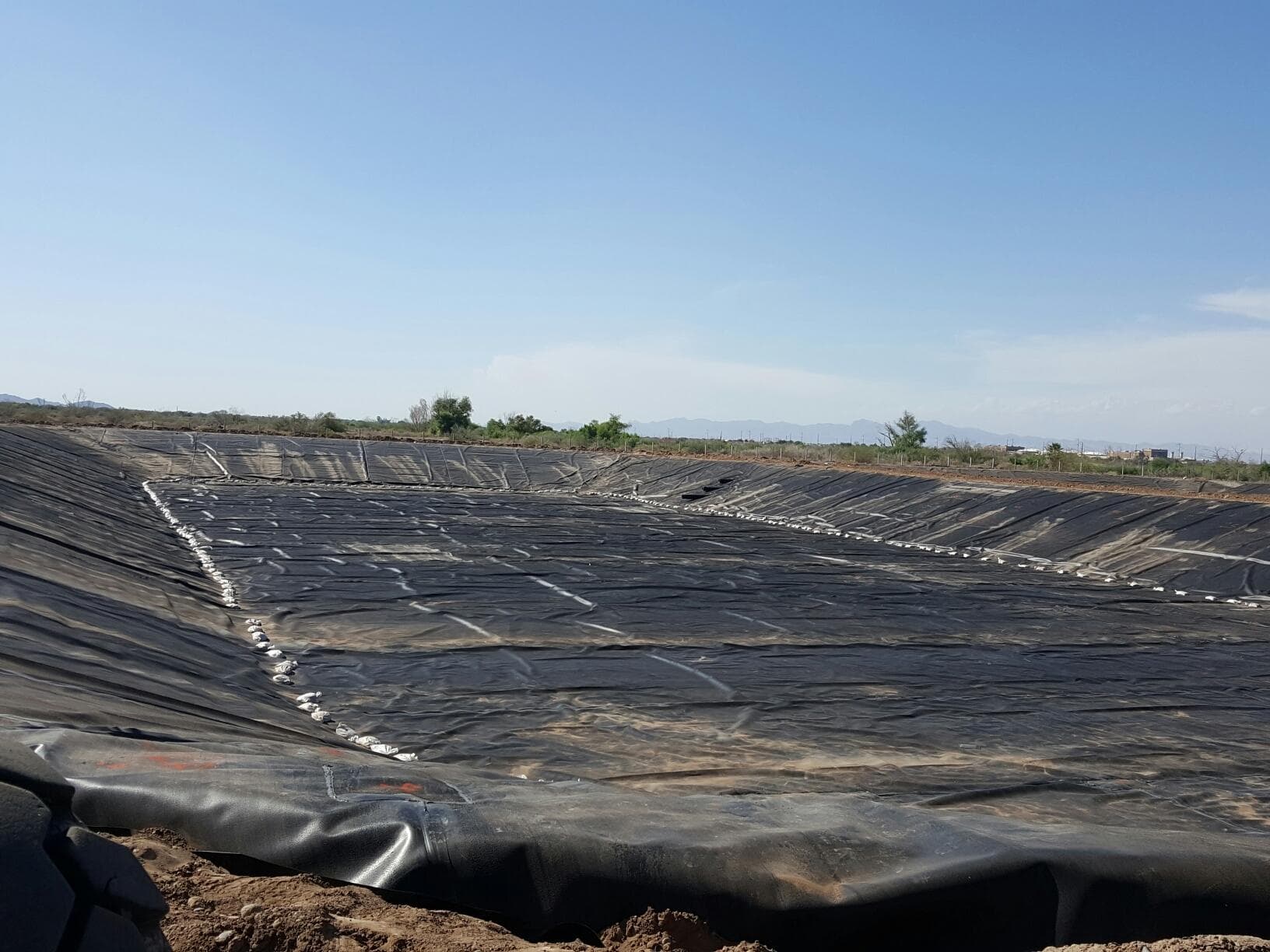
SPCC Secondary Containment Compliance
The federal SPCC rule (40 CFR Part 112) requires facilities with more than 1,320 gallons of aboveground oil storage to provide secondary containment that is sufficiently impervious to hold a discharge until it is cleaned up, and bare earthen berms rarely qualify. EC Applications brings existing containment up to that standard across California, Texas, and Nevada: lining earthen and concrete berms with chemically compatible geomembranes, resealing penetrations and terminations, and documenting the work so the containment holds up in the SPCC plan as well as in the field.
What does sufficiently impervious mean in practice?
The SPCC rule does not hand facilities a permeability number. It requires that dikes, berms, and retaining walls be sufficiently impervious to contain discharged oil until it can be detected and cleaned up. In practice, the question an inspector or PE asks is whether a spill on Friday night would still be inside the containment on Monday morning, or soaked into the ground beneath it. Compacted native soil berms, weathered gravel floors, and cracked concrete rarely pass that test.
A geomembrane liner that is chemically compatible with the stored product is the accepted way to make a containment structure sufficiently impervious. The liner turns the berm from an earthwork feature into a verified barrier: welded seams that have been tested, boots sealed around every penetration, and terminations attached so oil cannot escape under or around the edge. That is the upgrade this page covers.
Why containment fails inspection
Most SPCC containment findings trace to a short list. Earthen berms that were never lined, so the floor of the containment is bare soil. Concrete that has cracked, spalled, or opened at its joints. Old liners that have aged out: UV-degraded sheet, failed seams, boots pulled loose from pipes, terminations that no longer seal. Penetrations that were added after the containment was built, with piping passed through the berm and sealed with whatever was on the truck. And capacity that shrank over the years as equipment, piping, and sediment accumulated inside the bermed area.
Each of those has a defined fix, and few of them require rebuilding the containment. Lining or relining the structure, refabricating boots, resealing terminations, and restoring capacity are geomembrane work, and they can usually be done while the facility keeps operating.
What a compliance upgrade looks like
For a regular-shaped berm around one or a few tanks, the usual path is a prefabricated drop-in liner: shop-fabricated to the berm's dimensions with corners and boots built in, placed and attached with minimal hot work. For large tank farms, irregular containments, or designs that call for composite systems with drainage or leak detection layers, crews field-install the geomembrane, welding panels in place and testing every seam. Concrete vaults and channels that cannot take a sheet liner can be coated with spray-applied membrane bonded to the prepared surface.
Every penetration gets a fabricated boot clamped with stainless steel bands over compatible sealant, and the liner terminates with batten bars anchored to concrete or with embedment welds, so the barrier is continuous from wall to wall. Work is sequenced cell by cell so tanks stay in service, and hot work and spill controls are coordinated with the facility's EHS requirements.
Getting the capacity math right
SPCC containment must hold the full volume of the largest tank plus freeboard for precipitation, which many state and local codes and most engineers apply as 110 percent of the largest tank's capacity. The number that matters is net volume: the space actually available after subtracting what other tanks, equipment, supports, and accumulated sediment displace inside the berm, accounting for the geometry the liner itself takes.
A lining project is the right moment to check that math, because the survey work is already happening. EC Applications verifies the containment geometry during design, so the finished system passes on volume as well as on imperviousness, and flags containments that need wall height or footprint changes before the liner goes in rather than after.
Documentation that survives the audit
An SPCC plan is a certified document, and the containment described in it has to match what is in the ground. EC Applications turns over the records that make that connection: the liner material and its chemical compatibility basis, weld and boot test results from trial welds through nondestructive testing of every field seam, and as-built documentation of the finished containment. When the plan's PE or an EPA inspector asks how the containment is sufficiently impervious, the answer is a tested, documented membrane rather than an assertion about compacted soil.
The same crews handle the aftercare that keeps containment compliant over time: periodic inspection, patching damage, rebooting penetrations, and retesting seams, so an aging system is brought back to spec without waiting for a finding. For the containment fundamentals behind this page, see the secondary containment service; for what the rule requires facility-wide, the SPCC requirements guide on the blog walks through the plan itself.
Prepare a secondary containment inquiry
Send the stored products, tank capacities, containment dimensions, and available drawings. Include the SPCC plan preparer's sizing and imperviousness requirements so the liner installation scope can follow the facility plan.
Applications
- Lining unlined earthen containment berms
- Relining aged or failed containment liners
- Spray-applied membrane for cracked concrete vaults
- Penetration boot refabrication and resealing
- Termination re-battening and embedment rework
- Containment capacity verification during design
- Tank farm and fuel storage compliance retrofits
- Generator and transformer pad containment
- QA documentation for SPCC plan certification
Quality assurance
Installation quality is verified against the project specification using the applicable ASTM and GRI test methods, with documented QA records at handoff.
Materials we install
- XR geomembranes
- HDPE / LLDPE
- polypropylene
- spray-applied membrane
Why ECA for this work
- Two CSLB-licensed entities: California licenses #894068 and #1003207.
- In-house specialty fabrication shop for prefabricated panels and custom geosynthetic products.
- Offices in Anaheim, California; Midland, Texas; and Sparks, Nevada, serving sites nationwide.
How the work gets done
- 1
Assess the containment
Inspect the structure, existing liner, penetrations, and terminations, and identify what stands between the containment and the sufficiently impervious standard.
- 2
Verify capacity
Check net containment volume against the largest tank plus freeboard, accounting for displacement by equipment and the liner geometry.
- 3
Match the material
Select a geomembrane chemically compatible with the stored product and suited to exposed service, confirmed against manufacturer resistance data.
- 4
Line the containment
Install a prefabricated drop-in liner or field-welded system, seal every penetration with fabricated boots, and terminate the liner to the structure.
- 5
Test and document
Nondestructively test seams and boots, and turn over material, testing, and as-built records that support the certified SPCC plan.
- 6
Maintain compliance
Inspect, patch, reboot, and retest over the containment's life so it stays sufficiently impervious between audits.
Frequently asked questions
More of what we install
Ready to scope your spcc containment compliance project?
Our crews handle engineering, fabrication, field installation, and maintenance. Tell us about your site and we will scope it with you.