
Public Works Liner Contractor
EC Applications performs the geosynthetics scopes that show up in public works bids: tunnel waterproofing membranes, EPS geofoam lightweight fill for highways and bridge approaches, and canal, reservoir, and basin lining for public agencies and heavy-civil general contractors.
The geosynthetics line items inside public infrastructure
Public works projects rarely bid geosynthetics as a standalone contract. The membrane, geofoam, and geotextile scopes sit inside larger transportation and water infrastructure packages, and the general contractor needs a specialty subcontractor who can carry that portion of the work with its own crews, equipment, and quality documentation. That is the role EC Applications fills: a self-performing installer for tunnel waterproofing systems, EPS geofoam lightweight fill, geomembrane lining for canals, reservoirs, and treatment basins, and the geotextile separation and cushion layers that support each of those systems.
Because the geosynthetics scope usually sits on the critical path between earthwork or excavation and the concrete or paving that follows, schedule reliability matters as much as workmanship. ECA plans installation sequences around the GC's pour and backfill schedule, staffs to the windows the project allows, and turns over each area with the seam testing and QC records the owner's inspector expects to see before the next trade covers the work.
Tunnel waterproofing for transit, water, and utility tunnels
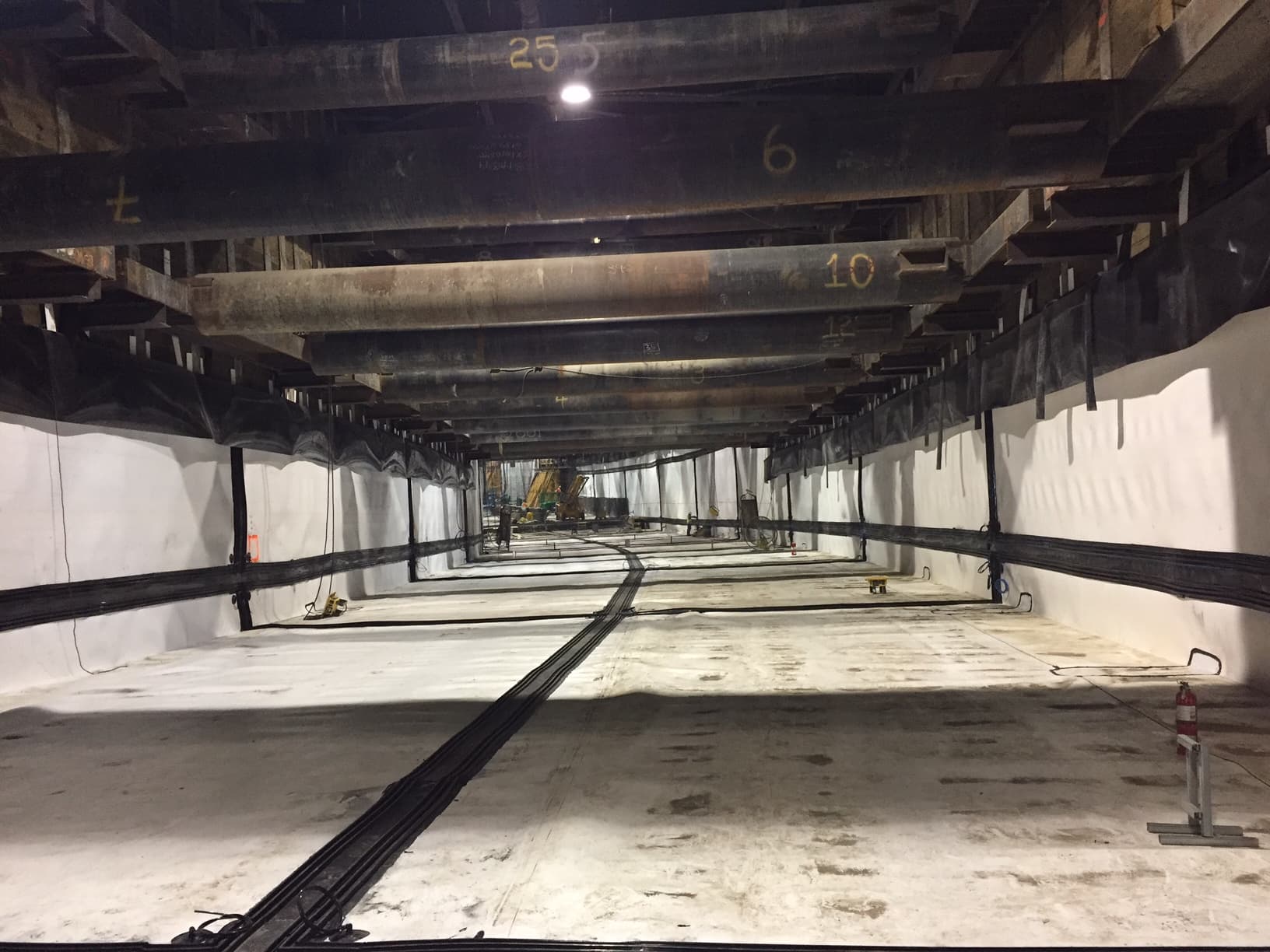
Underground structures depend on a continuous membrane barrier between the excavated ground and the final lining. In a typical sheet-applied tunnel waterproofing system, a geotextile cushion layer is fixed against the shotcrete or excavated substrate to protect the membrane from puncture, and the geomembrane sheets are then welded into a continuous envelope around the structure. Waterstops divide the membrane into compartments so that if a leak ever develops, it can be isolated and grouted within a limited zone instead of migrating along the entire structure.
This is exacting work: overhead and vertical welding, tight radii at cross passages and portals, and seam testing on every weld before the membrane disappears behind reinforcement and concrete. ECA installs sheet waterproofing systems for transit, water conveyance, and utility tunnels and coordinates the membrane sequence with the contractor's rebar and formwork cycle so waterproofing never becomes the reason a pour slips.
EPS geofoam: lightweight fill for highways and bridge approaches
Where highways and bridge approaches cross soft or settlement-prone ground, conventional soil fill can overload the subgrade, drive long-term settlement, and put lateral pressure on abutments and buried utilities. EPS geofoam solves the problem by removing the weight: blocks manufactured to ASTM D6817 weigh roughly one percent of typical compacted soil, so an embankment can be built to grade without surcharging the foundation soils or waiting months for consolidation.
Departments of transportation across the country specify geofoam for bridge approach embankments, roadway widening over compressible soils, slope stabilization, and fills over utilities that cannot take additional load. The installed system is straightforward but detail-dependent: a prepared base, blocks placed in an interlocked running-bond pattern, mechanical connectors between courses, and a load distribution slab or pavement section above. ECA supplies and places geofoam as a complete scope, including the geomembrane or geotextile protection layers many specifications require around the block mass.
Canal, reservoir, and basin lining for public agencies
Unlined earthen canals can lose a significant share of the water they convey to seepage, which is why irrigation districts and water agencies line conveyance and storage facilities with geomembranes. A lined canal or reservoir cuts seepage losses to near zero, protects adjacent ground from saturation, and gives the agency a maintainable, inspectable asset. ECA lines canals, raw water reservoirs, recharge and detention basins, and treated water storage for public owners, working around the outage windows and water delivery schedules that govern this kind of infrastructure.
On the wastewater side, the same installation discipline applies to treatment lagoons, equalization basins, sludge drying beds, and emergency overflow basins at municipal plants. These facilities are regulated containments: the liner system, the seam testing, and the construction quality assurance records are all part of what the plant shows its regulator. ECA delivers the destructive and non-destructive seam test documentation and panel placement records the owner's CQA firm needs to certify the installation.
Built for public procurement
Public work carries obligations beyond the technical scope: prevailing wage compliance, certified payroll, submittal packages with material certifications and installer qualifications, and inspection hold points written into the specification. ECA is set up to work within that framework, whether contracted directly by an agency or as a subcontractor to a heavy-civil general contractor. Submittals reference the governing test standards, field seaming follows the project CQA plan, and turnover documentation is organized so closeout does not stall on the liner scope.
The company holds two California CSLB licenses, #894068 and #1003207, and operates from offices in Anaheim, California; Midland, Texas; and Sparks, Nevada, which lets crews mobilize to public infrastructure work across the western United States.
Services for this market
- Tunnels
Sheet-applied geomembrane waterproofing systems for transit, water conveyance, and utility tunnels, sequenced with the GC's lining cycle.
- EPS Lightweight Fill
EPS geofoam lightweight fill for bridge approaches, embankments over soft ground, roadway widening, and retaining wall backfill.
- Water Reservoirs
Canal, reservoir, and recharge basin lining for irrigation districts and municipal water agencies.
- Wastewater Containment
Treatment lagoon, equalization basin, and sludge bed liners for municipal wastewater plants, with full CQA documentation.
Frequently asked questions
More markets we serve
Working on a public works project?
Tell us about the site and our team will scope the right containment approach with you, from materials to installation.