On this page
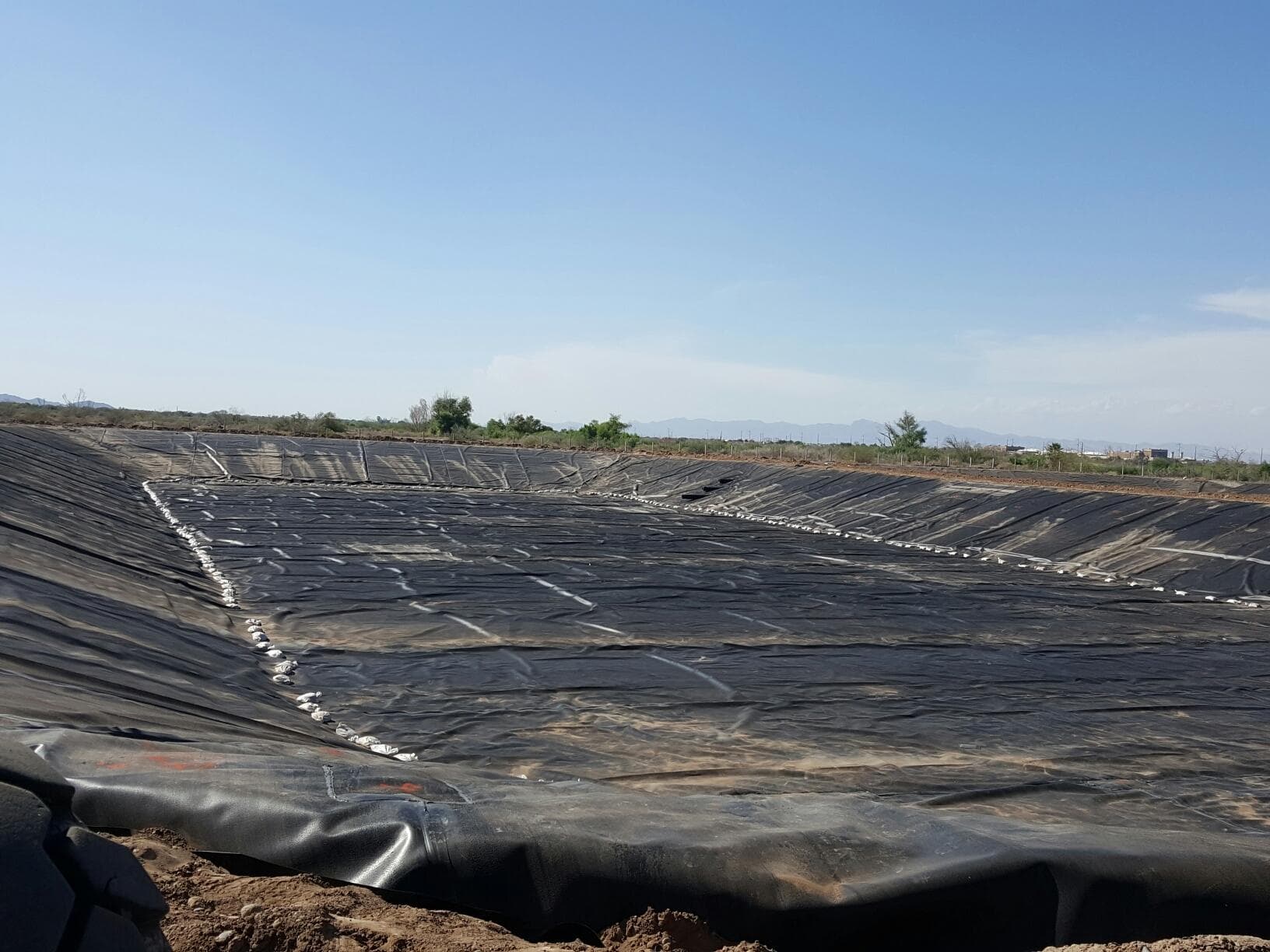
A produced water pit liner is a geomembrane, most commonly 40 to 60 mil HDPE, installed over prepared subgrade to keep high-salinity oilfield wastewater from reaching soil and groundwater. Liners are required by state oil and gas regulators for nearly all produced water pits, and the material has to survive brine that is often three to six times saltier than seawater, plus residual hydrocarbons, for the life of the pit. This article walks through what produced water is, why containment is regulated, which materials hold up, how lined pits compare to steel tanks, how fast a pit can be lined, and what quality assurance and end-of-life steps apply.
What is produced water and why is containment regulated?
Produced water is the water that comes up the wellbore along with oil and gas. It is a mix of ancient formation brine and, in unconventional wells, returned frac fluid. It is by far the largest waste stream in upstream oil and gas: U.S. onshore wells generate more than 20 billion barrels of produced water per year by widely cited industry estimates, and mature fields commonly produce 7 barrels of water or more for every barrel of oil.
The chemistry is what makes containment matter. Total dissolved solids in Permian Basin produced water routinely exceed 100,000 mg/L and can top 200,000 mg/L, compared with roughly 35,000 mg/L for seawater. Add residual hydrocarbons, dissolved metals, and treatment chemicals, and a single release can render shallow groundwater unusable and sterilize soil for years. That is why every major producing state requires engineered containment for produced water storage, even though exploration and production wastes have been exempt from federal RCRA Subtitle C hazardous waste regulation since 1988. The federal exemption did not deregulate produced water; it pushed primary authority to the states, and the states regulate pits specifically.
- Texas: the Railroad Commission's updated oil and gas waste management rules (16 TAC Chapter 4, Subchapter A, effective July 1, 2025) replaced the long-standing Statewide Rule 8 framework and tightened permitting, siting, and liner requirements for pits, including produced water recycling pits.
- New Mexico: the Oil Conservation Division's pit rules (19.15.17 NMAC) require geomembrane liner systems for pits, with double liners and leak detection for many permanent and recycling containments.
- California: CalGEM and the Regional Water Quality Control Boards regulate produced water ponds under the state's oilfield produced water pond program, with lined containment and monitoring as the baseline expectation.
- Disposal by injection falls under the federal Safe Drinking Water Act UIC Class II program, but everything stored at the surface on its way to injection, recycling, or treatment sits in state-regulated containment.
Which liner materials handle high-TDS brine and hydrocarbons?
Produced water is one of the harder services in containment because the liner sees two attack mechanisms at once: extreme ionic strength from the brine and softening or swelling from hydrocarbon carryover. Not every geomembrane tolerates both.
- HDPE (high density polyethylene) is the default for produced water. Its density of 0.940 g/cc or higher gives it broad chemical resistance to brines and aliphatic hydrocarbons, and the GRI-GM13 specification gives buyers an industry-standard checklist for thickness, tensile properties, stress crack resistance, and oxidative induction time. A 60 mil HDPE liner is the workhorse for long-term pits; 40 mil is common for shorter-duration service.
- XR-type reinforced geomembranes (ethylene interpolymer alloy on a polyester scrim) offer excellent hydrocarbon resistance in a lighter, more flexible sheet that prefabricates well into large panels.
- Reinforced polyethylene (RPE) and string-reinforced LLDPE are widely used for temporary pits and frac water corrals where deployment speed and low weight matter more than decades of service life.
- PVC and unreinforced polypropylene are generally poor choices for produced water because plasticizer loss and hydrocarbon attack shorten their life in this chemistry.
- Geosynthetic clay liners (GCLs) deserve caution as a standalone barrier: high-TDS brine suppresses bentonite swelling and can raise GCL permeability by orders of magnitude, which is why regulators and designers treat GCLs as a supplement beneath a geomembrane, not a substitute for one, in produced water service.
For permanent facilities and recycling pits, the design standard is increasingly a double liner: a 60 mil HDPE primary over a leak detection layer (geonet or drainage composite) over a secondary geomembrane. That geometry turns a primary liner defect from an environmental release into a maintenance work order, because the leak detection sump tells you about the problem while the secondary liner is still containing it.
Lined pit vs steel tanks: how do they compare?
The alternative to a lined pit is above-ground steel, either rented 500 barrel frac tanks or bolted/welded above-ground storage tanks. The comparison usually comes down to volume and duration.
- Scale: a single lined pit can hold 100,000 to 500,000 barrels or more. Matching even the low end of that with 500 barrel frac tanks means hundreds of tank rentals, manifolding, and truck traffic.
- Cost per barrel stored: for large volumes held more than a few weeks, lined earthen containment is typically the lowest-cost option per barrel by a wide margin. Frac tank rental economics only win for small volumes and short durations.
- Speed at small scale: tanks win when you need 2,000 barrels of storage tomorrow. Pits win when you need 200,000 barrels this month.
- Inspection and repair: steel tanks corrode in high-chloride service and need coating programs; a geomembrane pit needs liner inspections and can be electrically leak-tested across its entire floor, which no tank farm can match.
- Regulatory posture: both routes are permitted paths in the major producing states, but pits carry siting, liner specification, and closure requirements that tanks do not, so permitting lead time belongs in the schedule.
How fast can a pit be lined?
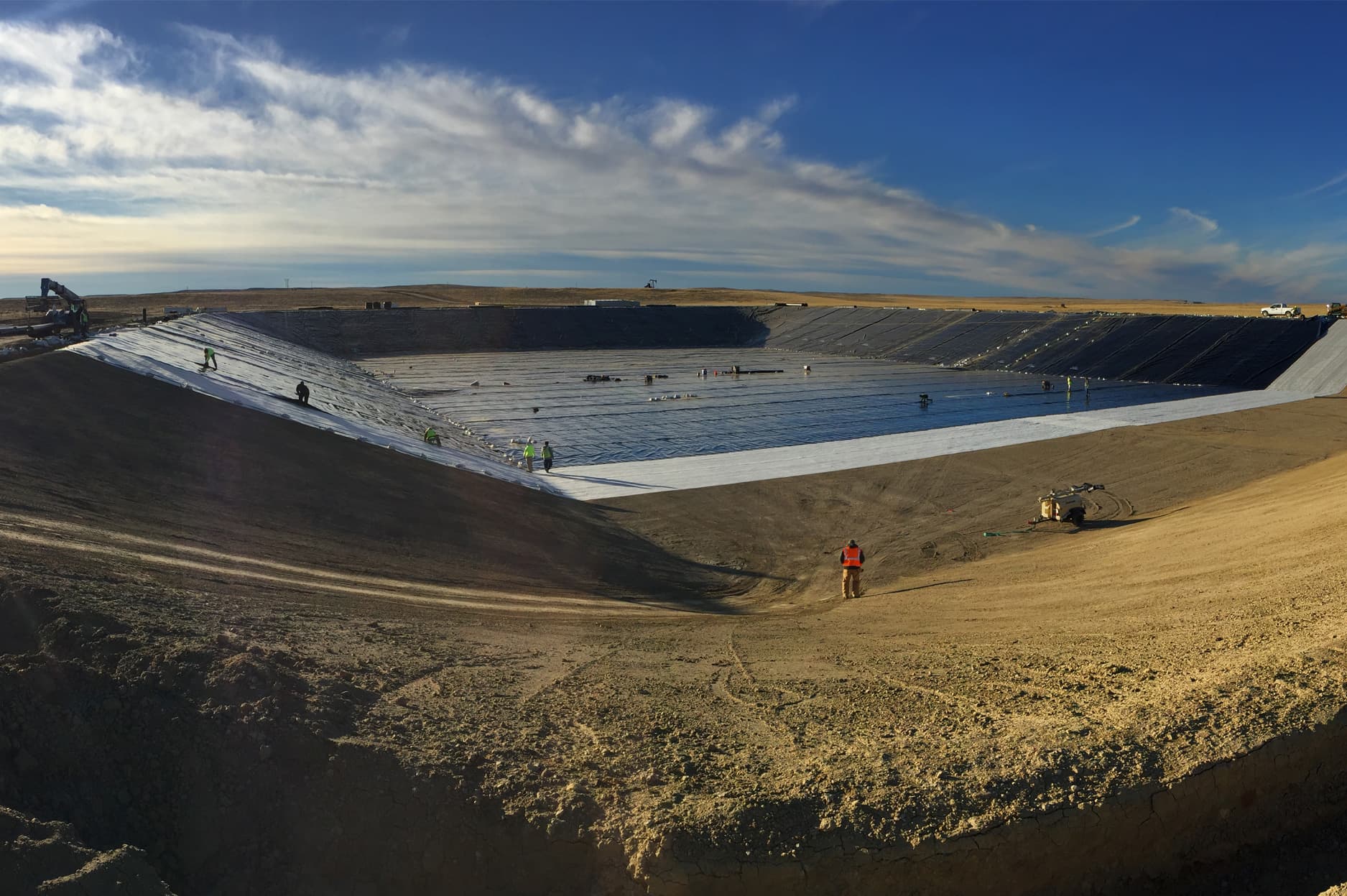
Speed is where fabrication method matters. Field-welded liner arrives on rolls (HDPE rolls are typically about 23 feet wide) and every seam between panels is welded on site, so schedule scales with weld footage and weather windows. Prefabricated liner is factory-welded into large panels under controlled conditions, trucked to the pad folded on pallets, and unfolded into place, so most of the seaming is already done before the crew arrives.
EC Applications fabricates custom panels up to 25,000 square feet or 4,000 pounds per panel and stocks off-the-shelf liner inventory at its California, Texas, and Nevada locations, including the Midland yard serving the Permian Basin. In practice that means a typical single-well drilling or completion pit measured in tens of thousands of square feet can be lined in a day or two once the subgrade is ready, and stocked panel sizes can ship on short notice rather than waiting on a fabrication queue. Larger produced water ponds combine prefabricated panels with field welding at the panel joints, which still cuts field seam footage dramatically compared to an all-field-weld job.
The schedule item people underestimate is subgrade preparation. A geomembrane is only as good as what it lies on: the surface must be smooth, compacted, free of rock and debris that could puncture the sheet, and often covered with a nonwoven geotextile cushion. Rushing dirt work to hit a rig schedule is the most common root cause of early liner damage.
What QA and leak detection applies?
Produced water pit liners are tested, not trusted. A standard construction quality assurance program includes trial welds at the start of each shift, nondestructive testing of every field seam, and destructive seam sampling.
- Dual-track fusion welds are pressure-tested through the air channel between the weld tracks (ASTM D5820), which verifies the full length of every seam without cutting the liner.
- Extrusion welds and repairs are checked by vacuum box or spark testing.
- Destructive samples are cut at specified intervals and pulled in peel and shear per ASTM D6392 to confirm weld strength against the project specification.
- Electrical leak location surveys (ASTM D7002 for exposed liners, ASTM D7007 for liners under water or cover soil) find pinholes and punctures across the entire installed surface, not just the seams. Industry studies consistently attribute the majority of geomembrane damage to construction activity after liner placement, which is exactly what these surveys catch.
- For double-lined pits, the leak detection sump provides ongoing performance monitoring for the life of the facility: measurable flow in the sump is the trigger for investigation and repair.
What happens at end of pit life?
Every producing state requires formal pit closure, and the liner strategy affects how painful that is. Closure generally means removing remaining fluids, removing or managing bottom solids and any impacted soil, then either removing the liner for disposal or, where rules allow, folding and burying it in place. Temporary drilling and completion pits in Texas and New Mexico carry closure deadlines measured in months after operations end, not years, and closure documentation is part of the regulatory record. A liner that survived its service life intact makes closure a demolition task; a liner that leaked makes it a remediation project. That difference, more than material price per square foot, is the real economic argument for specifying the right membrane, cushioning it properly, and leak-testing it before the first barrel goes in.
The bottom line
Produced water containment is a solved engineering problem when three things line up: a chemically appropriate geomembrane (usually 40 to 60 mil HDPE or an XR-type reinforced membrane), a CQA program that tests every seam and sweeps the whole surface for leaks, and an installer who can meet oilfield schedules with prefabricated panels and stocked material. Get those right and a lined pit is the cheapest, most inspectable large-volume water storage available on a pad.