
On this page
Nevada's rule for mining process ponds ends with a shutdown clause. NAC 445A.435 requires every pond intended to contain process fluids to have a primary synthetic liner and a secondary liner, with a material between them that can rapidly transport any fluid entering it to an accessible collection point with a system for recovering it. When that material can no longer collect, transport, and remove liquid fast enough to prevent hydraulic head transference from the primary liner to the secondary liner, the pond must be shut down.
Read closely, the rule does not assume the primary liner will be perfect. It assumes some liquid will get through, and it sets the standard on what happens next. The layer between the liners is the part of a double-lined pond that decides whether the pond stays in service.
Two liners, a drainage layer, and a sump
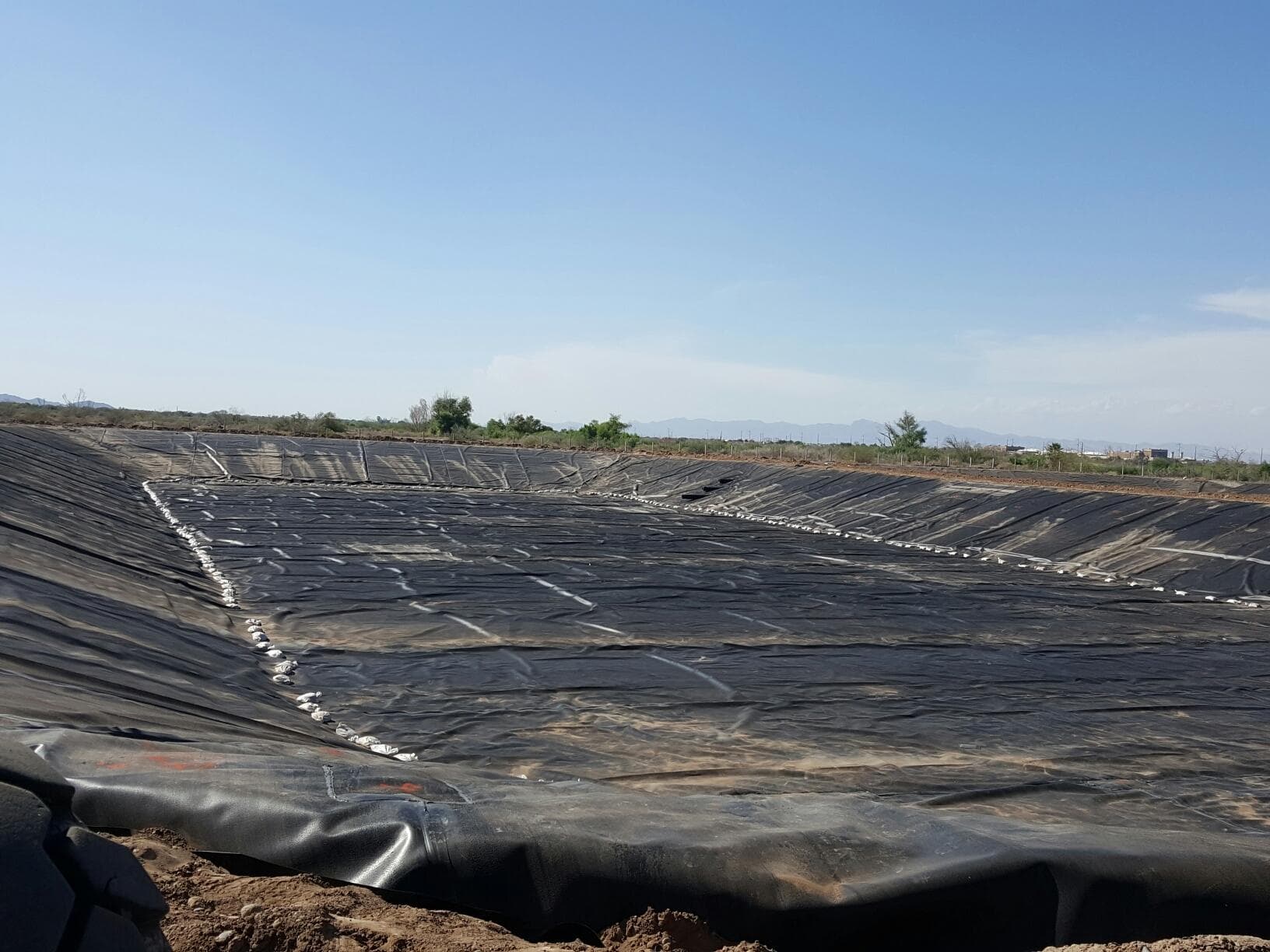
From the bottom up, the stack is a prepared subgrade, the secondary geomembrane, the leak detection layer, and the primary geomembrane that holds the process solution or leachate. The leak detection layer is usually a geonet or a drainage geocomposite: an HDPE core with open flow channels that carry liquid along the plane of the liner. Anything that passes through the primary lands in that layer and runs downhill.
Downhill ends at a sump, a low point formed in the secondary liner where the collected liquid pools. A riser pipe runs from the sump up the side slope, between the two liners, to the crest. The operator pumps or bails the sump through the riser, records the volume removed, and divides by the time since the last reading and the lined area. The result is a flow rate that can be held against the permit.
Bringing the riser out at the crest, above the liquid line, avoids cutting a pipe penetration through either liner below the waterline. The layer that holds the solution keeps the fewest possible places to leak.
The federal template is written as a flow rate
The hazardous waste rules for surface impoundments set out the same logic in more detail. 40 CFR 264.221(c) calls for a top liner, typically a geomembrane, a composite bottom liner whose lower component is at least 3 feet of compacted soil at no more than 1 x 10^-7 cm/sec, and a leak detection system between them. That system needs a bottom slope of one percent or more and, where geonet is used, a transmissivity of 3 x 10^-4 square meters per second or more. Each unit gets its own sump, sized so liquid does not back up into the drainage layer, with a way to measure and record what is removed.
264.222 then defines the action leakage rate as the maximum design flow rate the leak detection system can remove without the fluid head on the bottom liner exceeding 1 foot. Monitoring data is converted to an average daily flow in gallons per acre per day for each sump. The rule tells the designer to build in a safety margin and to account for clogging, rib layover, and creep of the synthetic components over time.
Mining process ponds and municipal landfill leachate ponds are generally permitted under state programs rather than those federal hazardous waste rules, but the same structure carries over. Nevada's NDEP guidance WTS-37 for holding and detention basins calls for a 60 mil primary and a 40 mil secondary HDPE liner or equivalent, with a 500 gallons per acre per day action limit on the primary.
A slow drainage layer hides its own failure
A geonet's catalog transmissivity is not what it delivers under a full pond. Transmissivity is measured per ASTM D4716 and changes with the normal load, the hydraulic gradient, and what is pressed against each face. Under a deep pond the primary liner is forced into the core, and a geotextile on the wrong face can be squeezed into the flow channels. The GRI-GC8 practice reduces the lab value for creep, intrusion, and clogging over the design life.
An undersized drainage layer does not announce itself. Leakage moves slowly, head builds on the secondary liner, and the sump reads low because the liquid has not arrived yet. The monitoring record looks clean for exactly the reason the Nevada rule says to shut the pond down.
Why the install sequence is unforgiving
The secondary liner has to be finished, tested, and accepted before anything covers it. Once the geonet and primary go down, every seam in the secondary is unreachable without tearing out the layers above. Dual-track fusion seams are air pressure tested per ASTM D5820, extrusion welds and repairs are vacuum box tested per ASTM D5641, and destructive samples go to shear and peel testing per ASTM D6392. On a double-lined pond, that full test record exists twice.
After that, the crew is working on top of a liner it will never see again. Geonet panels are overlapped and tied so they do not separate or roll when the primary is deployed over them. An unballasted stack can lift in wind. Every sandbag, tool, and vehicle load on the geonet is a load on the secondary beneath it. The sump and riser need details that tie into both liners without opening a path between them.
- Secondary geomembrane: seamed, tested, repaired, and documented before cover
- Leak detection layer: panels overlapped and tied, graded to drain to the sump
- Sump and riser: detailed so the riser runs between the liners to the crest
- Primary geomembrane: seamed and tested with the secondary no longer accessible
Leak location on the finished primary is its own planning problem. Electrical leak location surveys need a conductive path beneath the geomembrane, and a dry geonet does not provide one. Projects that want the primary surveyed decide how at the specification stage, often by specifying a conductive-backed geomembrane, rather than finding the limitation after the pond is built.
What the second liner buys the owner
A double-lined pond adds a second geomembrane, a drainage layer, a sump, and installation time. What it buys is a measurement. Instead of learning about a leak from a monitoring well, the operator reads flow from the sump on a schedule and can see whether it is rising against the action level. On a heap leach operation, the pregnant and barren solution ponds hold the most valuable liquid on the site. At a landfill, the leachate pond holds exactly what the base liner system exists to keep out of groundwater. In both, the sump reading tells the operator when to act.
EC Applications installs double-lined solution ponds, leachate ponds, and sumps from offices in Anaheim, California, Midland, Texas, and Sparks, Nevada, under CSLB licenses #894068 and #1003207.