On this page
In 1990, a technical note in Geotextiles and Geomembranes looked at seaming HDPE liners below 40°F (4.5°C) and reached a conclusion that still surprises owners. The temperature of the sheet was probably not the biggest risk. Frozen subgrade, bridging, snow and ice removal, and crews working cold all did more to threaten the installation.
That matters in the West more than people expect. Most Nevada mine sites sit between 4,500 and 7,000 feet, where nights fall below freezing for months while the afternoon sun still heats black sheet. Landfill cells and mine ponds are often needed on a schedule that does not stop for winter. The cold changes four things on a liner job.
What the seaming practice allows
The industry reference is GRI-GM9, the Geosynthetic Research Institute's practice for cold weather seaming of geomembranes. Answering a reader in Geosynthetics magazine in 2014, Robert Koerner wrote that it allows seaming down to minus 15°C (5°F). That is a floor with conditions attached, not a green light.
Below a sheet temperature of about 40°F, the Geosynthetic Materials Association guidance says shielding, preheating, and a slower seaming rate may be required, along with more frequent seam testing. The same guidance is explicit that GM9 does not override the project engineer or the specifications. In most cases a formal written exemption is needed before cold-weather seaming starts, and some installers recommend against seaming below 40°F ambient at all without owner-approved procedures.
Trial welds carry more weight
A wedge welder is set by speed, temperature, and pressure, and the right settings depend on the temperature of the sheet. In summer that number moves slowly. In winter it can swing across a single shift: a panel catching low morning sun, a north-facing side slope still in shade, a gust that strips heat off the sheet ahead of the wedge.
A trial weld qualifies the welder, the machine, and the settings for the conditions at the moment it is made. When those conditions change, the qualification no longer describes the work. On a cold job, that means more trial welds, more destructive samples where the CQA plan calls for them, and a crew lead willing to stop production welding until the settings are proven again.
Frost under the seam
Frozen ground causes a problem most people never think about. The heat from the welder thaws frost in the subgrade just beneath the seam, and that moisture condenses on the underside of the sheet ahead of the weld. A seam made through condensation is a contaminated seam.
The field fix is simple: a seaming board or slip sheet under the overlap, pulled along ahead of the welder, so the weld is made over a dry surface. Frost and moisture also have to come off the seam area itself before any welding starts, which on a cold morning can take real time.
Frozen subgrade is a puncture risk too. Frozen clods and tire ruts behave like rock until they thaw, and the guidance is to avoid placing sheet on sharp, frozen subgrade because it concentrates stress on the geomembrane. Ground accepted while frozen is also not quite the ground the liner will rest on after the spring thaw, which is a question for the engineer before deployment, not after.
The sheet shrinks overnight
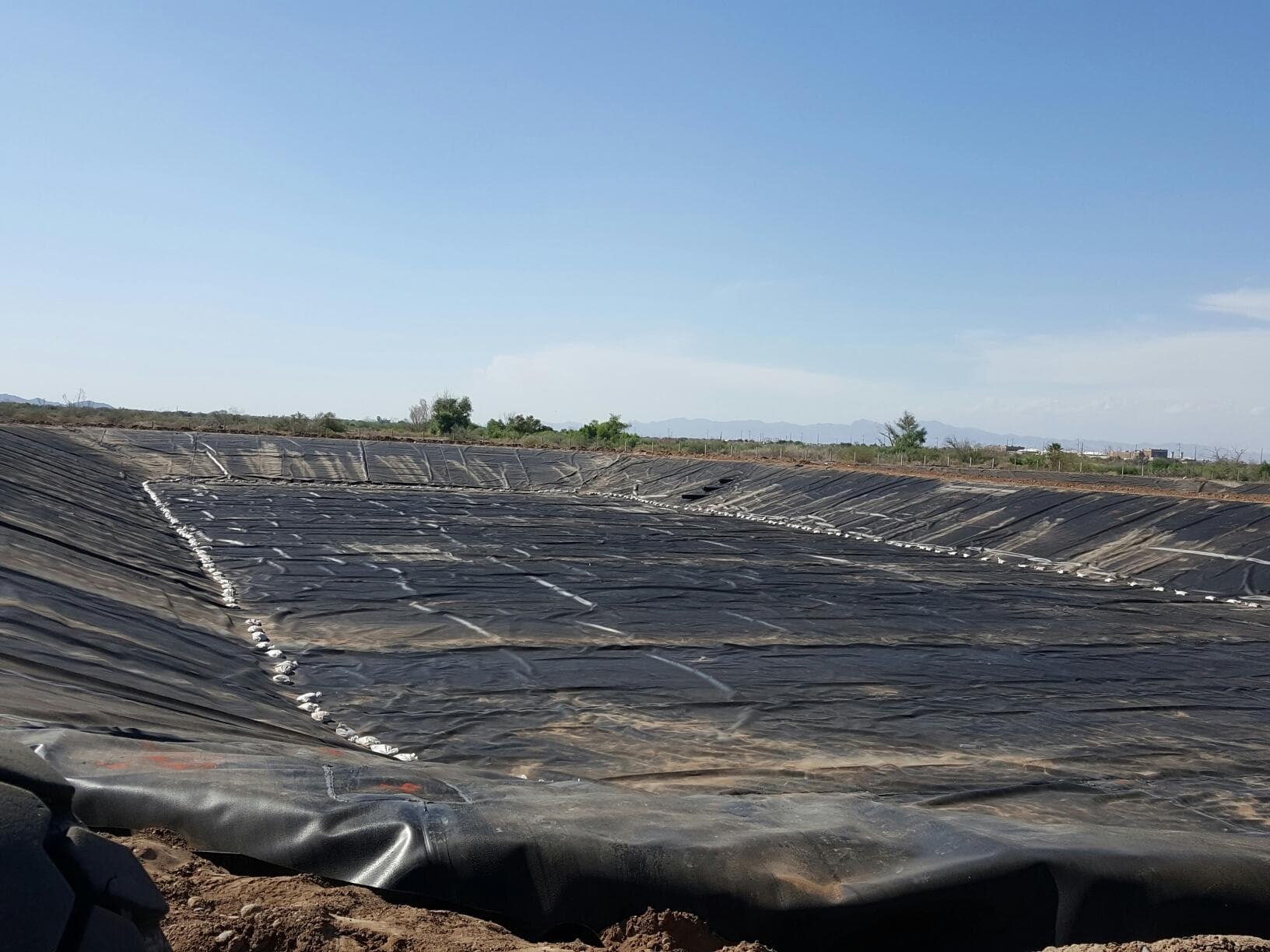
HDPE geomembrane expands and contracts at roughly 2 x 10^-4 per degree Celsius, per manufacturer data. A 300 foot panel that cools 30 degrees gives up close to 2 feet of length. In summer, extra length shows up as wrinkles. On a winter morning the opposite happens: the sheet pulls tight and lifts off the subgrade at the toe of slope and in corners.
That lifted span is called bridging or trampolining, and GMA guidance notes it is common at breaks in grade on cool mornings. Backfilling over it is the mistake. Soil placed on a bridged sheet stresses the geomembrane, and the guidance warns it can yield or rupture at seams and fittings.
- Leave slack in the panel layout so the sheet can contract without lifting off the subgrade.
- Push cover soil forward in fingers from a stable working area, working controlled slack into the sheet, as described in EPA/600/R-93/182, section 3.7.1.
- When trampolining is found, stop backfilling until the day warms and the sheet is back in contact with the material beneath it.
What it changes for the owner
In practice, a winter liner day is shorter than the daylight. Seaming waits for frost to clear and sheet temperatures to stabilize, cover placement waits for the sheet to relax back onto the subgrade, and both have to finish before the afternoon cold returns. None of that is in a bid table. It shows up as judgment calls on site: when to run another trial weld, when to hold the dozer, when to stop for the day.
That is why cold-weather work favors a deep crew bench. The owner gets a liner whose seam record holds up at permit review, and a schedule with no spring repair campaign hiding in it.
Where prefabrication fits the job, it helps too. EC Applications fabricates panels up to 25,000 square feet in its own shop, on clean tables out of the wind and weather, which moves much of the welding on containment, pond, and cover work indoors and leaves fewer field seams to make in the cold.
From the Sparks office east of Reno, EC Applications crews install heap leach pad, solution pond, tailings, and landfill liners on high-desert sites, and document every seam for the project CQA record. Our crews are the most experienced in the industry. They consistently deliver high quality installations with unparalleled customer service.