On this page
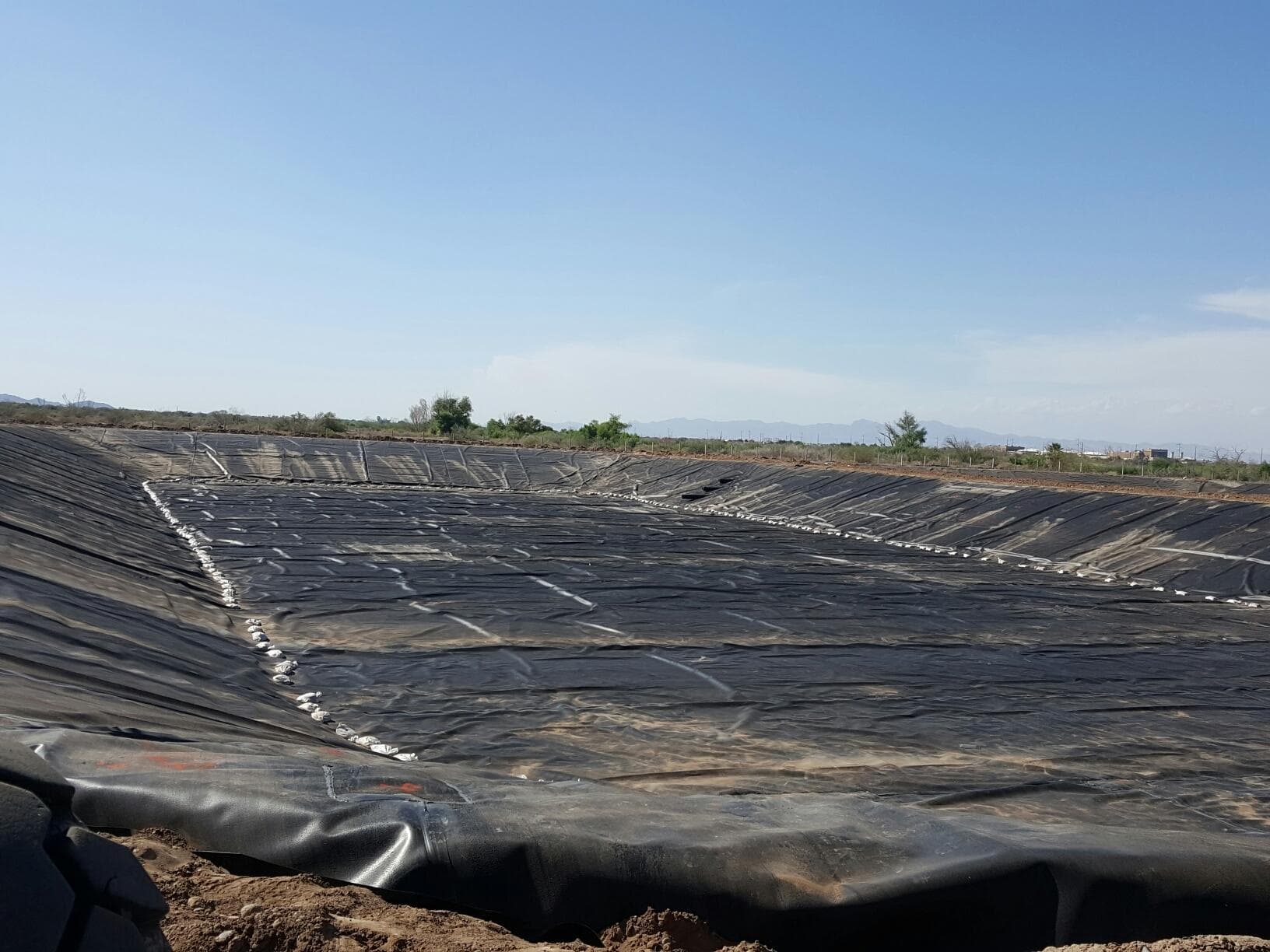
On a sunny afternoon at a Canadian test site, the air was 11 degrees Celsius and the black HDPE geomembrane on the base was 53. That gap is the whole story of wrinkles. A dark sheet in direct sun runs far hotter than the air around it, and HDPE grows as it heats.
Manufacturer data sheets put the linear thermal expansion of HDPE geomembrane at roughly 2 x 10^-4 per degree Celsius, tested to ASTM D696. A 300 foot panel that warms 30 degrees picks up close to 2 feet of length. The perimeter is anchored and the subgrade does not move, so that extra sheet has nowhere to go but up.
Why a wrinkle matters in a composite liner
A composite liner works because the geomembrane sits in intimate contact with the clay or GCL beneath it. If the sheet has a hole and the contact is tight, liquid that gets through has almost no room to spread, and the leak stays small. Federal Subtitle D design for municipal solid waste cells is built around that pairing.
A wrinkle breaks the contact. In his 2012 Casagrande Lecture, R. Kerry Rowe showed that leakage calculated for holes in a geomembrane in direct contact with clay typically comes out substantially smaller than what landfills actually record. Once typical connected wrinkle lengths were added to the calculation, the field numbers made sense. The same work found that, with excessive connected wrinkles avoided, a composite liner still leaks only a small fraction of what a geomembrane or clay liner would leak alone.
Holes are also more likely at wrinkles. The crown of a wrinkle sits closest to the dozer blade and tracks while cover goes down, and over the long term, tensile strain in the sheet is higher at a wrinkle than away from it. On a flat cell floor, a wrinkle can also dam leachate in the drainage layer, letting it build up to the wrinkle's height.
What the field measurements show
Researchers at Queen's University and their partners have measured wrinkles with low-altitude aerial photography at several sites in eastern Canada. For 1.5 mm (60 mil) HDPE, smooth or textured, wrinkles were typically about 0.06 m high and 0.2 to 0.3 m wide. A few reach 0.2 m high and 0.5 m wide, but that is rare.
Size is not the problem. Connection is. When wrinkles first form they stand alone. At the test site, once roughly 8 percent of the area was wrinkled, they began linking up, and connected wrinkle length grew rapidly, past 2,000 m when 30 percent of the site was wrinkled.
A municipal landfill base of 55 m by 140 m showed the daily cycle plainly. Wrinkles covered 3 percent of the area at 8:45 in the morning, 20 percent at 12:25, and 7 percent at 5:15 in the afternoon. The longest connected wrinkle grew from 30 m at 8:45 to 2,500 m at 1:45.
The clock decides the leakage
The practical finding is about time of day. At the Queen's test site, covering the geomembrane with the leachate collection layer before 8 in the morning or after about 4 in the afternoon kept connected wrinkles to 200 m or less. Cover placed around 1 in the afternoon locked in connected lengths near 2,000 m for each unrestrained area up to about 0.2 hectares.
Those numbers come from an eastern Canadian construction season. A summer cell floor in the Mojave, the Central Valley, or the Great Basin sees more sun and hotter sheet, so there is little reason to expect a wider cover window in the West.
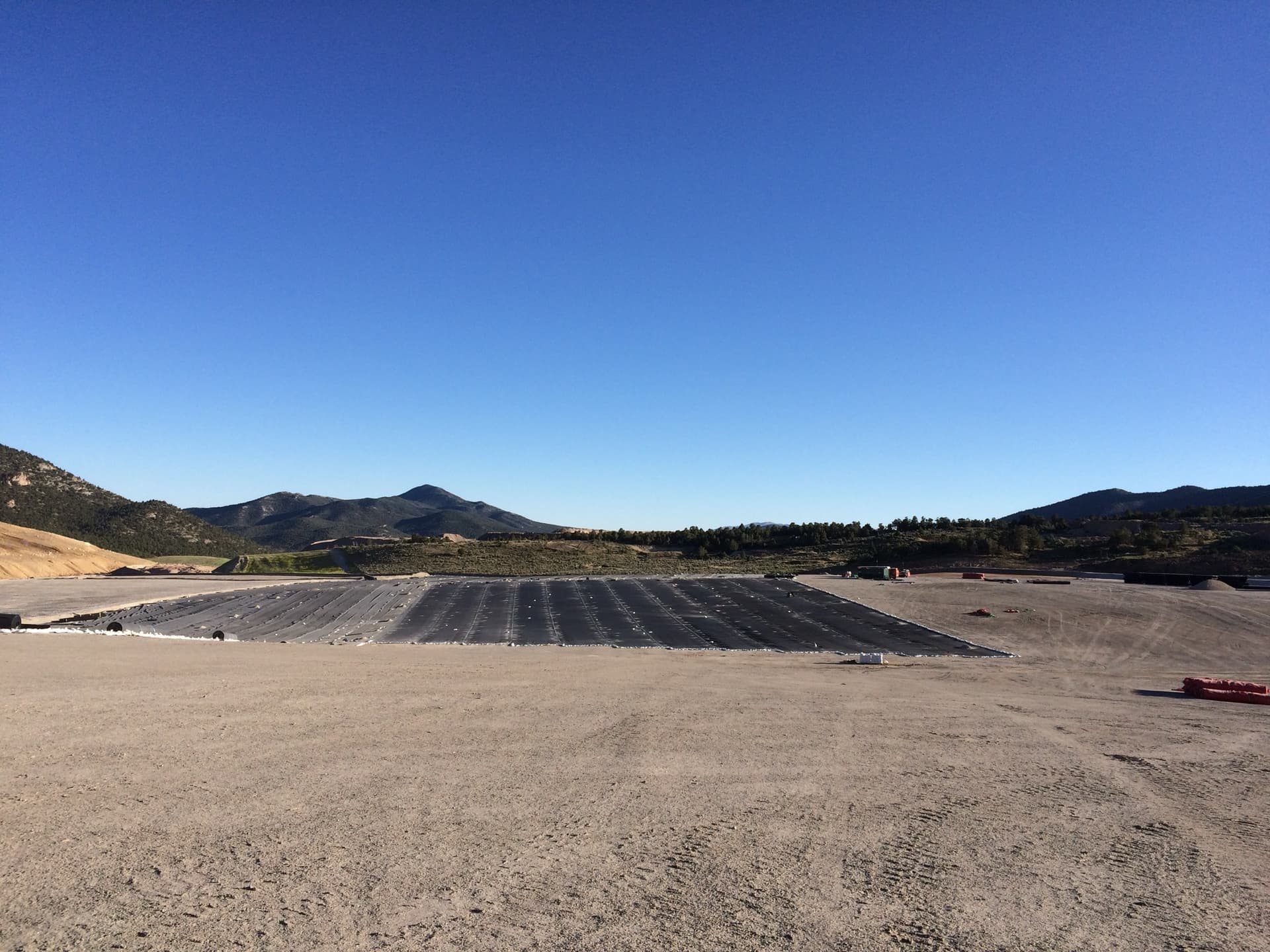
The same landfill study shows a cheap control. That base had been split into four subareas with lines of sandbags about 3 m apart, which kept wrinkles from linking across the whole floor. The 2,500 m wrinkle formed where one sandbag was missing and two subareas joined. With the bag in place, the longest wrinkle would have been about 1,550 m.
Material choices that help
- White-surfaced HDPE: a 2017 field study in the ASCE Journal of Geotechnical and Geoenvironmental Engineering found a coextruded white surface ran 21 to 23 degrees Celsius cooler at peak than black sheet. At the hottest part of the day, wrinkles covered about half as much of the white sheet, and the longest connected wrinkle was about a fifth as long.
- GCL instead of compacted clay: Rowe found leakage through composite liners with a GCL is typically much less than with a compacted clay liner, because the GCL interface limits how far liquid can spread from a hole.
- GCL overlap of 300 mm: wet and dry cycles under an exposed geomembrane can shrink GCL panels until the overlap opens. Covering quickly is the best protection, and a wider overlap buys margin.
None of these remove the need to cover on time. Exposed compacted clay can desiccate within hours under a sheet running 50 to 70 degrees Celsius, and GCL panel separation has been seen in under two months in some cases.
Why this is a crew and schedule problem
Every one of those controls lives in the field. Deploying panels so cover can follow the same day, placing ballast grids, welding while sheet temperature changes through the shift, and running trial welds and seam tests fast enough that cover is never held up all fall to the installer. Then the earthwork contractor has to bring drainage stone onto the sheet in the cool hours, with enough material ahead of the equipment to keep tracks off the geomembrane.
EC Applications installs the full composite section on landfill cells as one scope: subgrade acceptance, GCL or clay interface verification, geomembrane deployment and welding, and the geonets, geocomposites, and cushion geotextiles above. Our crews work to the project CQA plan and document each seam before the next layer covers the work, and they coordinate with the earthwork contractor so cover goes down while the sheet still lies flat.
Our crews are the most experienced in the industry. They consistently deliver high quality installations with unparalleled customer service.