On this page
- What a gas-containment cover over a lagoon actually is
- Why 45 mil XR-5 over a 12 ounce geotextile
- Over 150 penetrations, and why each one is the real work
- Phasing and simultaneous crews over an existing lagoon
- Vacuum testing every seam, smoke testing the whole system
- Anchoring the perimeter
- What this means for an owner specifying a cover over an existing lagoon
- Takeaways before you accept a cover
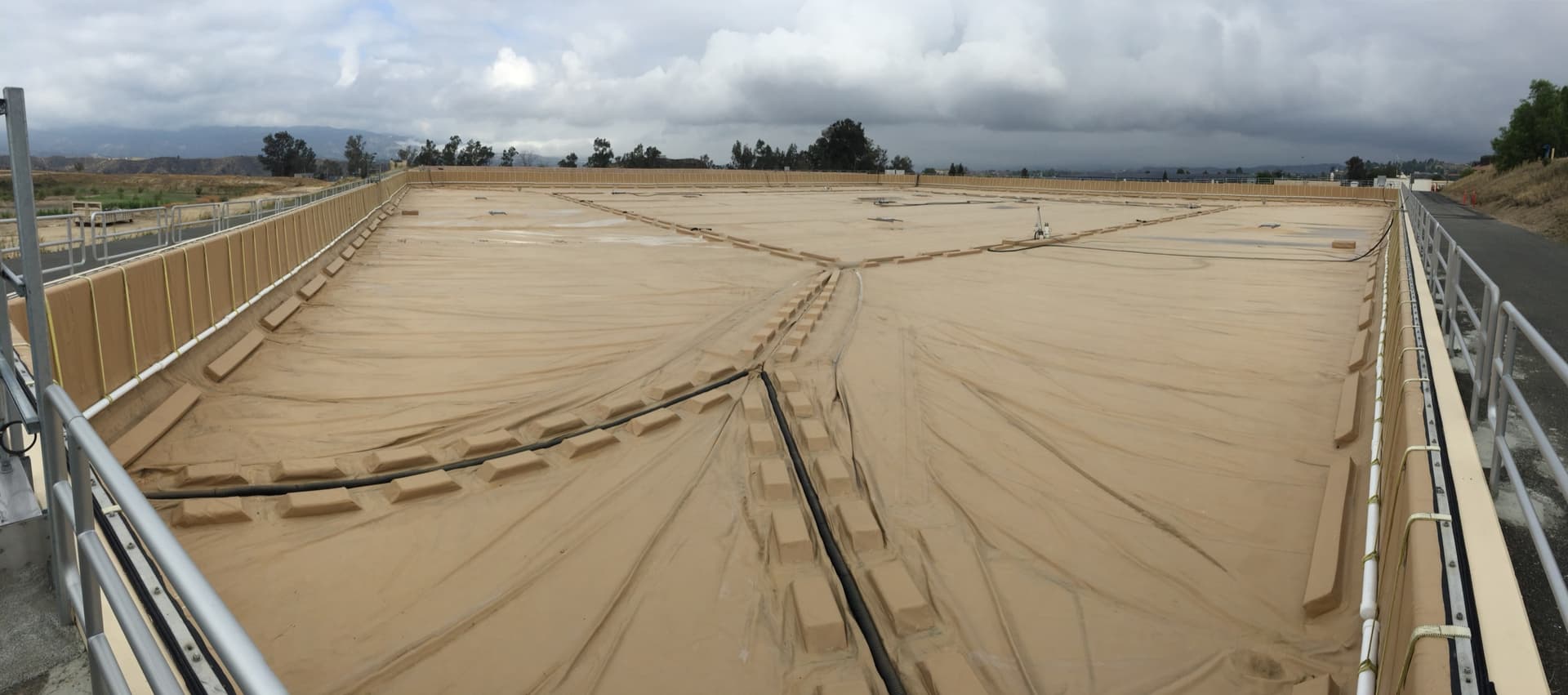
In 2009, EC Applications installed a 600,000 square foot biogas cover and passive gas-containment barrier over an existing lagoon for Hawaiian Electric Company in Hawaii. The work went in across multiple phases, coordinated across simultaneous contractor crews, and it sealed more than 150 penetrations through the liner. Every seam was vacuum tested, and once the cover was complete the whole system was smoke tested to confirm it held gas without a leak. Numbers like those describe a specific kind of job. A large gas-tight membrane, detailed one penetration at a time, and proven before anyone signed off on it.
What a gas-containment cover over a lagoon actually is
Lagoons can generate gas that needs to be captured and contained rather than left to vent off the top. The installation that does it is a continuous membrane placed over the lagoon, so gas collecting beneath the cover is held instead of escaping to atmosphere. From the installer's side, the cover is a fabrication and detailing problem. It is a single sheet that has to stay continuous and gas-tight across a large surface, around every pipe and structure that passes through it, and at the perimeter where it terminates.
The install is simple to describe and demanding to execute. The geotextile cushion goes down first, panels of reinforced membrane are positioned and joined into one sheet, and the edges are anchored. The difficulty is scale and continuity. On a 600,000 square foot cover, a defect anywhere is a defect in the whole system, so the work is less about speed and more about never breaking the barrier the material creates.
Why 45 mil XR-5 over a 12 ounce geotextile
XR-5 is a reinforced geomembrane, an ethylene interpolymer alloy coating bonded to a woven polyester scrim. The scrim carries load and holds dimension, so the sheet does not creep or neck down under its own weight and wind, and the coating gives the chemical resistance and UV stability a cover needs when it sits exposed for years. That pairing of dimensional stability and durability is why 45 mil XR-5 gets specified over an unreinforced sheet.
The 12 ounce geotextile underneath is the cushion layer. Its job is to keep the membrane off anything that could puncture it, which on an existing lagoon means berm surfaces, edges, and any hard points the cover bears against. A membrane is only as sound as what it rests on, so the cushion is not an accessory. It keeps the barrier intact where it contacts the ground.
Over 150 penetrations, and why each one is the real work
Every pipe, riser, or structure that passes through a cover is a hole cut in an otherwise continuous sheet, and a hole is a leak path until it is detailed closed. On this project there were more than 150 of them. That count, more than the square footage, is what defines the difficulty of the job, because the open field is repetitive while the penetrations are each individual.
Each penetration is sealed with a field-fabricated boot or flashing. The membrane is cut to the pipe, a collar of the same material is welded around it, and the assembly is banded or welded tight so gas cannot track up the annular gap. On a gas-tight cover a boot has to be as sound as the field seams around it, and there is no shortcut for volume. More than 150 penetrations means more than 150 individually welded and inspected details.
Phasing and simultaneous crews over an existing lagoon
The cover went in across multiple phases with simultaneous contractor crews rather than as one sheet placed in a single pass. On an existing lagoon that is the practical way to cover a surface this large. You stage the work so each phase is a workable area, and you run more than one crew to hold schedule. The cost of that approach is coordination. Every phase boundary becomes a seam that has to tie into the next phase cleanly, and every crew has to weld to the same standard so the finished cover reads as one sheet.
Simultaneous crews multiply the seams being made at once and the hands on the membrane, which is exactly why the testing regime matters. When several crews build toward each other, no section is done until its seams and boots pass. A phase boundary is not a place where responsibility gets blurred.
Vacuum testing every seam, smoke testing the whole system
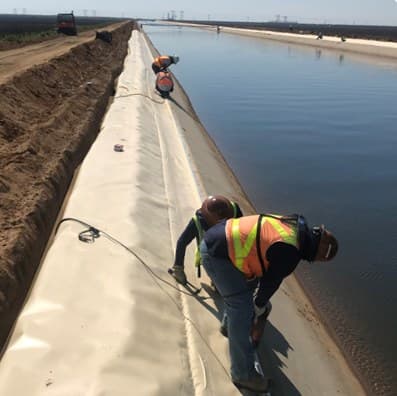
Every seam on the cover was vacuum tested. A vacuum box is set over a soaped seam and pulled down to a partial vacuum, and if the weld leaks, bubbles appear at the flaw. It is a direct, seam-by-seam way to prove a weld held rather than assume it did, and on a gas-containment cover it is the baseline quality check for both the field seams and the penetration boots.
Vacuum testing proves individual seams. It does not prove the system. That is what the smoke test is for. Smoke is introduced under the completed cover, and anywhere it escapes marks a leak the seam-by-seam testing missed, whether at a boot, a termination, or a spot of membrane damage. Smoke testing the whole installation verifies that a cover assembled from thousands of feet of seam and more than 150 penetrations is leak-proof as a single gas-tight envelope.
Anchoring the perimeter
A cover is only contained if its edges are. On this project the perimeter was secured with roughly 1,000 linear feet of stainless-steel mechanical attachment, a batten-bar style termination that clamps the membrane down along its edge. Stainless is the right metal for a perimeter that sits outdoors over the long term, because the attachment has to survive the same exposure the membrane does. A well-anchored perimeter keeps wind from working the cover loose, and it closes the barrier at its edge.
What this means for an owner specifying a cover over an existing lagoon
If you own a lagoon that needs a gas-containment cover, the HECO project shows where the risk actually lives. It is not in the open field of the membrane. It is in the penetrations, the phase-boundary seams, and the perimeter termination, and it is only provable if every seam is tested and the finished system is leak-checked as a whole. EC Applications is a geosynthetics installation contractor that self-performs this work, with its headquarters in Anaheim, California, and offices in Midland, Texas, and Sparks, Nevada, and it holds California contractor licenses CSLB #894068 and CSLB #1003207.
Takeaways before you accept a cover
A few points are worth stating plainly for owners.
- Specify the reinforced membrane and the geotextile cushion for the service life and exposure you actually need, not just the square footage.
- Budget the schedule around penetration detailing, because the boots are the slow, individual work, not the open field.
- Require both seam-level and whole-system leak verification before the cover is accepted, so a leak has to reveal itself before startup rather than after.
A large cover installed in phases by multiple crews can still come off as one continuous gas-tight envelope. The HECO cover did, and the reason was testing every seam and smoke testing the result, not trusting the material to be right on its own.