On this page
The liner standard for a new coal ash unit opens with three sentences. Under 40 CFR 257.70(b), a composite liner is a geomembrane of at least 30 mil over at least two feet of compacted soil with a hydraulic conductivity of no more than 1 x 10^-7 centimeters per second. If the geomembrane is HDPE, it must be at least 60 mil. The third sentence is the one that governs the field work: the geomembrane must be installed in direct and uniform contact with the compacted soil.
EPA published the coal combustion residuals (CCR) rule in April 2015 under RCRA Subtitle D. Section 257.70 applies the composite liner to new CCR landfills and lateral expansions. Section 257.72 applies the same liner, by cross-reference, to new CCR surface impoundments and to lateral expansions of existing ones, and adds two sentences of its own. The liner must cover all surrounding earth likely to be in contact with CCR, and dikes shall not be constructed on top of the composite liner.
Direct and uniform contact is an installation requirement
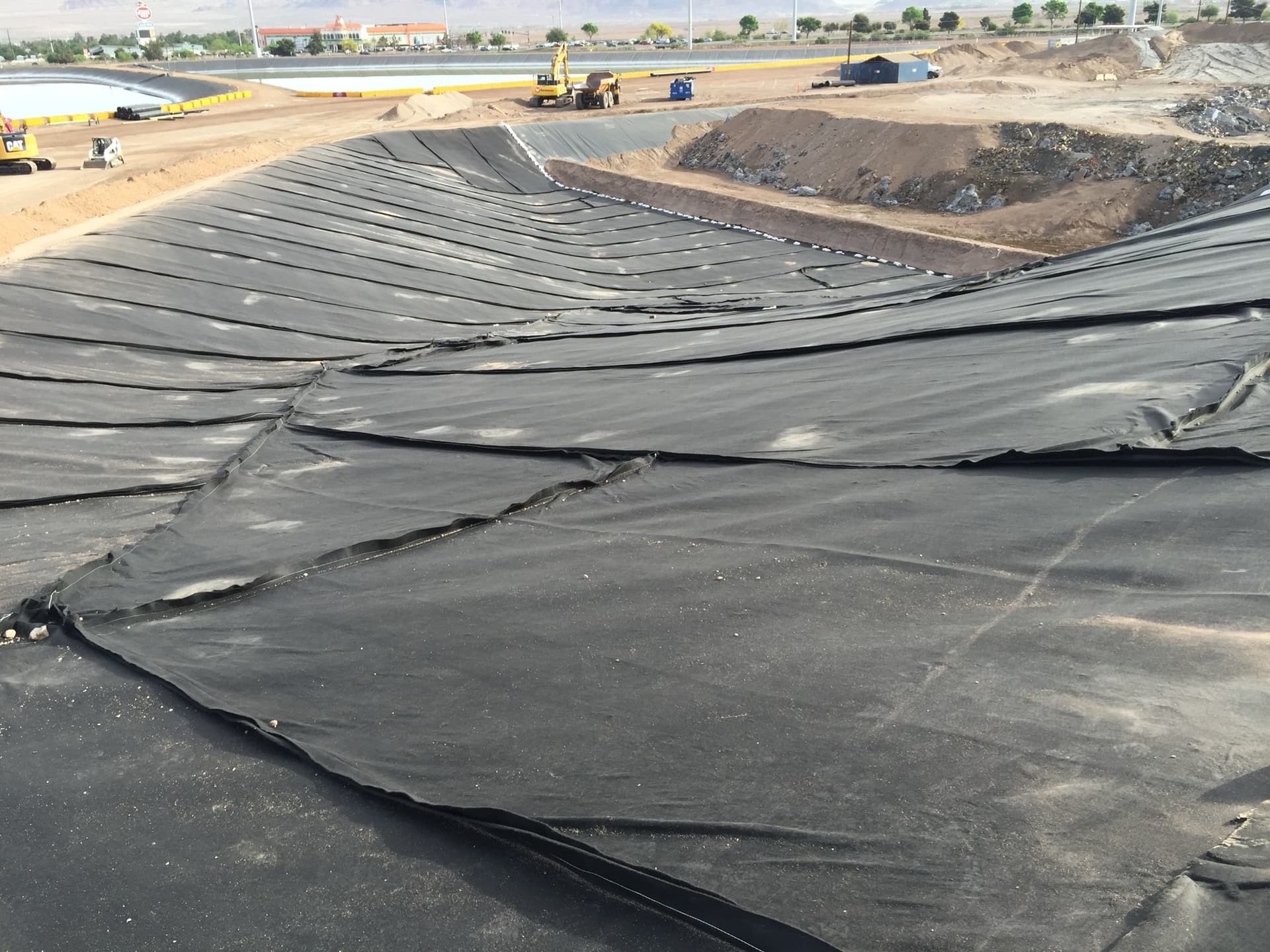
A composite liner works because its two layers act as one. When a hole in the geomembrane sits tight against low-permeability soil, liquid that passes the hole has almost nowhere to go, and the leak stays small. When a wrinkle or a void separates the sheet from the soil, liquid spreads sideways through that gap and reaches far more soil than the hole alone would expose. The rule does not say how to achieve contact. It says contact has to exist.
That puts the requirement on the crew. HDPE expands noticeably as it heats, so a sheet deployed flat in cool morning air can carry wrinkles by afternoon. Deployment, seaming, and cover placement have to be sequenced around sheet temperature. The compacted soil surface has to be smooth, free of stones and ruts, and kept from drying and cracking before it is covered, because the soil layer only meets its conductivity limit while it holds together.
Four more conditions in 257.70(b)
The same paragraph lists four conditions the composite liner must meet:
- Materials with the chemical properties, strength, and thickness to prevent failure from pressure gradients, contact with the CCR or leachate, climatic conditions, the stress of installation, and the stress of daily operation.
- Shear resistance at the interface between the upper and lower components, to prevent the upper component from sliding, including on slopes.
- A foundation or base that supports the liner and prevents failure from settlement, compression, or uplift.
- Coverage of all surrounding earth likely to be in contact with the CCR or leachate.
Two of those read like field instructions. The stress of installation is written in as a design load, next to static head and daily operation. The interface shear condition is why steep side slopes are often lined with textured geomembrane, whose roughened surface grips the soil below it where smooth sheet would slide. For landfills, 257.70(d) adds a leachate collection and removal system designed to keep less than 30 centimeters of leachate over the liner.
Clay alone no longer counts as lined
As written in 2015, 257.71(a)(1)(i) let an existing surface impoundment count as lined if it had two feet of compacted soil at 1 x 10^-7 centimeters per second, with no geomembrane at all. On August 21, 2018, the D.C. Circuit vacated that provision in Utility Solid Waste Activities Group v. EPA. EPA's rule of August 28, 2020 reclassified clay-lined impoundments as unlined, and the paragraph now reads Reserved.
Under the current text, an existing impoundment is unlined if it was not built with a 257.70(b) composite liner or a 257.70(c) alternative composite liner, or if the owner failed to document one. Section 257.101(a)(1) required unlined impoundments to stop receiving CCR and non-CCR wastestreams as soon as technically feasible, and no later than April 11, 2021, and then to retrofit or close. The alternate liner demonstration in 257.71(d) and the alternative closure procedures in 257.103 are the only exceptions to that timeframe.
A retrofit starts with an empty impoundment
Retrofit is defined in 257.102(k). The owner must first remove all CCR, including any contaminated soils and sediments, and then comply with 257.72. That means a new composite liner that meets 257.70(b) or (c), carried over every surface the ash could reach. The retrofit has to be finished within the same time frames and procedures that apply to closing the impoundment.
In practice, the liner goes onto a basin that held ash, often for decades. The compacted soil component has to be rebuilt or proven to the same conductivity limit before any sheet is deployed. Because dikes cannot be built on top of the composite liner, any embankment work has to be complete before lining starts. The geomembrane then runs up and over interior slopes that the rule expects to hold it in place without sliding.
Closing in place is a cap job
An owner who leaves CCR in place must first eliminate free liquids and stabilize the remaining waste enough to support a cover, under 257.102(d)(2). The prescriptive final cover in 257.102(d)(3)(i) has a permeability less than or equal to that of any bottom liner or natural subsoils present, or no greater than 1 x 10^-5 centimeters per second, whichever is less. It needs an infiltration layer of at least 18 inches of earthen material, an erosion layer no thinner than six inches capable of sustaining native plant growth, and a design that accommodates settling and subsidence.
That is the same structure as the Subtitle D municipal landfill cover in 258.60, and it leads to the same place. Section 257.102(d)(3)(ii) allows an alternative final cover that achieves an equivalent reduction in infiltration and equivalent erosion protection, and that equivalence test is where a geomembrane cap over wet, settling ash gets measured.
Certification brackets the work
Sections 257.70(e) and (f), and 257.72(c) and (d), require certification from a qualified professional engineer, or approval from the Participating State Director or EPA, twice. Once before construction, that the design meets the rule. Once on completion, that the liner was built as designed. The second certification rests on the installation record: panel layout, seam test results, repairs, and documented contact with the soil.
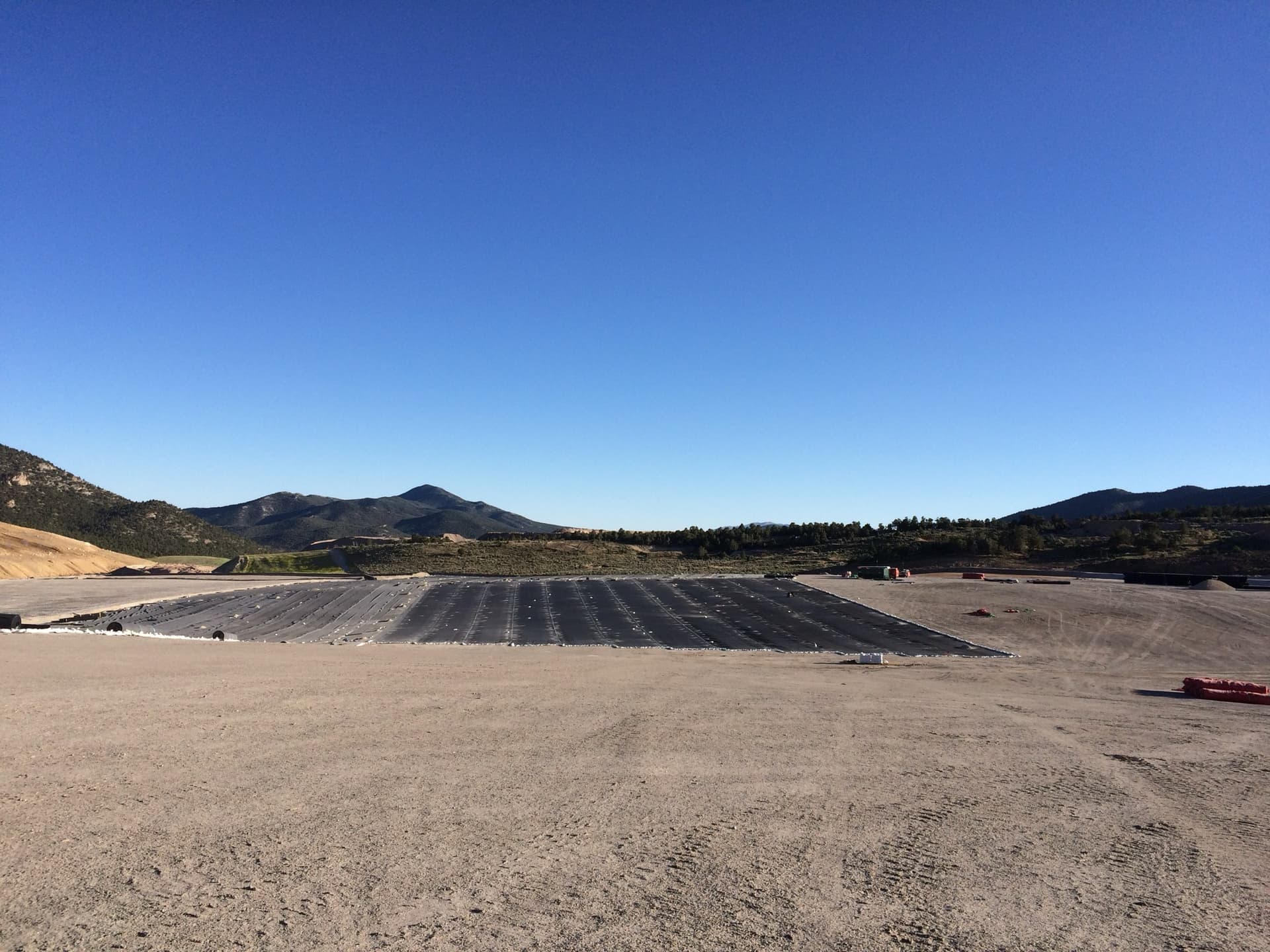
EC Applications installs composite base liners for new CCR landfill cells, geomembrane liners for ash ponds and contact water basins, and low-permeability capping systems for impoundments closing in place. Crews work from offices in Anaheim, California, Midland, Texas, and Sparks, Nevada, under CSLB licenses #894068 and #1003207. EPA amended the closure deadlines again in May 2024 and February 2026 without changing the liner, retrofit, or final cover text quoted here, so check the current eCFR text at the start of any design.