On this page
GRI-GM13 and GRI-GM17 include carbon black, oxidative induction time (OIT), oven-aging, and UV criteria for polyethylene geomembranes. Those manufacturing checks help qualify a formulation. They do not establish how many years it will last in a lagoon. Selection also depends on the wastewater, operating temperatures, exposed edges, subgrade, and installation details.
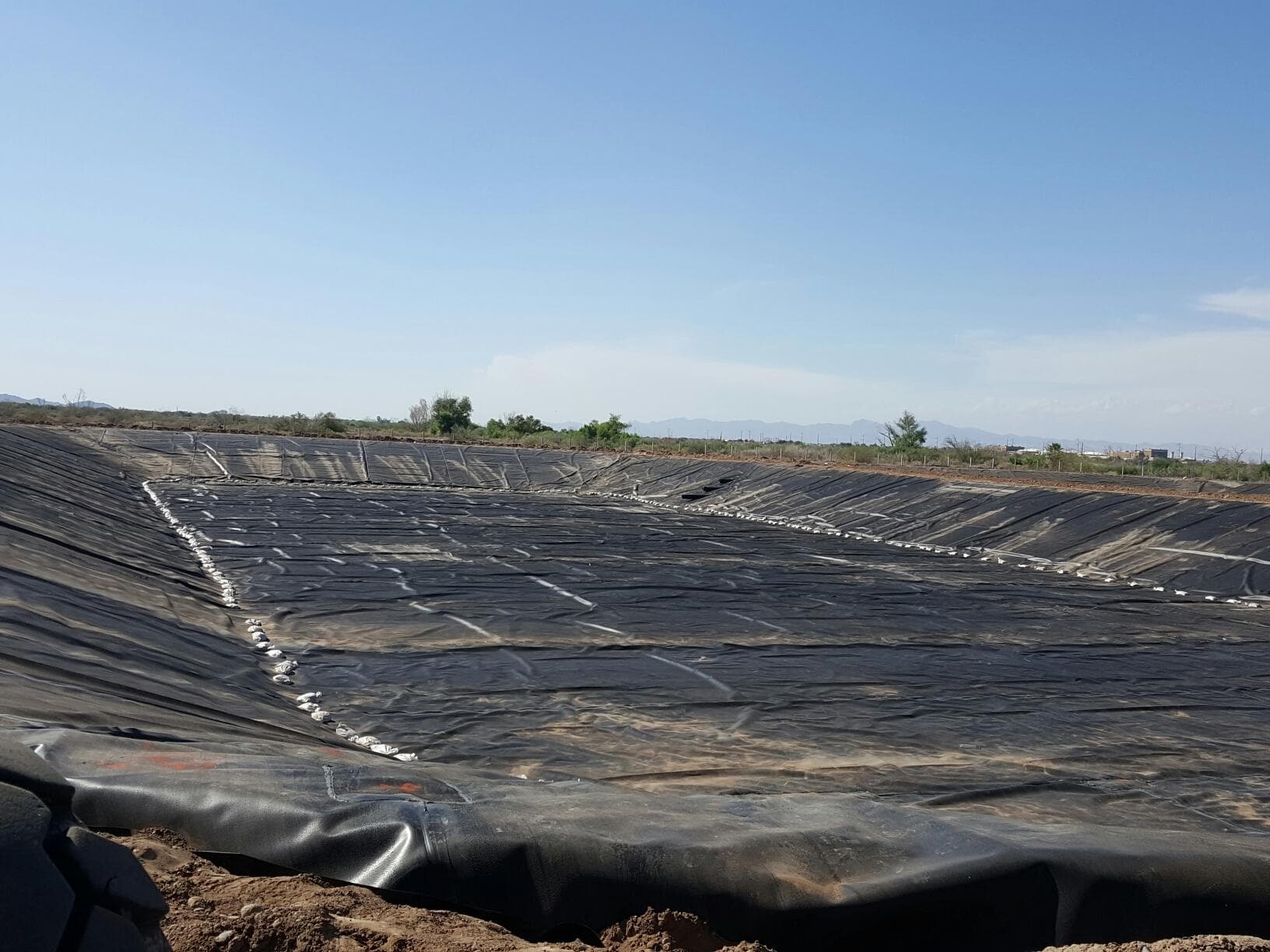
In an uncovered lagoon, the liner above the waterline sees sunlight, temperature changes, and wind. Drawdown exposes additional sheet. A covered lagoon has a different exposure profile, but the cover does not remove the need to check temperature and chemical contact. Record minimum and maximum operating levels, maintenance conditions, and influent composition before comparing materials. Water over the floor should not be assumed to provide complete UV protection throughout that cycle.
HDPE and the limits of a material submittal
HDPE is a candidate for wastewater containment, subject to compatibility and design review. A submittal should identify thickness, surface, formulation, and test results. For example, GRI-GM13's 60 mil smooth-sheet minimum average values include 126 lb/in tensile yield strength, 42 lb tear resistance, and 108 lb index puncture resistance. The 60 mil textured-sheet puncture value is 90 lb. Compare the correct table to the proposed product; those index values do not establish allowable loads at the site.
HDPE installation needs allowance for thermal movement and careful detailing at slope breaks and penetrations. AGRU's installation guidance calls for prepared subgrade, controlled deployment, and management of waves and wrinkles. GRI-GM13 also includes a 500 hour stress-crack resistance criterion under ASTM D5397. Meeting that laboratory criterion does not eliminate stress concentrations from poor support or restrictive connections.
LLDPE, for lagoons that will move
LLDPE's flexibility can help where the geotechnical review identifies movement, but it does not excuse an unprepared subgrade. GRI-GM17 sets different break-elongation minima for smooth and textured sheet: 800 and 250 percent, respectively. Its axi-symmetric break resistance strain minimum is 30 percent. These laboratory properties help compare products; they are not permissible settlement strains. Evaluate the seams, attachments, and local strain concentrations with the engineer.
At 60 mil, compare smooth LLDPE's 84 lb index puncture minimum with smooth HDPE's 108 lb; for textured sheet, the corresponding values are 66 and 90 lb. The tear minima are 33 lb for LLDPE and 42 lb for HDPE. Those manufacturing comparisons inform review but do not size a protection layer. LLDPE also has exposed-service formulations, including Solmax's GSE LLX. Confirm weathering evidence for the proposed grade instead of treating flexibility as a reason to exclude it from sunlight.
Reinforced sheet for small lagoons and complicated geometry
Reinforced flexible polypropylene incorporates an internal scrim, so its mechanical behavior and applicable test methods differ from nonreinforced polyethylene sheet. GRI-GM18 covers reinforced grades at 36, 45, and 60 mil, along with nonreinforced products. ASTM D6434 guides test-method selection for both types. Check the method behind a reported strength value before comparing it with another material. A coated-fabric grab tensile result and a sheet tensile result are not interchangeable.
Prefabricated reinforced panels can reduce field seaming. The proposed layout should identify which connections remain in the field and how each will be inspected. Confirm panel weights, lifting access, temporary restraint, and repair procedures with the fabricator and installer. Penetrations still require suitable details, and large panels still need wind controls. Compare the complete deployment plan against a roll-based alternative before assuming a schedule advantage.
When the effluent actually governs
Industrial wastewater can make chemical compatibility a deciding factor. Reinforced ethylene interpolymer alloy (EIA) products such as XR-5 are candidates for review, not an automatic answer for every solvent or mixture. GRI-GM34 covers EIA geomembranes. Obtain the selected grade's data and manufacturer assessment for the actual concentrations, temperatures, and contact duration. Where appropriate, EPA Method 9090A testing can help evaluate changes in liner properties after contact with the wastewater.
PVC requires the same attention to the actual formulation. ASTM D7176 covers nonreinforced PVC for buried applications; citing it alone does not qualify exposed freeboard service. It also does not establish a blanket ban on every exposed PVC product. Request product-specific weathering evidence for any exposed use and define the proposed protection where buried service is intended. Adding a cover does not by itself establish chemical compatibility or the correct liner thickness.
What the material choice does not solve
Gas or water pressure beneath a geomembrane can cause uplift regardless of the chosen polymer. GSI's White Paper 33 addresses underdrain design for this problem. Review groundwater, potential gas generation, drainage capacity, vent outlets, and empty-lagoon conditions with the engineer. Polymer density alone cannot establish uplift resistance: GRI-GM13 defines HDPE sheet at 0.940 g/cc or higher, while GRI-GM17 defines LLDPE at 0.939 g/cc or lower. The resistance comes from the designed system and operating conditions.
Edge restraints, ballast, and slope interfaces also need design checks. Textured sheet alone does not establish slope stability; review the actual interface materials and loading. The installation plan should show how the liner will be restrained during deployment and operation, how attachments will be inspected, and how maintenance crews will reach the exposed edges.
How the decision usually goes
Start with the operating profile and geotechnical findings, then compare products that meet the required chemical and exposure conditions. Review thickness, surface texture, protection, seams, and connections as one system. Ask the installer to explain deployment and testing at the difficult details before award. The final material, acceptance criteria, and maintenance provisions belong in the project specification so competing bids address the same lagoon.