On this page
NRCS Conservation Practice Standard 521 lists two minimum thicknesses for the same HDPE liner. Thirty mil if the impoundment holds clear water. Sixty mil if it holds wastewater. Nothing about the basin has to change between those two columns. Same subgrade, same 2:1 side slopes, same anchor trench. The stored liquid changed, so the sheet doubles.
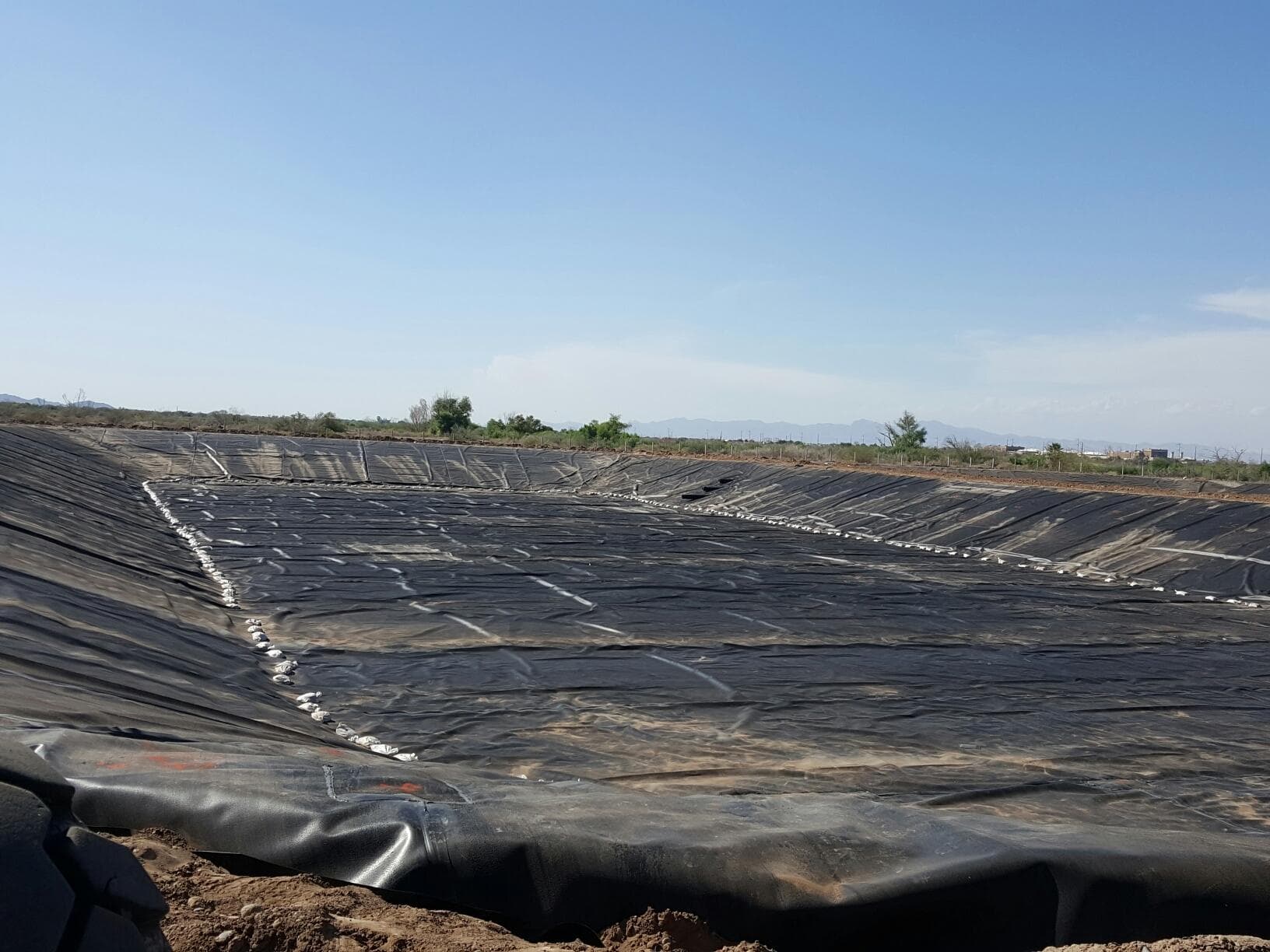
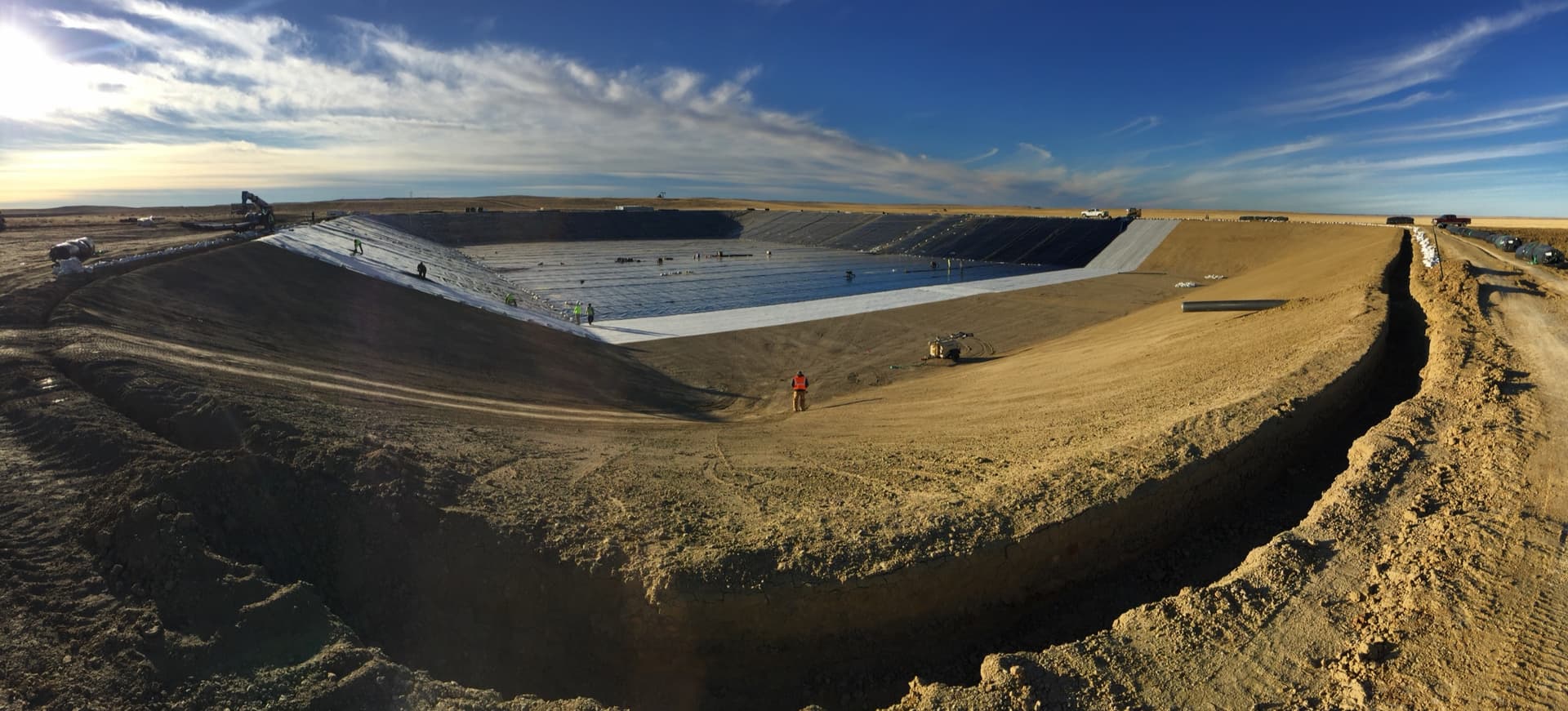
That table is the quickest way to explain why an agricultural liner is not one product. An irrigation storage pond and a dairy waste pond can sit a quarter mile apart, get dug by the same excavator to the same geometry, and still carry different liner specs, different venting, different leak detection, and different inspection expectations.
The material table, and what puts a pond in the wastewater column
Code 521 covers geomembrane and geosynthetic clay liners for water, wastewater, salt, manure, and similar agricultural impoundments. Its Table 1 gives a minimum thickness for each material in each service, in mils.
- HDPE: 60 mil wastewater, 30 mil clear water
- LLDPE: 60 mil wastewater, 30 mil clear water
- Reinforced LLDPE: 45 mil wastewater, 24 mil clear water
- PVC: 40 mil wastewater, 30 mil clear water
- EPDM: 45 mil in both wastewater and clear water
- Flexible polypropylene: 45 mil wastewater, 30 mil clear water
- Reinforced flexible polypropylene: 45 mil wastewater, 36 mil clear water
- Reinforced slit-film woven polyethylene: not recommended for waste storage, 36 mil clear water
- Geosynthetic clay liner: 0.75 pounds per square foot
What moves a pond into the wastewater column is the facility it serves. A manure, process water, or feedlot runoff impoundment is a waste storage facility under Conservation Practice Standard 313, and 313 tells the designer to either line the impoundment to Code 520, 521, or 522, or prove the foundation soils already meet the maximum specific discharge NRCS gives in Appendix 10D of the Agricultural Waste Management Field Handbook. It then adds the phrase that matters most on a real project: that federal criterion or the state and local regulation, whichever is more restrictive.
The national table is a floor. States with active dairy and confined animal programs publish their own version of 313 and 521, and the state version is the one a plan reviewer holds the design against.
Venting is not optional on an ag pond
Every geomembrane pond liner under 521 requires vents at the crest of the side slopes, spaced no more than 50 feet apart. A pond without a bottom gas venting system has to be graded to a minimum 2 percent bottom slope so gas and liquid have somewhere to go.
Waste storage gets a venting system beneath the liner where the manufacturer recommends one or where the site investigation finds gas potential, and the standard names the conditions that create it: animal waste that has already seeped into the foundation soil, organics in the soil, and fine-grained soils under a fluctuating water table. A new lagoon built on an old feed area, or a retrofit over a lagoon that was never lined, hits all three at once. We have written separately about what trapped gas does to a liner once the pond is in service.
Groundwater gets its own rule. Any geomembrane liner needs a drainage system if the pond invert sits within 2 feet of the seasonal high water table, and 313 asks for the design bottom to be at least 2 feet above that table to begin with.
When leak detection stops being optional
521 ties leak detection to the soil under the sheet. On Group I or II soils with an estimated permeability greater than 5 x 10^-5 cm/sec, a leak detection system is required under a geomembrane at a waste storage facility. On Group II, III, or IV soils at least 2 feet deep at or below that permeability, it is optional.
The system can be electronic, or a restrictive soil layer at 5 x 10^-5 cm/sec or lower, at least 12 inches thick, separated from the geomembrane by a permeable layer draining to a collection pipe. A secondary geomembrane of at least 15 mil can stand in for the soil layer.
The standard is candid about why any of this exists. It tells designers to size the drainage system for one 0.16 square inch hole per acre of liner surface, citing Giroud and Bonaparte. That is an assumption that the liner leaks a little, written into the practice standard itself.
What actually damages an agricultural liner
Agitation. Where a pond management plan shows agitators or pumps working in a spot, 521 requires protective measures at that spot, and it lists them as increasing thickness above the Table 1 minimum or building protective ramps and aprons. Access ramps get concrete with embedded channels tying into the liner.
Penetrations. Waste storage penetrations have to be watertight, and pipes get checked for buoyancy and anchored accordingly. For wastewater HDPE with penetrations over 2 inches in diameter, the standard suggests a concrete pad with the liner embedded to hold the connection and take the discharge.
Angular material. A cushion layer is required between the liner and any angular particle or concretion larger than 3/8 inch, and the cushion is either a 10 ounce per square yard or heavier nonwoven geotextile meeting GRI Test Method GT12(a), or 6 inches of soil screened to the same particle criteria. Cover soil carries the same particle limit, and PVC and geosynthetic clay liners have to be covered with at least 12 inches of it.
Thermal movement. HDPE and LLDPE anchor trenches wait at least 24 hours before backfill so the sheet finishes expanding and contracting first. A crew that closes the trench the same afternoon it deployed panels locks stress into a liner that will spend its life outdoors.
The safety language is worth reading twice
521 asks for signs, fences, ladders, texturing, ropes, bars, and rails as appropriate for humans, wildlife, and livestock. 313 gets more specific and tells designers to consider textured liners or added features such as tire ladders that let something climb out, because exposed HDPE and similar materials are slippery when wet. 521 also flags concealed voids, and the example it gives is an anchor trench left unbackfilled.
What to settle before the excavator shows up
Decide the clear water or wastewater question before the geometry is final. Thickness drives panel size, handling, and how much of the seaming happens in a shop instead of in the field, and venting and leak detection change what gets excavated. Both are cheaper to design in than to add after a pond is dug.
Then pull the state version of 313 and 521 rather than the national one, since the national standard defers to whatever is more restrictive locally. And on a retrofit, plan on removing the old organic layer instead of covering it, because residual sludge and buried vegetation are the exact gas source the standard warns about.
EC Applications installs geomembrane liners and floating covers for irrigation storage, farm reservoirs, and agricultural lagoons out of Anaheim, Midland, and Sparks. If a design is already stamped, we build to it. If it is still being drawn, the questions above are the ones worth settling first.