On this page
- 1. What does your permit actually require?
- 2. What is actually in the water?
- 3. Single liner or double liner with leak detection?
- 4. What material and thickness, and can the installer prove it?
- 5. Who owns the subgrade, and what will it look like?
- 6. How will every seam be tested?
- 7. What happens at the details: pipes, anchor trench, and freeboard?
- The bottom line
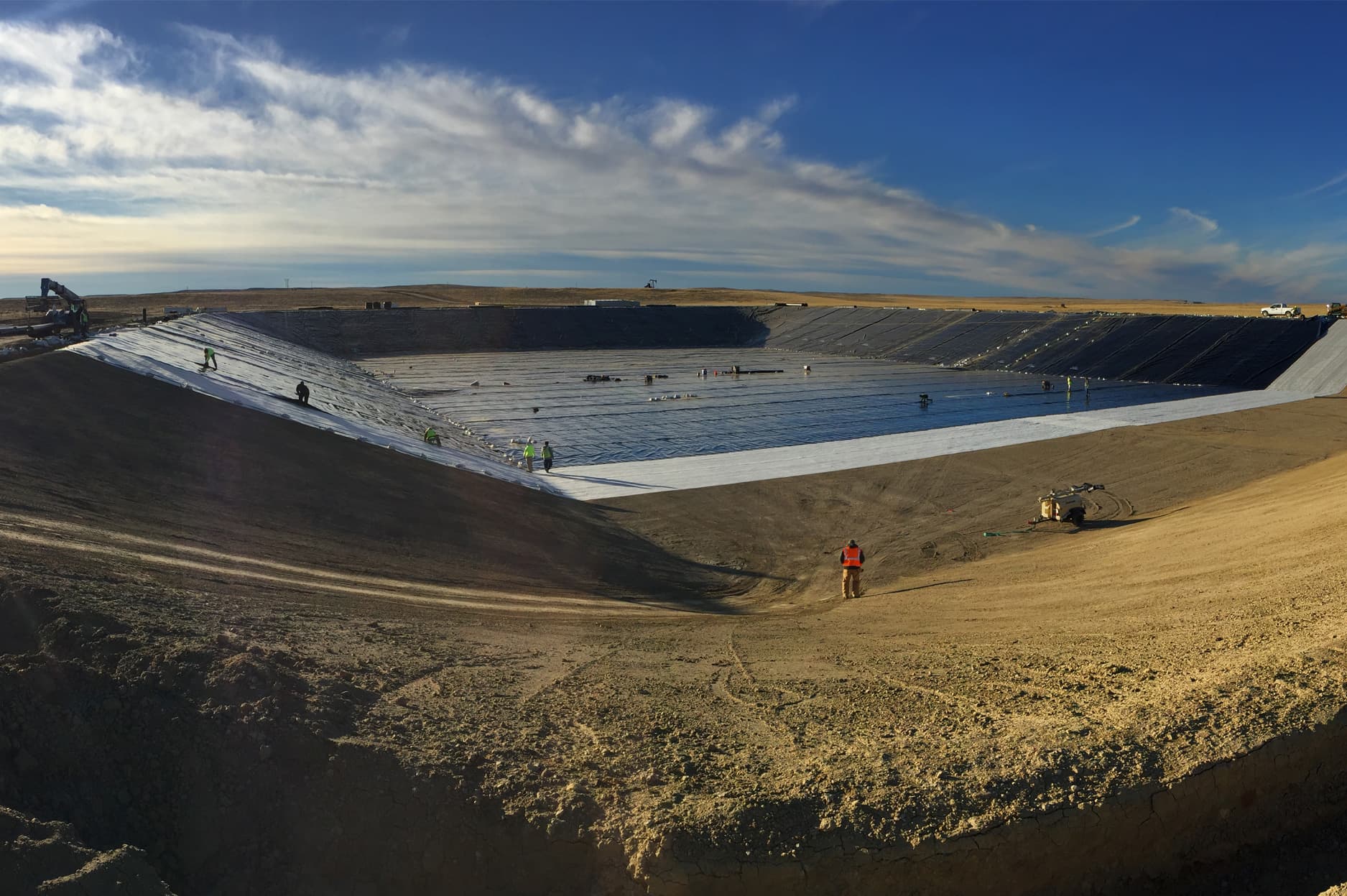
The seven questions that matter before lining a produced-water pit: what does the permit require, what is actually in the water, single or double liner, what material and thickness, who owns the subgrade, how will seams be tested, and what happens at the details. Every one of them is answerable before an installer prices the job, and every one of them changes the price, the schedule, or both. In the Permian Basin, where a pit can go from survey stakes to holding water in weeks, the operators who move fastest are the ones who show up to the bid with these answers in hand.
1. What does your permit actually require?
Produced-water pits are permitted by state oil and gas regulators, the Railroad Commission of Texas on the Texas side of the Permian and the New Mexico Oil Conservation Division across the line, and the permit or rule governing your pit type dictates liner requirements: material class, minimum thickness, whether a leak detection system is required, freeboard, fencing and netting, and closure obligations. A recycling pit, a temporary completion pit, and a long-term storage pit can carry very different requirements on the same lease.
Get the permit conditions into the installer's hands with the bid documents. An experienced contractor will price the liner the permit describes, flag anything the design drawings missed, and build the QA documentation the inspector will eventually ask for.
2. What is actually in the water?
Produced water is not just salty. It commonly runs three to six times the salinity of seawater, and it arrives with residual hydrocarbons, treatment chemicals, and in recycling service, whatever the frac chemistry adds. High-TDS brine is comfortably inside HDPE's envelope, which is why 40 to 60 mil HDPE dominates this market, but heavy hydrocarbon carryover, hot water from processing, or aggressive biocide programs are worth disclosing to the material supplier.
The practical ask: share a water analysis, even a rough one, and the expected temperature range. Material selection against real chemistry is a ten-minute check during submittal review and an expensive argument after a liner softens in service.
3. Single liner or double liner with leak detection?
For temporary pits, a single geomembrane over prepared subgrade is often all the rule requires. For permanent facilities and recycling pits, the design standard is increasingly a double liner: a primary geomembrane over a leak detection layer, geonet or drainage geocomposite, over a secondary geomembrane, draining to a monitored sump. That geometry turns a primary liner defect from an environmental release into a maintenance work order.
Decide this before design, not after: a double-lined pit changes the excavation depth, the anchor trench, the sump details, and the schedule. If the pit will ever be part of a recycling program, building the leak detection in from the start is dramatically cheaper than retrofitting it.
4. What material and thickness, and can the installer prove it?
The workhorse specification is 40 to 60 mil HDPE conforming to GRI-GM13, with 60 mil the common choice for pits that will see traffic, wave action, or years of service. LLDPE appears where subgrade settlement is expected, and reinforced membranes show up on steep interior slopes and prefabricated drop-in liners for smaller pits. Whatever the choice, the submittal should carry the manufacturer's conformance data and roll-specific QC certificates, not just a product name.
Thickness buys survivability more than permeability: any intact geomembrane is effectively impermeable, but a thicker sheet takes more abuse from wind, weighted sandbags, equipment, and the day the pit gets cleaned out with an excavator.
5. Who owns the subgrade, and what will it look like?
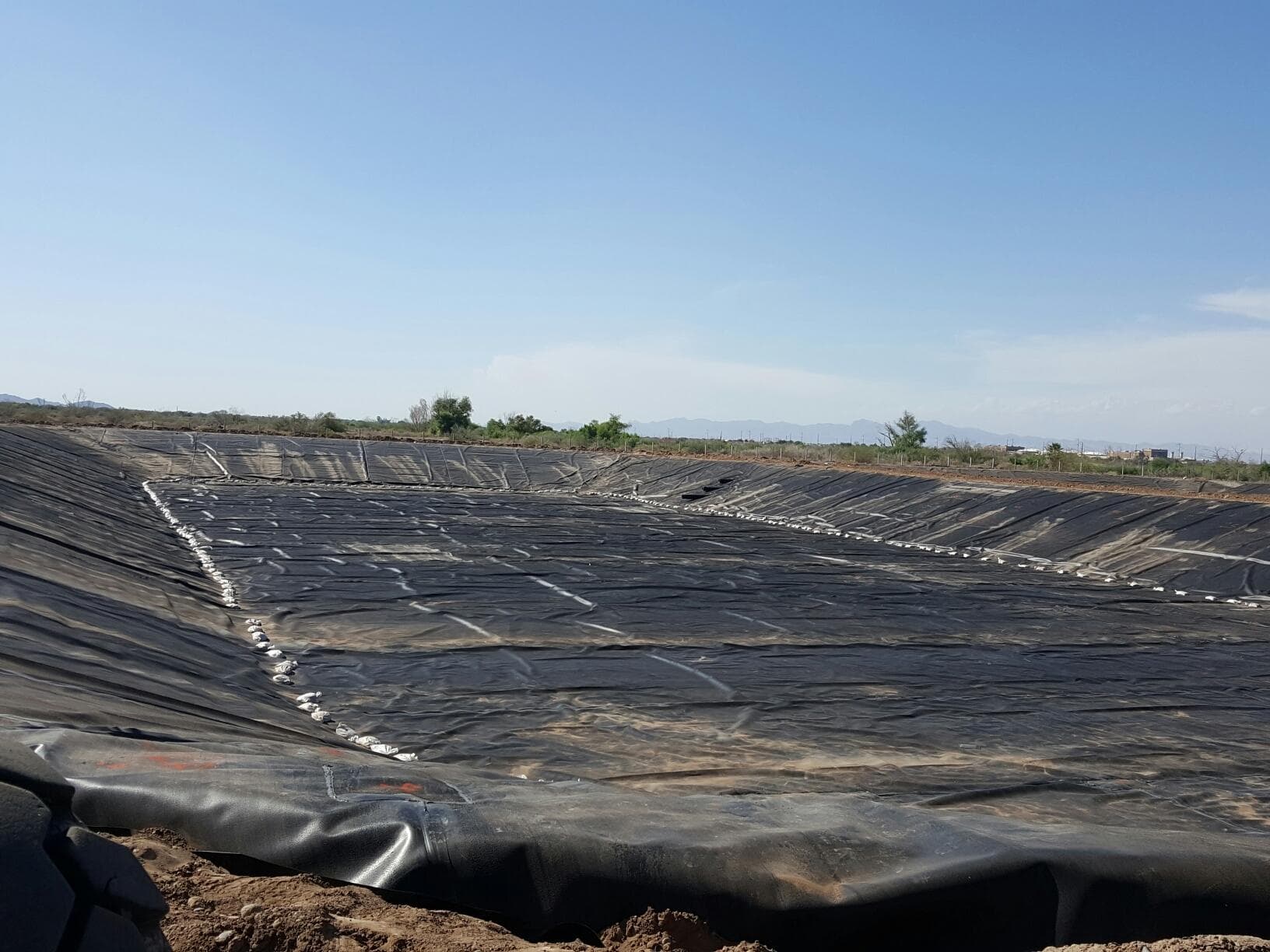
More liner damage starts below the sheet than above it. The liner contract should state, in writing, who delivers the finished subgrade and to what condition: smooth-rolled, free of rock and caliche edges that can puncture under load, no ruts or sloughing, moisture-conditioned enough not to dust or crack, with interior slopes at the designed grade. In West Texas caliche country, that often means a drag-box or a layer of screened fill on the floor, and a geotextile cushion where excavation leaves sharp material in the slopes.
The installer should walk and accept the subgrade panel by panel before deployment. If the earthwork and lining contracts are separate, make the acceptance step explicit so a rocky floor is the dirt contractor's problem on Tuesday, not the liner warranty argument six months later.
6. How will every seam be tested?
A produced-water pit liner is only as good as its seams, and seam QA is a solved problem: dual-track wedge fusion welds air-pressure tested along the channel per ASTM D5820, extrusion welds and repairs vacuum-box tested per ASTM D5641, trial welds at the start of each shift, and destructive samples pulled at the specified frequency and tested in shear and peel per ASTM D6392. On the Permian's wind, expect the crew to manage deployment hours around it; welding into a dust storm is how bad seams happen.
Ask the bidder for their standard QA record package before you sign. If panel layouts, weld logs, test results, and repair maps are not part of the answer, the low bid is not the same scope as the compliant one.
7. What happens at the details: pipes, anchor trench, and freeboard?
Open floor almost never leaks; details do. Walk the drawings for every liner penetration and termination: transfer and suction pipes get welded boots, not sandbags and hope; the anchor trench is cut, the liner keyed in, and the trench backfilled per the drawings so wind cannot get under the sheet; interior corners are fitted and welded rather than folded; and the design freeboard survives the liner installation rather than being eaten by it. If the pit gets netting or bird balls, the attachment points belong in the liner design too.
Details are also where schedule hides. A pit with two penetrations and clean geometry lines out days faster than the same acreage with a manifold corner, and pricing that difference up front beats a change order in week two.
The bottom line
Seven questions, none of them exotic: permit, chemistry, liner geometry, material, subgrade, seams, details. Operators who answer them before the RFP get comparable bids, compliant pits, and installations measured in days. Our oil and gas containment crews line produced water pits across Texas and the Permian Basin from our Midland office, and we are glad to walk a drawing set through these questions before you commit to a design.