On this page
- 1. HDPE geomembrane: the default primary liner
- 2. LLDPE geomembrane: for floors that will move
- 3. GCL: the low-permeability layer when clay is scarce
- 4. Compacted clay: still the benchmark where borrow is good
- 5. Materials that support the liner rather than replace it
- What rarely belongs on a leach pad
- How the ranking plays out in a real cross-section
The short answer: HDPE geomembrane is the best liner material for most heap leach pads, LLDPE is the better sheet where high ore loads meet imperfect subgrade, and the low-permeability layer beneath the geomembrane, a GCL or compacted clay, is what turns either sheet into the composite system regulators actually permit. The materials below are ranked by how often they earn their place on a pad, but the honest engineering answer is that a modern leach pad uses several of them in one cross-section, each doing the job it is best at.
The stakes justify the care. A leach pad liner is simultaneously the floor of the recovery circuit and the barrier protecting groundwater, and in Nevada, the center of North American heap leaching, it is permitted under a zero-discharge design standard (Nevada Administrative Code 445A). Every material choice below feeds a permit demonstration, a solution balance, and a construction quality assurance plan.
1. HDPE geomembrane: the default primary liner
HDPE earns the top spot on chemistry and economics. Gold heaps run dilute alkaline cyanide around pH 10 to 11; copper heaps run dilute sulfuric acid near pH 1 to 2. HDPE shrugs at both ends of that range, and its GRI-GM13 specification gives every submittal a testable baseline for density, tensile properties, puncture, stress crack resistance, and oxidative induction time. On the acres of open floor a pad represents, HDPE's commodity pricing and mature field-welding QA are hard to argue with.
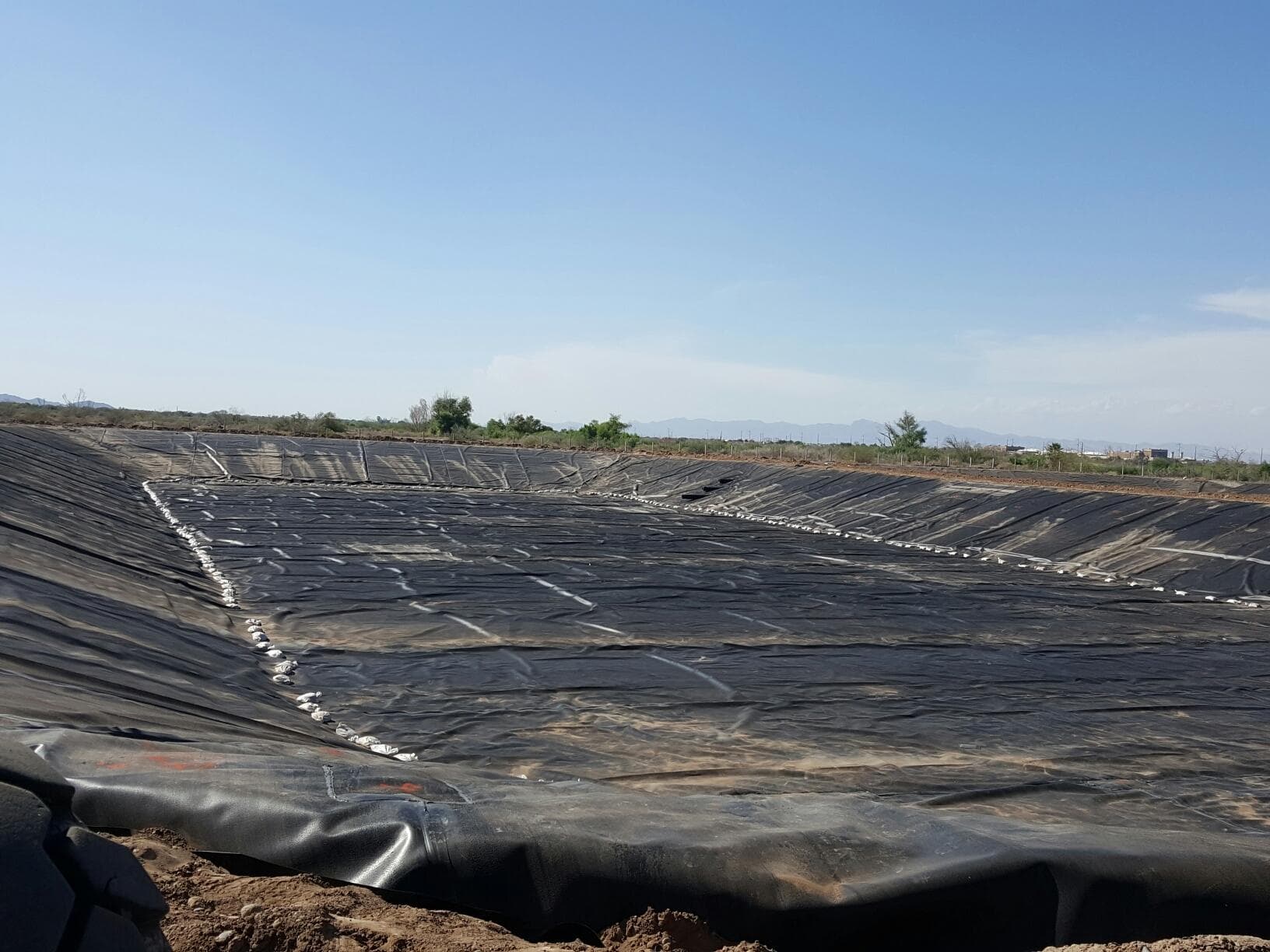
Typical pad specifications call for 60 to 100 mil sheet, with 80 mil common on floors under high ore stacks. Smooth sheet runs on flat floor areas for deployment speed and seam quality; textured sheet goes on slopes where interface friction controls veneer stability. The material's one soft spot is stiffness: on subgrade that will deform under load, concentrated strain becomes the design issue, which is exactly where the number two material takes over.
2. LLDPE geomembrane: for floors that will move
A heap stacked hundreds of feet high presses the liner into every soft spot and subgrade irregularity beneath it. LLDPE, specified per GRI-GM17, is built for that: 800 percent break elongation and a required 30 percent multiaxial strain capacity per ASTM D5617, against no such requirement for HDPE. Where the geotechnical report shows compressible ground, collapsing soils, or high differential settlement under ore load, LLDPE keeps a liner intact that stiffer sheet would strain.
The tradeoff is chemical margin. LLDPE handles typical leach chemistry, but HDPE holds more reserve against aggressive solutions, which is why many designs deploy LLDPE on pad floors and keep HDPE under the ponds and solution channels where concentration and exposure are highest. The two materials weld with the same equipment and test to the same ASTM methods, so mixing them adds no mobilization or QA burden.
3. GCL: the low-permeability layer when clay is scarce
Zero-discharge designs get their performance from composite action: a geomembrane in intimate contact with a low-permeability layer that throttles leakage through any defect. Where suitable clay borrow is not available or the schedule cannot absorb an earthwork campaign, a geosynthetic clay liner does that job from a roll, delivering hydraulic conductivity of 5 x 10^-9 cm/sec or lower per GRI-GCL3 from a material a fraction of an inch thick.
GCLs deploy fast, tolerate weather that stops clay placement cold, and self-heal small punctures as the bentonite swells. The design checks that matter on a mine site are chemical compatibility, since aggressive or high-calcium solutions can degrade bentonite performance over time (tested per ASTM D6766), and slope shear, which requires needlepunch-reinforced products and project-specific interface testing.
4. Compacted clay: still the benchmark where borrow is good
When a qualified clay source sits on or near the mine, the traditional section, commonly 12 inches or more of soil compacted to 1 x 10^-6 cm/sec or lower beneath the geomembrane, remains thoroughly bankable. Thick soil brings attenuation capacity no thin composite matches, and it is indifferent to the cation exchange chemistry that GCLs must be checked for.
Its costs are schedule and QA: borrow qualification, moisture conditioning, lift-by-lift compaction, and per-lift density and permeability testing, all weather-dependent. On remote Nevada sites with short construction seasons, that math is often what sends the design to a GCL.
5. Materials that support the liner rather than replace it
- Geotextiles: nonwoven cushion fabrics protect the geomembrane from subgrade and overliner rock, specified by weight class and puncture resistance.
- Geocomposite drainage: geonet composites form the leak detection layer in double-lined ponds and keep hydraulic head low where the design calls for it.
- Overliner rock: not a geosynthetic, but the screened, durable crushed rock above the sheet is the liner's day-to-day armor, and its gradation belongs in the same specification conversation.
What rarely belongs on a leach pad
PVC and reinforced polypropylene, both excellent materials in their own applications, rarely appear on leach pads: PVC because long-term exposed service and aggressive process chemistry work against a plasticized sheet, and RPP because pads are exactly the large-area, chemistry-driven work where field-welded polyethylene dominates. Their prefabrication advantages pay off on ponds, covers, and detail-heavy containments instead.
How the ranking plays out in a real cross-section
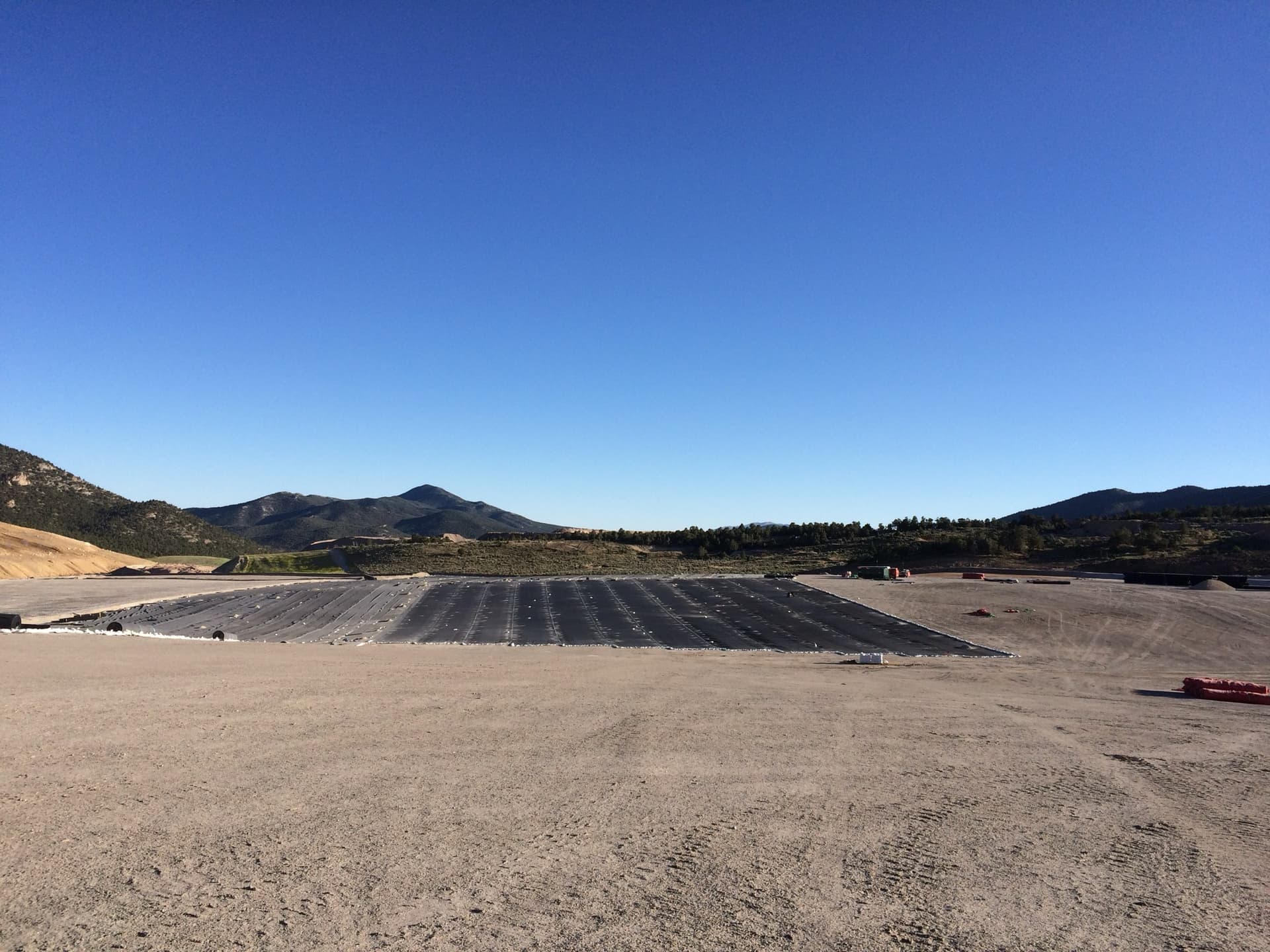
A representative Nevada pad, bottom up: prepared subgrade, then a GCL or 12 plus inches of compacted low-permeability soil, then a 60 to 100 mil HDPE or LLDPE primary geomembrane chosen by settlement expectations, then 1.5 to 3 feet of screened overliner rock carrying the solution collection piping. Ponds go double-lined with a geocomposite leak detection layer between geomembranes. Every seam is nondestructively tested, destructive samples are pulled per the CQA plan and tested per ASTM D6392, and the as-built record becomes part of the permit file.
That is also the practical answer to which material is best: the one your engineer's solution chemistry, geotechnical report, and permit demonstration point at, installed by a crew that has welded all of them. Our heap leach pad liner installation crews work out of Sparks, Nevada, near the northern Nevada mining districts, and we install every material on this list, so the recommendation you get is driven by the design, not by inventory.