On this page
An unbaffled treatment basin can deliver as little as 10 percent of its nameplate detention time to the water actually passing through it. A tank sized on paper for 60 minutes of contact may be credited with closer to 6. That missing time is hydraulic short-circuiting: incoming flow cutting a fast path from inlet to outlet while the rest of the basin sits nearly still. For a drinking water plant that has to prove disinfection contact time, or a wastewater lagoon that has to settle solids and hold a biological process, the lost volume is the difference between passing and failing. Baffle curtains are the standard fix, and understanding why starts with how regulators credit detention time.
What hydraulic short-circuiting is
Every basin has a theoretical detention time: the volume divided by the flow rate. Fill a 100,000 gallon tank at 100,000 gallons per hour and that time is one hour. Water does not move through a tank as an orderly plug. Momentum from the inlet, temperature-driven density differences, wind across the surface, and the plain geometry of a wide open basin push the flow into preferential channels. Some water races from inlet to outlet in a fraction of the theoretical time, and some sits in corners and along walls as dead zones that barely turn over.
A tracer test makes this visible. Dose the inlet, measure the outlet, and the concentration curve spreads out. The first tracer arrives long before the theoretical detention time, and a long tail lingers well after. That spread between the fast path and the slow path is the signature of short-circuiting, and in an open unbaffled basin it is wide.
Detention time is not what the nameplate says
Regulators account for this, which is why disinfection credit is not based on the full theoretical detention time. Under the Surface Water Treatment Rule, disinfection is credited on CT, the disinfectant residual concentration multiplied by the contact time, and the contact time used is T10 rather than the nameplate value. T10 is the detention time that 90 percent of the water meets or exceeds, the conservative slice that accounts for the fast-moving fraction. The ratio of T10 to the theoretical detention time is the baffling factor, and EPA guidance assigns it by basin geometry.
- Unbaffled, agitated basin: baffling factor around 0.1. Only a tenth of the theoretical detention time counts as contact time.
- Poor baffling: about 0.3.
- Average baffling: about 0.5.
- Superior baffling: about 0.7.
- Perfect plug flow, the theoretical ideal: 1.0.
A contact basin at a baffling factor of 0.1 gives up nine tenths of its contact time to short-circuiting. Move that same basin to superior baffling at 0.7 and its credited contact time increases sevenfold, with no new tank and the same footprint. Read the tiers honestly, though: EPA describes the superior tier as a perforated inlet baffle and an outlet weir or perforated launders working together with the serpentine intra-basin baffles, so reaching 0.7 usually means addressing inlet and outlet conditions alongside the curtains. Curtains on their own, dropped into a basin whose inlet and outlet are left alone, more often land in the average range near 0.5, which is still a fivefold gain on a 0.1 basin. Because CT is concentration multiplied by time, recovering contact time this way can also let a plant hold its disinfection target at a lower chemical dose.
“The contact time of mixing basins and storage reservoirs used in calculating CT should be the minimum detention time experienced by 90 percent of the water passing through the unit. This detention time was designated as T10 according to the convention adopted by Thirumurthi (1969).”
EPA, Disinfection Profiling and Benchmarking Technical Guidance Manual (815-R-20-003), Appendix E
What short-circuiting costs a wastewater basin
The same physics degrades wastewater treatment. Facultative lagoons, and the quiescent zones of partial-mix systems, are designed around a detention time long enough for solids to settle and for the biological community to work down the BOD load. Short-circuiting cuts the real detention below the design value, so a fraction of the flow leaves before it is fully treated, and effluent quality gets erratic even when the plant is sized correctly on paper. Tracer studies of open lagoons routinely measure effective detention well under the design number. The dead zones cost more than lost time: stagnant volume accumulates solids, can turn anaerobic, and drives odor and short-lived releases when the hydraulics shift.
How a baffle curtain fixes it
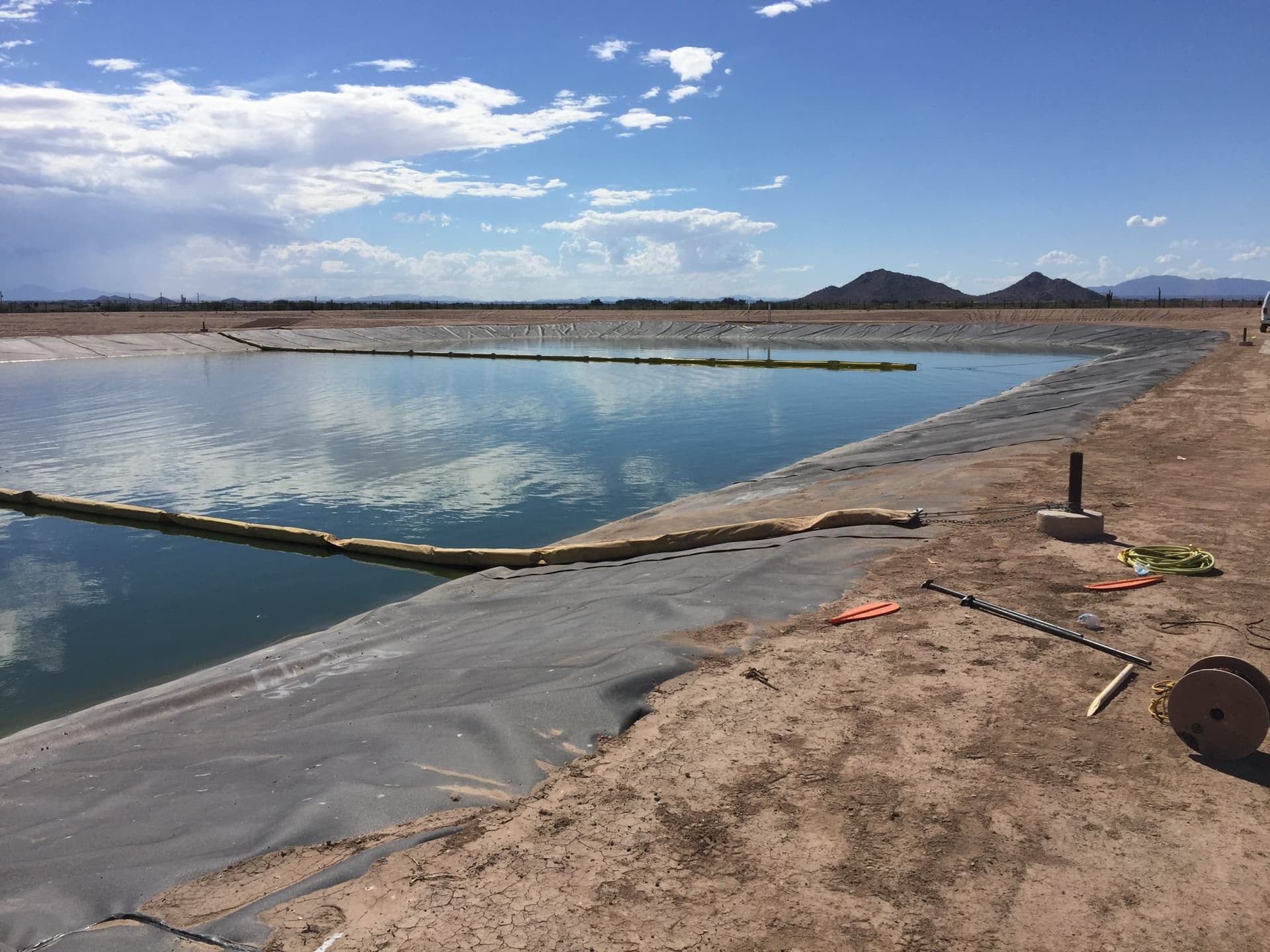
A baffle curtain is a vertical flexible wall hung across the basin, from the surface to near the floor, that blocks the direct path and forces the flow to travel around it. Arrange several in an alternating pattern and the water has to weave a long serpentine route from inlet to outlet instead of cutting straight across. The curtains do two things at once. They lengthen the actual flow path so more of the theoretical detention time is realized, and they put the previously stagnant dead-zone volume back into the working flow. A basin that tracer-tested as poorly baffled can be moved up the baffling factor scale by curtains alone.
Layout does the work. Curtain spacing, the size of the end gaps the water turns around, and any ported openings set the flow path, and therefore the detention time the baffles deliver, so the curtains are installed to the project engineer's hydraulic drawings rather than placed by eye.
What the curtain itself is
A baffle curtain is a tension structure, not a liner. Flow pushes on the panel face and that load runs through the membrane to its supports, so curtains are built from scrim-reinforced coated fabrics, a woven polyester core coated on both sides for the water barrier. Three materials dominate: XR geomembrane, CSPE (also called Hypalon), and reinforced polypropylene, with potable applications specified in grades certified to NSF/ANSI 61 for drinking water contact. A floating curtain holds its shape with closed-cell foam flotation along the top hem, a ballast chain along the bottom to pull it plumb, and tension members and end anchorage that carry the flow load to the walls or banks.
Why it is a retrofit, not a rebuild
Baffle curtains are common because of the economics. The alternative to fixing short-circuiting is building more basin, and adding tankage or a new contact chamber to a working plant is slow and disruptive. A curtain layout corrects the hydraulics of the structure that already exists for a fraction of that effort. Floating baffles go further: the panels are factory fabricated to depth and length and floated into position on the water surface, so they can be installed on a live basin without draining it, bypassing it, or interrupting the plant. EC Applications fabricates and installs both floating and fixed baffle curtains in these materials, deploys floating systems on basins that stay in service, and works from offices in California, Texas, and Nevada, holding California CSLB licenses #894068 and #1003207 for municipal work in that state.
The bottom line
Short-circuiting stays invisible until a tracer test or a compliance report exposes it, and by then a plant is often paying for it in chemical dose, erratic effluent, or a contact basin that will not make its numbers. Baffle curtains fix the hydraulics instead of the paperwork: they convert wasted volume back into working detention time, usually without new construction and often without taking the basin offline. For a utility weighing a new contact chamber against a curtain retrofit, the first useful question is not what the curtains cost. It is how much of the basin it already owns is doing any work.